
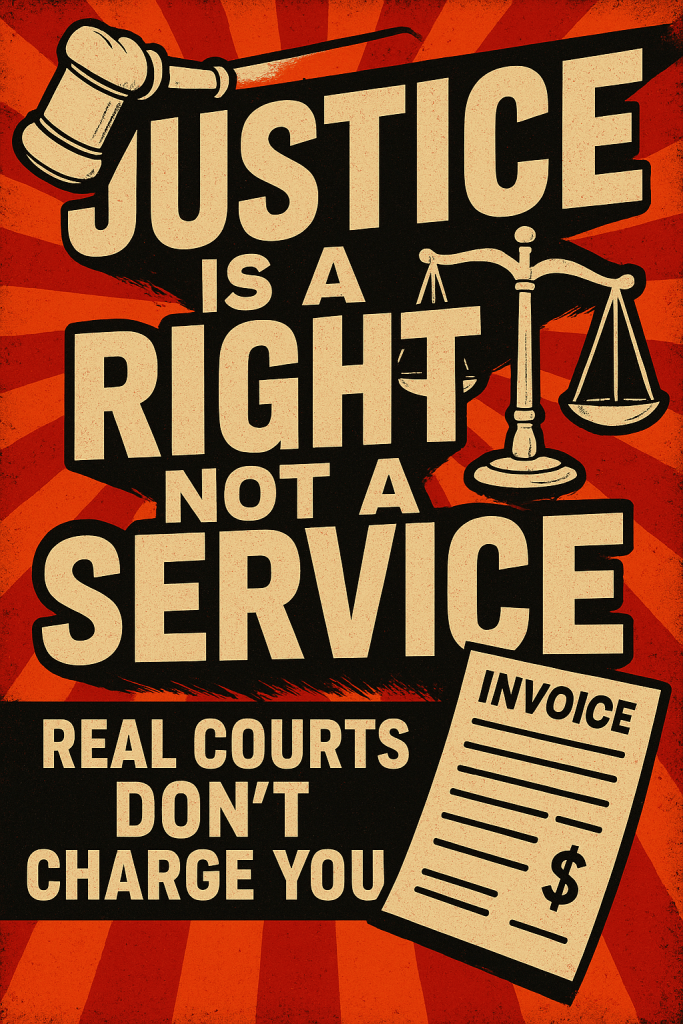
“A real court under the Judicial Branch doesn’t charge you — because justice is a right, not a service.”
That principle used to be the bedrock of American democracy. But today, across the country, especially in family courts, a different system has quietly taken hold — one that bills you for your rights and sells justice like a private service. It looks like a court, acts like a court, and wears the robes of a court. But dig a little deeper, and you’ll find something else entirely.
Welcome to the world of Alternative Dispute Resolution (ADR) — the administrative “shadow courts” that aren’t part of the Judicial Branch at all.
WHAT A REAL COURT IS — AND ISN’T
Under the U.S. Constitution, justice is not a luxury — it is a right. Courts were never intended to operate as pay-per-service entities. The Judicial Branch:
- Is funded by taxpayer dollars, not user fees
- Provides access to justice, not services for purchase
- Cannot lawfully charge you to:
- File a complaint
- Get a hearing
- Be protected by due process of law
These rights are enshrined in the Fifth and Fourteenth Amendments of the Constitution, which prohibit the government from depriving anyone of “life, liberty, or property, without due process of law.”
YOU CAN’T PUT A PRICE ON DUE PROCESS — AND THE SUPREME COURT AGREES
The U.S. Supreme Court has repeatedly affirmed that access to justice must not depend on your ability to pay. Consider the following landmark rulings:
- Boddie v. Connecticut (1971): The Court held it unconstitutional to deny a divorce to poor individuals who couldn’t pay court fees. “A State may not… pre-empt the right to dissolve [a marriage] by denying access to its courts to individuals unable to pay fees.”
- M.L.B. v. S.L.J. (1996): A state cannot require payment of court costs in order to appeal a termination of parental rights. The Court called family and parental rights “basic civil rights of man.”
- Griffin v. Illinois (1956): A state must provide trial transcripts to indigent defendants so they can appeal criminal convictions. “There can be no equal justice where the kind of trial a man gets depends on the amount of money he has.”
- Turner v. Rogers (2011): In child support cases, states must provide due process protections in civil contempt proceedings that risk incarceration. You cannot be jailed for child support arrears without a fair process — even if the court labels it “civil.”
These rulings are clear: you cannot be denied access to justice, parenting rights, or freedom because you can’t afford to pay.
SO WHY DO ADR COURTS SEND YOU A BILL?
Because they’re not courts at all — at least not in the constitutional sense.
ADR courts are not governed by Article III of the Constitution. They are not judicial bodies. They are:
- Grant-funded contractors
- Policy enforcement centers
- Administrative service vendors
- Private mental health and social work entities embedded in court proceedings
And they operate under administrative authority, not judicial power.
That’s why you get invoices for:
- Supervised visitation
- Reunification therapy
- Monitored exchanges
- “Compliance” programs you never agreed to
- Private service providers appointed by judges without your consent
It’s not just coercive. It’s unconstitutional.
THE SYSTEM FLIPS THE SCRIPT: RIGHTS BECOME SERVICES
When administrative courts replace judicial ones, here’s what happens:
- Parents are told their access to children depends on payment for outside services
- Indigent litigants are excluded or punished for noncompliance with therapy orders
- Self-represented parents are buried under compliance directives instead of afforded hearings
- Due process is outsourced to vendors with no accountability
And courts — or what appear to be courts — enforce these conditions as if they were law.
But there’s a fundamental truth they don’t want you to know:
You have the constitutional right to access the courts, raise a complaint, and be heard without having to pay for the privilege.
THE RIGHT TO PETITION — NOT PAY
The First Amendment protects your right to petition the government for redress of grievances. This includes the right to bring legal complaints and seek relief in court.
That right cannot be licensed, limited, or monetized by administrative agencies or judges outsourcing justice to vendors.
And yet, in ADR systems across the U.S., especially in family law and juvenile dependency, constitutional rights are repackaged as services — offered only if you can afford the therapy, monitoring, or mediation “assigned” to you.
SO WHO PROFITS?
- Contractors who build empires on court referrals
- Therapists and vendors with exclusive court-approved status
- Courts that boast “efficiency” metrics while offloading costs to parents
- States that obtain Title IV-D and IV-E federal grants tied to service-based compliance
But you?
You pay the price — literally and figuratively.
THE TRUTH THEY DON’T WANT YOU TO KNOW
- Justice is not a service.
- Parenting is not a privilege licensed by therapists.
- Due process cannot be billed like a product.
- Courts that charge for access have abandoned their constitutional role.
RECLAIMING JUSTICE — WITHOUT A PRICE TAG
The only way back is forward:
- Demand court reform that restores constitutional due process
- Refuse coerced services that violate your rights
- Challenge unconstitutional orders in higher courts
- Expose ADR abuse and administrative overreach
- Educate others: You don’t have to pay to be a parent.
Justice is a right. Not a luxury.
Not a therapy session.
Not a billable event.
Not a vendor contract.
A right.
Support independent investigative journalism like this.
Subscribe to learn more, submit tips, or donate.
 The People's Law Review