
Everyone thought it was a win for parental rights — but it was actually the backdoor to destroy them.
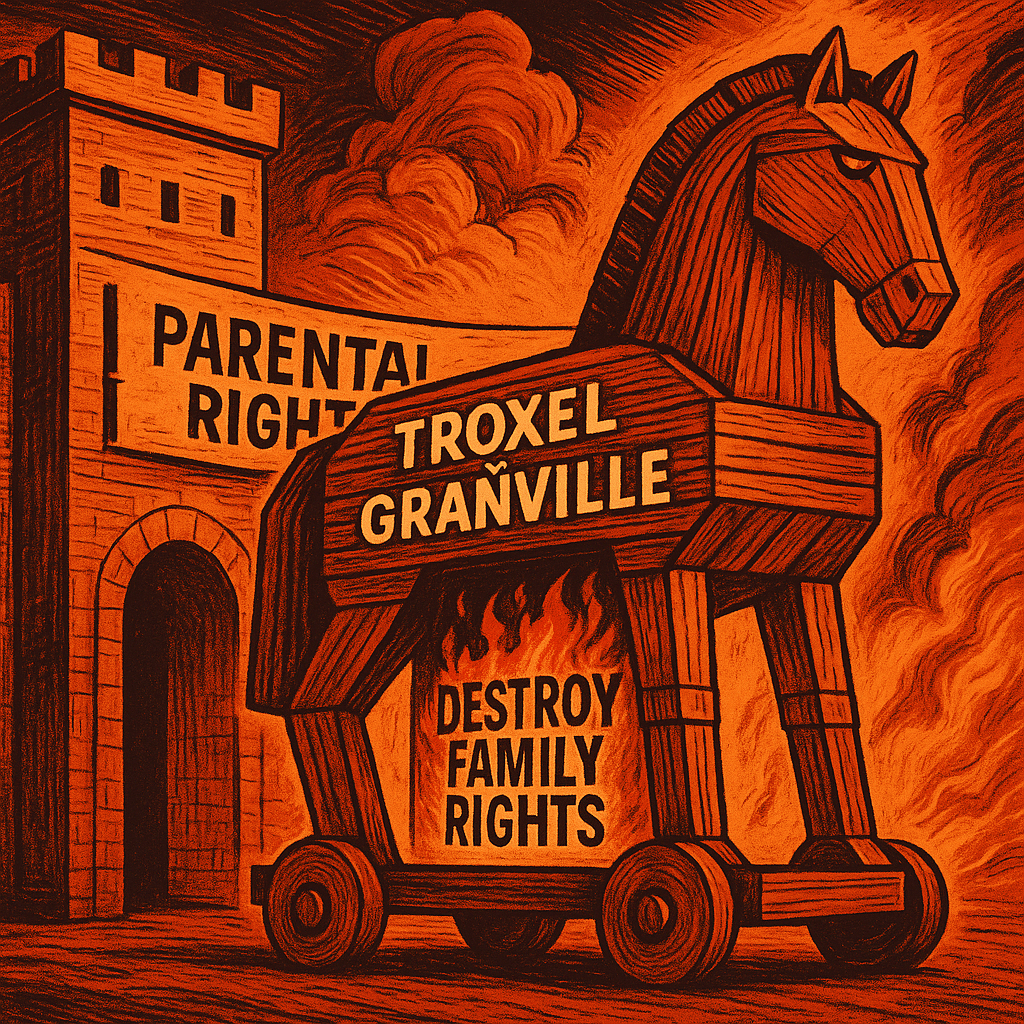
Troxel v. Granville Was the Trojan Horse of Family Law
Everyone thought it was a win for parental rights — but it was actually the backdoor to destroy them.
In 2000, the U.S. Supreme Court issued its ruling in Troxel v. Granville, a case widely hailed as a victory for parental rights. Legal analysts praised it. Advocacy groups claimed it affirmed that parents — not the government — know best. And for a brief moment, it looked like the Constitution had parents’ backs.
But if you dig a little deeper, you’ll see Troxel wasn’t a win at all. It was a trap. A Trojan Horse.
It didn’t strengthen parental rights. It weakened them — by embedding vague language, affirming judicial discretion, and refusing to apply constitutional scrutiny. And it did all this in the very moment the family court system was shifting into a privatized, unaccountable administrative model known as ADR (Alternative Dispute Resolution).
Let’s unpack how the decision that was supposed to protect your family rights became the very loophole used to dismantle them.
The Case: Troxel v. Granville, 530 U.S. 57 (2000)
Tommy Granville died, leaving behind two daughters. His parents — the Troxels — wanted more visitation time with their grandkids. The girls’ mother, a fit parent, said no. She didn’t want the courts overruling her decisions as a parent.
But under Washington law, “any person” could petition for visitation at “any time” — and the court could grant it based solely on the “best interest of the child.”
So the Troxels sued. The case made it all the way to the Supreme Court.
Legal Question: Did Washington’s third-party visitation law violate the constitutional rights of a fit parent to decide what’s best for their own children?
The Ruling: Vague, Weak, and Dangerous
The Court ruled 6–3 that the Washington law was too broad. But here’s the kicker:
- They didn’t strike down all third-party visitation laws.
- They didn’t say that parents have the absolute right to decide.
- They didn’t require courts to apply strict scrutiny, the standard used when a true fundamental constitutional right is at stake.
Instead, they gave us a soft, mushy opinion that said “parents’ wishes should be given special weight,” but left it entirely up to the states and judges to figure out what that means.
Why It’s a Trojan Horse
1. No Clear Constitutional Standard
The Court called parental rights “fundamental” under the 14th Amendment — but didn’t use the actual constitutional test that protects fundamental rights: strict scrutiny. Instead, they used vague language like “presumption,” “deference,” and “special weight.”
Translation: No enforceable rule. Just vibes.
2. “Best Interest” Became a Loophole, Not a Limit
The Court criticized the Washington law for giving judges too much power — but didn’t define when and how a court can override a fit parent. They left the “best interest of the child” intact as a decision-making tool.
That’s how family courts today can say:
“Yes, you’re a good parent. But we just think this is better.”
And that’s enough to take away your rights.
3. No Due Process. No Jury. No Challenge to ADR
The Court didn’t demand that parents be given a jury trial, a meaningful due process hearing, or constitutional protections. They just said: “This specific law is too broad.”
They never challenged the structure of family court — a structure that, since the 1990 Judicial Improvements Act, had already moved many custody cases into private ADR systems with limited transparency, no oversight, and very little constitutional enforcement.
Troxel let all that slide.
4. Perfect Timing — for a Broken System
The decision came in 2000 — ten years into the privatization of family court under ADR. Instead of challenging that shift, the Court nodded along with it. It accepted the use of non-adversarial procedures, judicial discretion, and administrative norms — all without meaningful constitutional oversight.
The Outcome
- Granville (the mother) won her case — but not on strong constitutional grounds.
- Parents nationwide lost the war — because no national standard was created, and no protections were enforced.
Instead, we got a patchwork system where judges still routinely override fit parents — especially under the vague and ever-expanding doctrine of “best interest.”
Bottom Line: It Was a Trojan Horse
Troxel v. Granville looked like a gift to parents — a declaration of rights. But inside that gift was the blueprint for undermining those rights. It told states and courts:
“Yes, parental rights exist… but only as far as we feel like recognizing them.”
It didn’t limit the family court machine. It fueled it.
And two decades later, that machine continues to churn — with no due process, no clear standards, and no real accountability — all thanks to a case that was supposed to protect us.
Call to Action:
It’s time to stop pretending Troxel was a victory. It’s time to demand real constitutional standards in family law — starting with the right to raise your own children without government interference unless you are proven unfit.
Until we do, the Trojan Horse keeps rolling.
Support independent legal reporting and reform advocacy. Follow The People’s Law Review and subscribe for more breakdowns like this. Donate to fuel the fight.
 The People's Law Review