
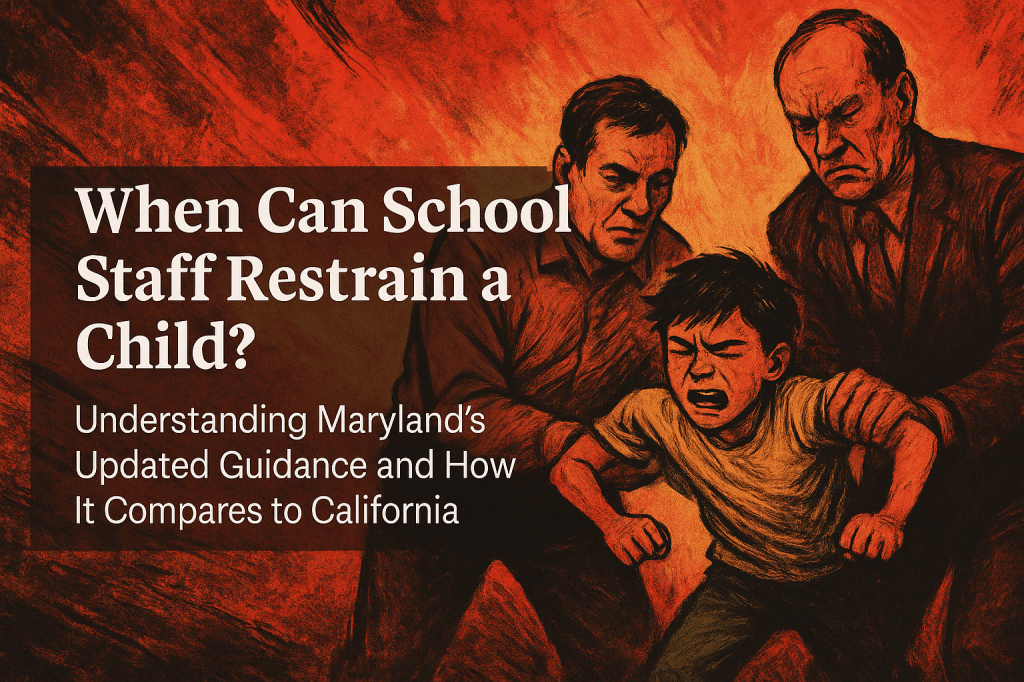
In the realm of public education, few issues raise as many red flags—or as many legal and ethical questions—as the physical restraint of children. Across the U.S., states differ in how they regulate the use of restraint in schools, particularly as it relates to students with disabilities. Maryland recently revised its policies, and California has also weighed in with updated transparency and accountability measures.
As someone from Maryland closely following a disturbing case in San Marcos, California—where a 10-year-old child was physically grabbed by two school administrators in an attempt to drag the child into an office to meet with a child abduction unit under highly questionable circumstances—I wanted to understand where Maryland stands today. The child had committed no crime, was not in danger, and the supposed “intervention” was based on a false pretense. The comparison between these two blue-leaning states is both timely and necessary.
Maryland’s Updated Restraint Guidance (2024)
The Maryland State Department of Education (MSDE) recently issued updated guidance clarifying the use of physical restraint in schools. The revised document, “FAQ on Restraint and Seclusion,” is meant to increase school staff’s understanding of when restraint is lawful, what reporting is required, and how to uphold the rights of students—especially students with disabilities.
When Restraint Cannot Be Used in Maryland
According to the guidance:
- Restraint may not be used as punishment, discipline, or for staff convenience.
- Restraint cannot be used for non-emergency situations, such as preventing a child from leaving a classroom or forcing compliance.
- Restraint is prohibited if it restricts breathing, impairs communication, or causes physical harm.
When Restraint Can Be Used in Maryland
Maryland law (COMAR 13A.08.04.05) allows physical restraint only when:
- The child poses an imminent serious physical threat to themselves or others.
- Less restrictive interventions have failed or are deemed ineffective.
Moreover, the staff member applying restraint must be trained in approved behavior interventions unless it is an emergency situation.
Reporting Requirements
Maryland’s 2024 updates stress the importance of:
- Immediate parent notification following any restraint use.
- A written incident report provided within 24 hours.
- Documenting the intervention in the student’s educational record.
This new emphasis on documentation and accountability is designed to protect both the student and staff while ensuring compliance with state and federal law.
The San Marcos, California Incident: A Stark Contrast?
In the San Marcos case, a 10-year-old was met by two school administrators who attempted to forcibly remove the child and deliver him to a Child Abduction Unit, under questionable legal authority. No emergency existed. The child was not a threat. No court order was provided. The child did not want to go, and according to reports, the mother had not been given due process.
If this had occurred in Maryland under the new guidance, such a restraint would likely have been illegal. The child was not violent, there was no threat, and no lesser interventions were attempted. It appears that the action served the convenience of the administration—or worse, was in service of a potentially unlawful removal by a third party.
California’s Updated Guidance: Transparency, But Still Gaps
California’s April 2024 Data Reporting Requirements from the California Department of Education (CDE) aim to increase data transparency around restraint and seclusion. Schools are now required to report data on:
- Physical restraint incidents
- Mechanical restraint
- Seclusion use
While this marks a positive move toward public accountability, it does not regulate the use of restraint itself as tightly as Maryland does. California leaves much of the application of restraint policies to local educational agencies, which opens the door for abuse—especially when combined with opaque dealings by law enforcement or family court units.
The Bigger Problem: When Schools Are Used for Coercion
Both states must confront a growing problem: external agencies weaponizing school staff to remove children under false pretenses—often with no clear documentation, legal process, or immediate threat.
Using school staff to restrain a child for non-disciplinary, non-emergency reasons—especially to facilitate removal by a third party—is deeply troubling, and arguably unconstitutional under the 14th Amendment’s Due Process Clause and the Fourth Amendment’s protection against unlawful seizure.
Final Thoughts
The MSDE’s updated guidance is a meaningful step forward. It draws a clear line between protection and coercion, and it holds school staff accountable for the immense responsibility of physical intervention. However, as the San Marcos case shows, guidance is only as good as its enforcement.
Both Maryland and California must do more to:
- Train all school staff in trauma-informed de-escalation.
- Clarify the limits of school cooperation with third-party agencies, especially in family disputes.
- Require video or third-party documentation during any restraint or removal to ensure compliance and protect children.
No child should be physically seized from school under false pretenses, and no staff member should be complicit in an act that could legally and ethically be considered kidnapping.
Resources
Official Guidelines:
- Maryland State Department of Education – FAQ on Restraint and Seclusion (2024)
- California Department of Education – Restraint and Seclusion Reporting
National Policy & Advocacy:
- Disability Rights Maryland
- Council of Parent Attorneys and Advocates (COPAA)
- U.S. Department of Education – Restraint & Seclusion Resource Document
Federal Law:
- Individuals with Disabilities Education Act (IDEA)
- Section 504 of the Rehabilitation Act
- Americans with Disabilities Act (ADA)
Michael Phillips
Parental Rights Advocate | Legal Journalist | Founder of REBUILT Media, The People’s Law Review, and Father & Co.
Want to learn more about school discipline, false allegations, or child removals? Follow me for future articles and investigations.
 The People's Law Review