
How Santosky v. Kramer Should Have Protected Parents—But Often Doesn’t
By Michael Phillips
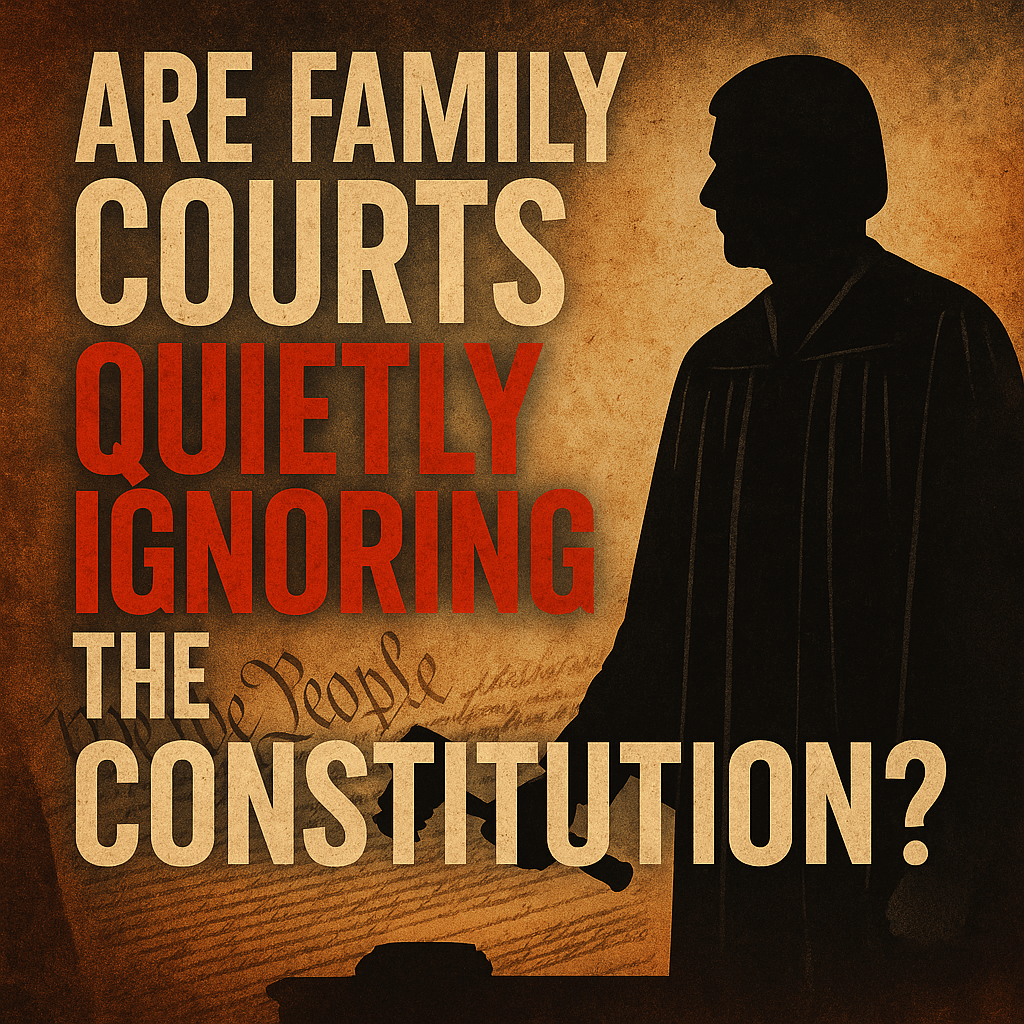
In 1982, the United States Supreme Court issued a landmark ruling meant to protect one of the most sacred liberties we have—the right to raise our own children. The case was Santosky v. Kramer, and it required that before the government can permanently terminate parental rights, it must prove the parent is unfit by clear and convincing evidence.
That’s a high legal threshold. And it should be. Because losing your parental rights is the civil equivalent of the death penalty.
But here’s the terrifying truth: family courts across the country ignore that standard every day.
They don’t always say they’re ignoring it. They’ll mention “clear and convincing” in a ruling, nod politely at Santosky, and then proceed to destroy families based on flimsy, subjective, or politically motivated findings. In practice, the burden of proof is quietly lowered. The presumption of innocence is reversed. And the Constitution is left bleeding in the hallway.
What Happened in Santosky v. Kramer?
The Santoskys were a poor family in New York. They struggled. Their home was unstable. Their parenting was imperfect. But they were fighting to stay together. The state removed their children and, after some time, filed to permanently sever their rights.
At the time, New York only required a “preponderance of the evidence” to do this—a lower burden than even what’s used in most criminal trials. That means 51% certainty. More likely than not. A coin flip with a bad vibe.
The Supreme Court said no.
In a 5–4 decision, the Court ruled that terminating parental rights requires at least “clear and convincing evidence.” The majority opinion stressed that parents have a fundamental liberty interest in the care and custody of their children—an interest protected by the Due Process Clause of the 14th Amendment.
“When the State moves to destroy weakened familial bonds, it must provide the parents with fundamentally fair procedures.”
This case was supposed to be a turning point. A bright red constitutional line in the sand. A warning to states: if you want to take someone’s child forever, you’d better have real, substantial, convincing proof—not just a social worker’s hunch or a judge’s bias.
But in Today’s Family Courts, That Line is Blurred
In theory, Santosky still governs. In practice, many judges don’t follow it.
I’ve spoken to dozens of parents—fathers and mothers—who lost custody or faced termination of rights without a single finding of abuse, neglect, or harm. Sometimes their only “crime” was poverty, disability, being falsely accused, or simply disagreeing with a therapist or caseworker.
They were never given a fair trial. Evidence was often hearsay or subjective opinions. Witnesses went unchallenged. Court-appointed experts wielded uncheckable power. And the standard of “clear and convincing” became a legal formality—a box to check before signing away someone’s life.
In many of these cases, no one even raised the question: Where is the evidence? Not just some evidence. Not emotional evidence. Clear and convincing evidence.
Family Court: The Constitutional Wild West
Why does this happen? Because family court often operates outside normal judicial standards.
- There are no juries.
- Hearsay is frequently allowed.
- Judges have incredible discretion.
- Proceedings are sealed, shielding abuses from public view.
- Many parents are self-represented, overwhelmed, and untrained in law.
- Appointed counsel, when available, is often overworked or ineffective.
Worst of all? Many judges believe they’re doing the right thing—“erring on the side of caution,” “protecting the child,” or “going with their gut.”
But erring on the side of caution is not the law. Santosky made clear that before you can destroy a family, you must meet a clear and convincing threshold.
The Stakes Are Too High for Pretend Protections
Parental termination isn’t just another court ruling. It ends a family. It rewrites a child’s identity. It has consequences for generations.
If we don’t take Santosky seriously, we’re complicit in a system where the government can erase parents with the stroke of a pen, based on feelings instead of facts.
That’s not just tragic—it’s unconstitutional.
What Needs to Change?
- Enforce Santosky strictly—not just in termination cases, but in any custody dispute where a parent’s fundamental rights are at stake.
- Provide competent representation for all parents in high-stakes custody battles, especially where CPS or court-appointed guardians are involved.
- Mandate written findings that clearly demonstrate how the “clear and convincing” standard was met.
- Open the black box: Reform secrecy laws that shield family courts from scrutiny and enable abuse.
- Train judges on constitutional rights in family law—not just “best interest” platitudes.
Conclusion: The Constitution Doesn’t End at the Family Court Door
The Supreme Court told us in Santosky v. Kramer that parental rights are fundamental. But in courtrooms across America, those words are treated like suggestions, not mandates.
We must demand better. We must hold courts accountable. And we must stop pretending that destroying a family is just another form of paperwork.
If your rights can be taken without clear and convincing evidence, then you don’t really have rights at all.
Support independent reporting on family law reform by subscribing, sharing, and joining the fight for due process. The Constitution matters—even in family court.
 The People's Law Review