
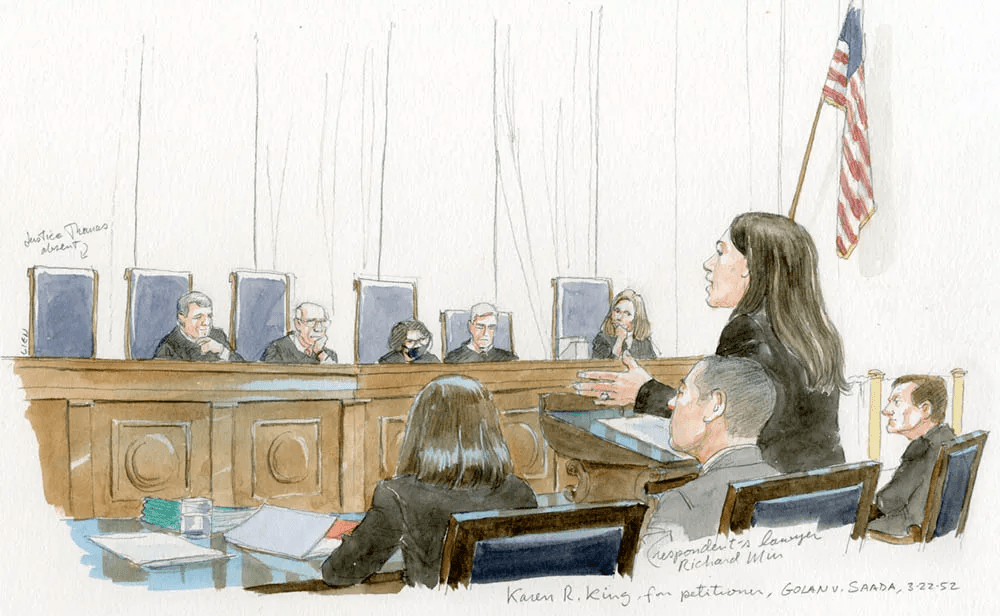
By Michael Phillips | People’s Law Review
In Golan v. Saada (2022), the U.S. Supreme Court clarified how American courts must apply the “grave risk of harm” exception under the Hague Convention on the Civil Aspects of International Child Abduction, a treaty governing the prompt return of children wrongfully removed or retained across international borders.
The Court’s unanimous decision rejected a rigid, judge-made requirement that courts must always consider “ameliorative measures” before denying a child’s return. Instead, it reaffirmed that trial courts retain discretion—and that child safety, not procedural box-checking, is the guiding principle.
Background of the Case
The case arose from a cross-border custody dispute between parents who had lived in Italy. The mother relocated with the child to the United States without the father’s consent. The father filed a petition under the Hague Convention seeking the child’s return to Italy.
Lower courts found that returning the child would expose him to a grave risk of physical or psychological harm, based on evidence of domestic violence. However, the Second Circuit had previously imposed a rule requiring courts to consider whether protective conditions—such as supervision orders or restraining measures—could mitigate the risk and allow the child’s return anyway.
That framework set the stage for Supreme Court review.
The Legal Question
At issue was a narrow but consequential question:
When a court finds that returning a child would expose them to a grave risk of harm, must the court still consider all possible ameliorative measures before denying return?
The Supreme Court’s Holding
The Supreme Court answered no.
The Court held that:
- The Hague Convention does not require courts to consider ameliorative measures in every case.
- Courts may consider protective measures where appropriate—but they are not obligated to do so.
- Judges retain broad discretion to deny return outright when serious safety concerns are present.
In other words, once a grave risk is established, courts are not compelled to search for hypothetical safeguards to justify sending a child back into danger.
Why the Decision Matters
1. Re-centering Child Safety
The ruling emphasizes that the Convention’s return mechanism is not absolute. Child safety is paramount, and courts need not force returns simply to preserve international comity.
2. Limiting Judicial Overreach
By rejecting the Second Circuit’s categorical rule, the Court curtailed the creation of extra-textual requirements not found in the treaty itself.
3. Preserving Trial Court Discretion
Family courts often confront fact-intensive, emotionally charged situations. Golan affirms that trial judges—who hear the evidence firsthand—are best positioned to assess risk.
Implications for Family Law and Parental Rights
While the Hague Convention is not a custody statute, its application can dramatically affect parent-child relationships. Golan v. Saada reinforces several principles relevant to broader family-law debates:
- Domestic violence allegations cannot be brushed aside in the name of procedural uniformity.
- Protective measures imposed abroad are not automatically reliable or enforceable.
- Courts should not act as international experimenters when a child’s safety is at stake.
For parents—particularly those fleeing abuse—this decision offers important reassurance that U.S. courts are not required to prioritize treaty formalism over real-world harm.
Conclusion
Golan v. Saada (2022) is a restrained but significant ruling. It does not weaken the Hague Convention’s core purpose of deterring international child abduction. Instead, it restores balance—ensuring that the Convention is applied with humanity, realism, and respect for judicial discretion.
In an area of law where rigid rules can have life-altering consequences, the Supreme Court made clear that protecting children comes first.
 The People's Law Review