
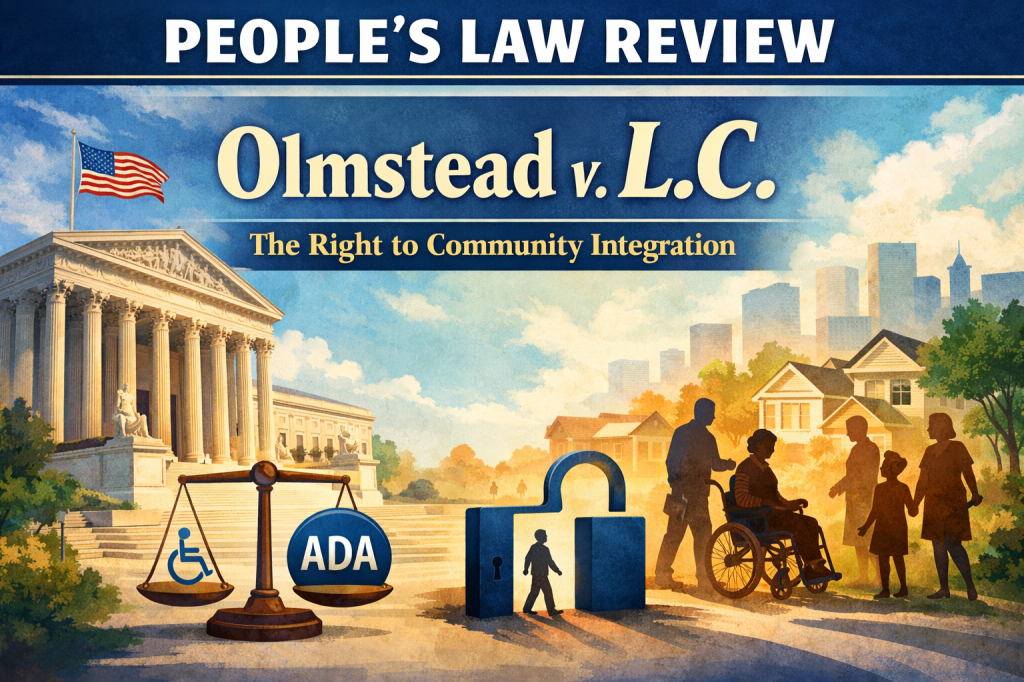
By Michael Phillips | People’s Law Review
In 1999, the U.S. Supreme Court decided Olmstead v. L.C., a landmark disability-rights case that reshaped how states must provide services to people with disabilities. Often described as the most significant disability civil-rights ruling since the passage of the Americans with Disabilities Act (ADA), Olmstead established that unnecessary institutionalization is not merely poor policy—it is unlawful discrimination.
More than two decades later, Olmstead remains central to disputes over Medicaid funding, waiting lists for services, disability segregation, and state budget priorities. Its core holding continues to constrain how governments balance cost, convenience, and civil rights.
Case Background
The plaintiffs, identified as L.C. (Lois Curtis) and E.W. (Elaine Wilson), were two women with mental disabilities who had been voluntarily admitted to the Georgia Regional Hospital at Atlanta. Although their treating professionals concluded that they could and should receive care in community-based settings, the State of Georgia continued to confine them in an institutional environment.
The reason was not medical necessity. It was administrative delay and funding priorities.
L.C. and E.W. sued Georgia officials under Title II of the Americans with Disabilities Act, which prohibits disability-based discrimination by state and local governments. They argued that unnecessary institutionalization amounted to unlawful segregation.
Lower courts agreed. The federal district court held that unjustified institutional placement was discriminatory per se, and the Eleventh Circuit largely affirmed, sending the case to the Supreme Court to resolve the scope of the state’s defenses.
The Supreme Court’s Decision
On June 22, 1999, the Supreme Court ruled 6–3 in favor of the plaintiffs. Justice Ruth Bader Ginsburg authored the majority opinion.
The Court held that unjustified segregation of people with disabilities constitutes discrimination under Title II of the ADA. This principle has become known as the ADA’s integration mandate.
The Integration Mandate Explained
The Court ruled that states must provide services to individuals with disabilities in the most integrated setting appropriate when three conditions are met:
- Community placement is appropriate, as determined by the state’s own treatment professionals.
- The individual does not oppose community-based care.
- The placement can be reasonably accommodated, considering the state’s resources and the needs of others with disabilities—meaning it does not require a “fundamental alteration” of state programs.
Importantly, the Court rejected the idea that states could rely on generalized funding shortages to justify continued segregation.
Why Institutionalization Is Discriminatory
Justice Ginsburg’s opinion emphasized two core harms caused by unnecessary institutional confinement:
- It reinforces harmful stereotypes that people with disabilities are incapable of participating in ordinary community life.
- It severely restricts fundamental life activities, including family relationships, employment, education, economic independence, social interaction, and cultural participation.
In other words, segregation was not treated as a neutral administrative choice—it was recognized as a civil-rights injury.
The “Fundamental Alteration” Defense—And Its Limits
The Court acknowledged that states face real budgetary and administrative constraints. It allowed states to assert a “fundamental alteration” defense, permitting them to consider costs and resource allocation when implementing community-based services.
But the defense is narrow.
States must show:
- They have a comprehensive, effectively working plan for placing qualified individuals in community settings; and
- Waiting lists move at a reasonable pace, not as a result of inertia or political neglect.
A lack of funding alone is not enough. Blanket policies, indefinite delays, and structural underinvestment do not excuse segregation.
Broader Impact Beyond Mental Health
Although Olmstead arose from a mental health context, its reach is far broader. Subsequent enforcement guidance from the U.S. Department of Justice has made clear that the ruling applies to all forms of disability, including intellectual, developmental, physical, and sensory disabilities.
The decision has driven:
- Expansion of Medicaid Home- and Community-Based Services (HCBS)
- Federal civil-rights enforcement actions
- State deinstitutionalization efforts
- Litigation challenging long waiting lists and service cuts
Continuing Relevance in State Policy Debates
Today, Olmstead is frequently invoked when states debate cuts to disability services or maintain years-long waiting lists for community placement. In states like Maryland, advocates argue that underfunding agencies such as the Developmental Disabilities Administration risks violating the ADA by effectively forcing people into institutional settings or denying services altogether.
The case remains a legal backstop against austerity measures that disproportionately burden people with disabilities.
A Civil Rights Landmark That Still Shapes the Law
Olmstead v. L.C. reframed disability services as a matter of civil rights, not charity or discretion. It recognized that segregation—however well-intentioned—can be discriminatory when it deprives individuals of the chance to live, work, and participate in their communities.
As the nation marked the decision’s 26th anniversary in 2025, its core message remains unchanged:
Community integration is not optional. It is a legal requirement.
For advocates, policymakers, and courts alike, Olmstead continues to serve as a constitutional-scale reminder that equality under the law includes the right to live outside institutions.
People’s Law Review
Legal analysis focused on civil rights, due process, and institutional accountability
 The People's Law Review