
By People’s Law Review
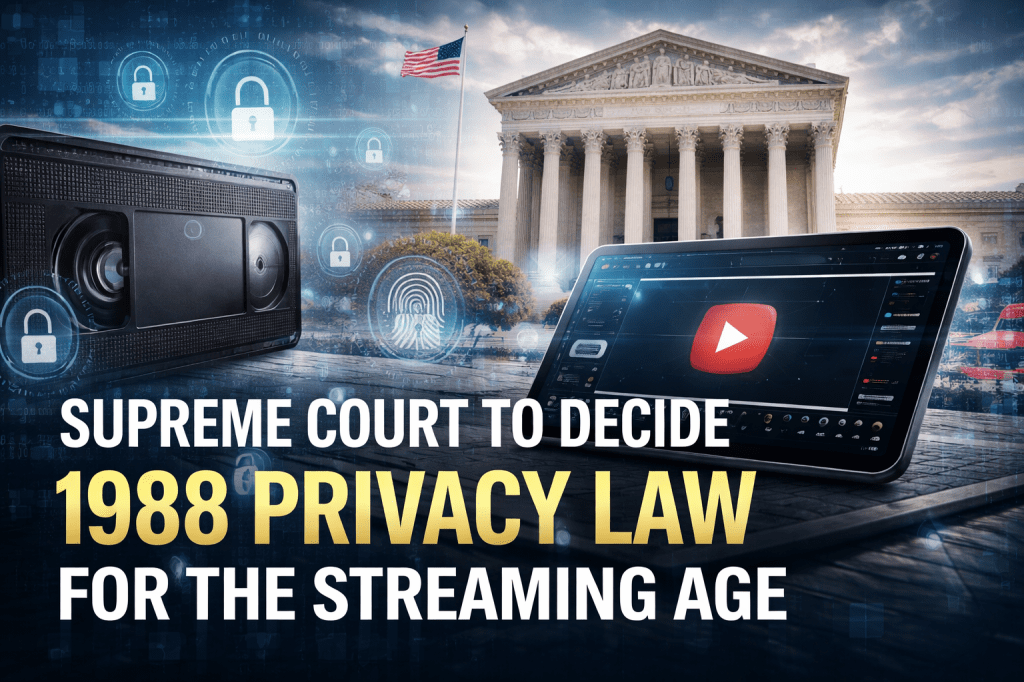
The U.S. Supreme Court has agreed to hear a case that could reshape digital privacy law for the modern internet—by answering a deceptively simple question: How does a 1988 videotape privacy law apply to online video today?
At issue is whether the Video Privacy Protection Act (VPPA)—a statute passed in the wake of a Washington scandal involving leaked video rental records—covers the data practices of modern streaming platforms, news sites, and apps that embed video content. The Court’s decision could have sweeping implications for online privacy, litigation risk, and how far courts should stretch old laws to regulate new technologies.
From VHS Tapes to Embedded Video Players
Congress enacted the VPPA in 1988 after a reporter obtained and published the video rental history of Supreme Court nominee Robert Bork. The law bars “video tape service providers” from disclosing personally identifiable information about consumers’ video viewing habits without consent.
For decades, the statute was largely dormant. But in the last ten years, plaintiffs’ attorneys have revived it—arguing that websites and apps violate the VPPA when they share user data with third parties such as analytics firms, ad networks, or social media platforms via embedded video players.
Lower courts have split over two central questions:
- Who qualifies as a “video tape service provider” in 2026?
- What counts as “personally identifiable information” in an era of pixels, cookies, and device identifiers?
The Supreme Court’s decision to take the case signals growing concern that lower courts are drifting too far apart—and that billions of dollars in potential liability hang in the balance.
Why This Case Matters
At the heart of the dispute is whether Congress intended a narrowly tailored consumer protection law—or whether courts should treat it as a broad digital privacy statute capable of governing modern data flows.
Some courts have allowed VPPA claims to proceed against companies that merely host or embed video, even when video is ancillary to their core business. Others have rejected these suits, warning that stretching the statute too far risks turning nearly every website into a potential defendant.
Technology companies argue that Congress could not have envisioned streaming video, let alone invisible data transfers triggered by autoplay clips or social media embeds. Privacy advocates counter that the underlying harm—companies disclosing what people watch—remains the same, regardless of format.
The Supreme Court will now decide which interpretation prevails.
The Broader Privacy Vacuum
This case also highlights a structural problem in U.S. lawmaking: Congress has repeatedly failed to pass a comprehensive federal privacy statute, leaving courts to retrofit decades-old laws to modern technology.
Instead of clear legislative guidance, judges are being asked to decide whether a law written for Blockbuster Video should regulate:
- Streaming platforms
- News sites with embedded clips
- Fitness apps with video tutorials
- Educational platforms
- Social media integrations
The result has been inconsistent rulings, forum shopping, and a surge in class-action lawsuits—many seeking statutory damages untethered to actual harm.
Implications for Consumers and the Courts
A broad ruling could strengthen user privacy protections—but also expose countless websites and small publishers to crushing litigation risk. A narrow ruling could rein in opportunistic lawsuits—but leave meaningful privacy concerns unresolved.
Either way, the Court’s decision will shape how aggressively plaintiffs can weaponize legacy statutes against modern platforms—and whether privacy policy is set by Congress or by courts interpreting laws from another technological era.
A Defining Moment for Digital Privacy Law
This case is not just about video. It’s about institutional competence: whether courts should act as de facto technology regulators when Congress fails to update the law.
By taking the case, the Supreme Court of the United States is signaling that the era of improvised digital privacy doctrine may be reaching a breaking point.
The ruling—expected later this term—could either reaffirm the limits of judicial interpretation or dramatically expand the reach of a 36-year-old statute into the heart of the modern internet.
For consumers, publishers, and policymakers alike, the stakes are high—and the outcome will echo far beyond online video.
 The People's Law Review