
When the Press May Publish Illegally Obtained Information
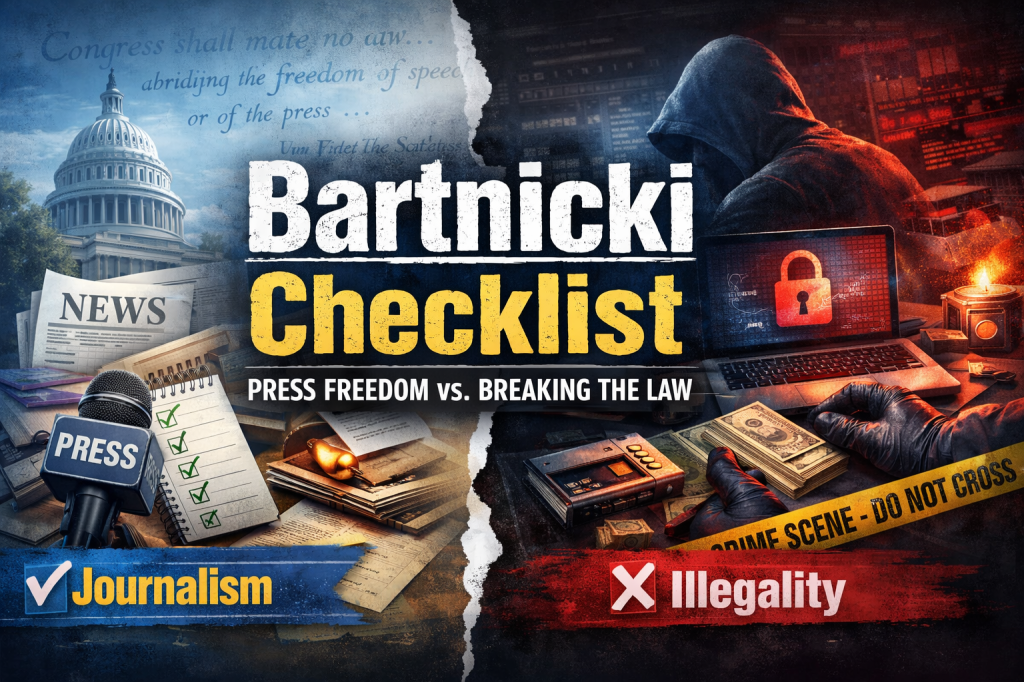
By Michael Phillips | People’s Law Review
In Bartnicki v. Vopper, 532 U.S. 514 (2001), the U.S. Supreme Court addressed a recurring constitutional tension: Can journalists lawfully publish truthful information that was obtained illegally by someone else?
The Court’s answer was clear—and remains foundational to modern press law:
Yes, so long as the journalist played no part in the illegal act and the information concerns a matter of public importance.
This decision continues to protect investigative reporting, whistleblower disclosures, and public-interest journalism across the United States.
Background of the Case
The case arose from an illegally intercepted telephone call between union negotiators during a contentious labor dispute. The recording was made by an unknown third party in violation of federal and state wiretap laws.
Radio commentator Fred Vopper, who did not participate in the interception, received the tape and aired its contents on his program. The recorded parties sued, arguing that publishing the contents violated wiretap statutes—even if the publisher was not the interceptor.
The Supreme Court disagreed.
The Core Holding
The Court held that the First Amendment protects the publication of truthful information of public concern when:
- The information was lawfully obtained by the publisher
- The publisher did not participate in or encourage the illegal act
- The subject matter is of public importance
This principle prevents the government from punishing journalists simply because their source broke the law.
“Play No Part” Means Exactly That
A key limitation of Bartnicki is often misunderstood or overstated. The Court was explicit: the press must play no role in the illegality.
That means a journalist may not:
- Direct or encourage a source to commit a crime
- Coordinate the illegal act
- Assist in hacking, wiretapping, theft, or unlawful access
- Conspire before or during the illegal acquisition
But a journalist may:
- Receive leaked materials after the fact
- Verify and publish information of public concern
- Report on misconduct revealed through unlawful acts by others
- Decline to suppress truthful information solely because a source acted illegally
The distinction is not moral—it is constitutional.
Why the Case Matters Today
Bartnicki underpins much of modern accountability journalism. Its logic has been cited or relied upon in cases involving:
- Whistleblower disclosures
- Leaked government documents
- Unauthorized recordings exposing misconduct
- Investigative reporting based on hacked or leaked data
- National security reporting where sources face prosecution
Without Bartnicki, the government could effectively silence reporting by criminalizing the source and punishing the publisher by proxy.
Relationship to Other Press-Freedom Cases
Bartnicki fits within a broader First Amendment framework protecting the press from downstream liability when reporting truthful matters of public concern.
It complements—but does not eliminate—other limits on publication, including:
- Classified information restrictions
- Trade secret law
- Prior restraint doctrine
- Defamation and privacy law
Importantly, Bartnicki does not grant journalists immunity for crimes—it protects them only when they remain observers, not participants.
Practical Takeaway for Journalists and Publishers
The rule from Bartnicki can be summarized simply:
You can publish the story—even if someone else broke the law—so long as you did not help them break it.
This distinction protects press independence while preserving the government’s ability to prosecute actual criminal conduct.
In an era of leaks, digital surveillance, and aggressive source prosecutions, Bartnicki v. Vopper remains one of the most important—and frequently misunderstood—press freedom decisions in American law.
People’s Law Review
Explaining the law where it meets power, speech, and accountability.
Bartnicki Checklist
What Journalists May Do — and What the First Amendment Does NOT Protect
Bartnicki ALLOWS publication when ALL of the following are true
Source & Acquisition
- ☐ You did not participate in the illegal act (wiretap, hack, theft, trespass, unlawful access)
- ☐ You did not request, direct, encourage, or coordinate the illegal act
- ☐ You received the material after the illegality was complete
- ☐ You obtained the material passively (tip, drop, leak, unsolicited delivery)
Content
- ☐ The information is truthful
- ☐ The subject matter is a matter of public concern
- Government misconduct
- Abuse of power
- Public safety
- Corruption, fraud, or official wrongdoing
- ☐ The story serves public accountability, not mere curiosity
Journalistic Conduct
- ☐ You engaged in independent verification
- ☐ You exercised editorial judgment (redactions, minimization where appropriate)
- ☐ You did not pay for or trade favors in exchange for committing a crime
- ☐ You are publishing information, not facilitating further illegality
Legal Posture
- ☐ Your reporting is after-the-fact, not part of an ongoing illegal operation
- ☐ You are prepared to show no conspiracy or joint action with the source
If every box above is checked, Bartnicki strongly protects publication.
Bartnicki DOES NOT PROTECT journalists who do any of the following
Participation or Encouragement
- ☐ Ask a source to record, hack, steal, intercept, or trespass
- ☐ Provide tools, instructions, access, or technical help for illegal acts
- ☐ Coordinate timing, targets, or methods of unlawful acquisition
- ☐ Agree in advance to publish in exchange for committing the crime
Joint Action / Conspiracy
- ☐ Act as a co-conspirator (even informally)
- ☐ Help conceal the crime or evade law enforcement
- ☐ Launder illegally obtained data while the crime is ongoing
Content Problems
- ☐ Publish information that is knowingly false
- ☐ Publish purely private information with no public significance
- ☐ Publish material solely for harassment, extortion, or coercion
Active Criminal Conduct
- ☐ Participate directly in hacking, wiretapping, or theft
- ☐ Break into systems or premises yourself
- ☐ Violate court orders, protective orders, or active injunctions
If any box above is checked, Bartnicki protection likely fails.
Gray Zones (Get Legal Review)
Bartnicki is strong—but not absolute. Pause if the story involves:
- ☐ Classified information implicating national security statutes
- ☐ Trade secrets or proprietary commercial data
- ☐ Ongoing criminal investigations
- ☐ Minors, medical data, or extreme privacy interests
- ☐ Payment structures that could be framed as inducement
Bartnicki may still apply, but additional doctrines (privacy law, Espionage Act issues, trade secret law) could complicate protection.
One-Sentence Rule Editors Can Use
If the newsroom didn’t help break the law, didn’t ask for the law to be broken, and is publishing truthful information of public concern, Bartnicki protects publication.
Why This Checklist Matters
Governments often try to chill reporting by criminalizing the source and intimidating the publisher. Bartnicki v. Vopper blocks that end-run around the First Amendment—but only if journalists remain observers, not participants.
This checklist helps preserve that line.
 The People's Law Review