
The Due Process Test Family Court Pretends Doesn’t Exist
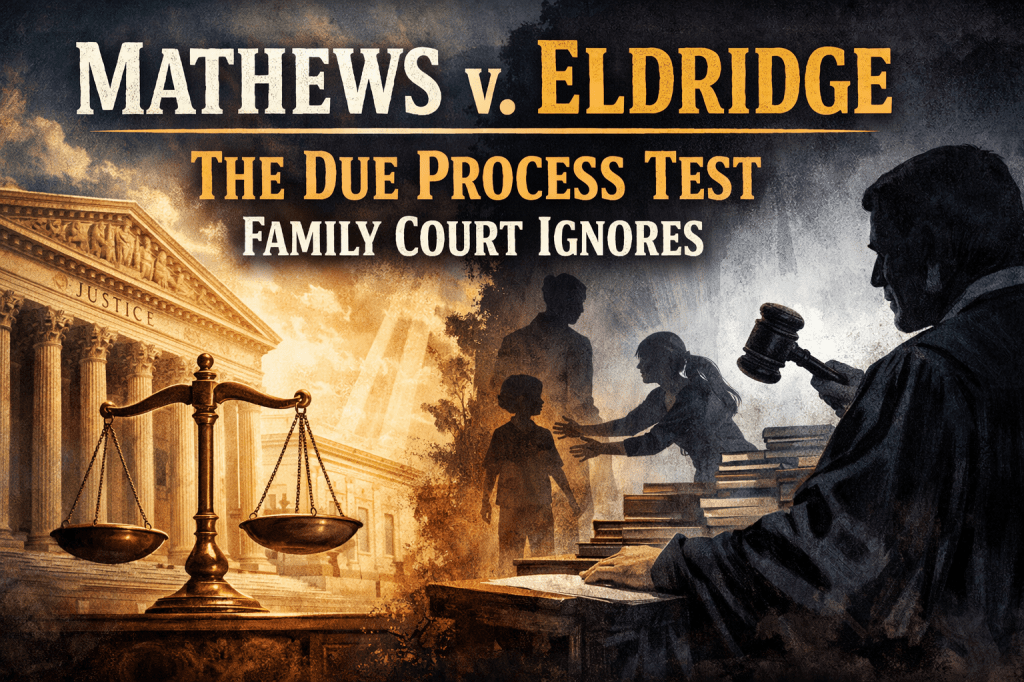
By Michael Phillips | People’s Law Review
Family court judges often speak in vague moral language—“best interests,” “judicial discretion,” “temporary measures”—while quietly bypassing the most important due process test in American law.
That test comes from Mathews v. Eldridge (1976).
It is not obscure.
It is not optional.
And it is violated in family court every single day.
The Case Everyone Cites—and No One Applies
Mathews v. Eldridge established the three-factor balancing test for determining what process is constitutionally required before the government deprives a person of a protected liberty or property interest.
The Supreme Court was clear:
Due process is not a formality. It is a balancing test that must be applied to real consequences.
Yet in family court, the test is almost never articulated, let alone enforced.
The result: parents lose fundamental rights with fewer protections than people fighting parking tickets.
The Mathews Test (In Plain English)
When the government acts against you, courts must weigh:
- The private interest affected
- The risk of erroneous deprivation under existing procedures
- The government’s interest, including administrative burdens
This is not discretionary.
This is the constitutional minimum.
Let’s walk through how family court fails each prong.
1. The Private Interest: The Parent–Child Bond
The Supreme Court has repeatedly held that the parent-child relationship is a fundamental liberty interest—among the most protected in American law.
This interest includes:
- Physical custody
- Legal decision-making
- Contact, communication, and bonding
- Reputation and parental fitness
- Freedom from state-imposed stigma
In family court, this interest is treated as negotiable.
Temporary orders strip parents of access for months or years.
Protective orders sever contact without findings of fact.
Status-quo doctrines freeze unconstitutional outcomes in place.
Under Mathews, this weighs heavily in favor of robust procedural protections.
Family court routinely acts as if it does not.
2. Risk of Erroneous Deprivation: Astronomical
This is where family court collapses under constitutional scrutiny.
Consider the standard procedures:
- Ex parte hearings with no notice
- Affidavits accepted as truth without cross-examination
- No evidentiary standards comparable to criminal court
- No juries
- Limited appellate review
- Sealed records preventing public accountability
- Temporary orders that function as permanent punishment
The risk of error is not hypothetical.
It is systemic.
False allegations are rewarded.
Delay becomes strategy.
Silence becomes guilt.
Under Mathews, a high risk of error demands stronger safeguards.
Family court responds by lowering them further.
3. Government Interest: Administrative Convenience Masquerading as Justice
What interest does the state claim?
- Speed
- Efficiency
- Docket management
- “Protecting children” (without proof of danger)
But Mathews is explicit: administrative convenience does not override fundamental liberty.
Courts may not sacrifice accuracy for efficiency when the cost is constitutional harm.
Family court does exactly that—prioritizing case flow over truth, expedience over rights.
The Constitution does not permit this tradeoff.
The Pattern: A Test Ignored, Not Failed
Family court does not misapply Mathews v. Eldridge.
It refuses to apply it at all.
Judges rarely:
- Identify the protected interest
- Analyze the risk of error
- Justify curtailed procedures
- Make findings tied to constitutional standards
Instead, outcomes are justified after the fact using discretionary language that never engages due process.
This is not oversight.
It is institutional avoidance.
Why This Matters
When courts ignore Mathews, due process becomes optional—and power goes unchecked.
Parents are told to comply first and appeal later, even though:
- Time lost with a child is irreversible
- Status-quo bias makes appeals meaningless
- “Temporary” orders become permanent facts
This is how constitutional violations hide in plain sight.
The Sleeper Doctrine Family Court Can’t Survive
If Mathews v. Eldridge were applied honestly in family court:
- Ex parte orders would be rare and tightly constrained
- Evidentiary hearings would happen before separation
- Allegations would face real scrutiny
- Delay would not be weaponized
- “Best interests” would not override due process
That is precisely why it isn’t enforced.
Final Thought
Family court does not operate in a constitutional vacuum.
Mathews v. Eldridge is the law.
The parent-child bond is a protected liberty interest.
And procedural shortcuts do not excuse constitutional harm.
The real scandal is not that family court gets it wrong.
It’s that no one forces it to get it right.
The Mathews v. Eldridge Due Process Checklist
(For Parents in Family Court)
Purpose: To require the court to articulate—and justify—how due process is being satisfied before a parent’s fundamental rights are restricted.
Threshold Statement (Say This First)
“Your Honor, before the Court restricts my parental rights, I respectfully request that the Court apply the due process balancing test required by Mathews v. Eldridge, and make findings on the record.”
Prong One: The Private Interest at Stake
Questions to raise:
- What specific liberty interest is being affected by this order?
- Does the Court acknowledge that the parent–child relationship is a fundamental constitutional right?
- Is the Court recognizing:
- Loss of physical custody?
- Loss of legal decision-making?
- Loss of contact or bonding time?
- Damage to parental reputation or fitness?
- Is this restriction temporary in name but indefinite in effect?
On the record trigger:
“Your Honor, can the Court identify the private interest being affected and explain how its constitutional weight has been considered?”
Prong Two: Risk of Erroneous Deprivation
Questions to raise:
- What is the risk of error under the current procedure?
- Was this order based on:
- Allegations rather than evidence?
- Affidavits without cross-examination?
- An ex parte hearing?
- Hearsay or unsworn statements?
- Has the Court allowed:
- An evidentiary hearing?
- Witness testimony?
- Cross-examination?
- What safeguards exist to prevent a wrongful deprivation?
On the record trigger:
“Your Honor, what procedural safeguards has the Court relied on to reduce the risk of erroneous deprivation of my parental rights?”
Prong Three: The Government’s Interest
Questions to raise:
- What specific government interest justifies restricting parental rights before a full hearing?
- Is the interest:
- Child safety based on evidence?
- Or administrative efficiency and docket management?
- Has the Court balanced convenience against constitutional harm?
- Would providing more process (notice, hearing, evidence) create a legitimate burden, or merely delay?
On the record trigger:
“Your Honor, what government interest outweighs the need for full procedural protections in this case?”
Balancing Requirement (Often Ignored)
Critical point to raise:
- Has the Court actually balanced all three factors together?
- Or has it relied on conclusory language like:
- “Best interests”
- “Judicial discretion”
- “Temporary order”
- Are there written or oral findings explaining why reduced process is constitutionally sufficient?
On the record trigger:
“Respectfully, has the Court conducted the required balancing under Mathews, or is the Court proceeding without that analysis?”
Preservation Statement (If the Court Refuses)
If the judge declines to engage:
“For the record, I object to the restriction of my parental rights without application of the Mathews v. Eldridge due process test and without findings addressing the private interest, risk of error, and government interest.”
This sentence matters.
It preserves constitutional error.
Why This Checklist Works
- It forces articulation, not vibes
- It reframes “best interests” as insufficient alone
- It exposes when courts prioritize efficiency over accuracy
- It creates a clean appellate record
- It shifts the burden back where it belongs: on the state
Bottom Line
Family court survives by skipping the test, not passing it.
This checklist doesn’t guarantee justice—but it makes constitutional shortcuts visible, reviewable, and harder to ignore.
Why This Checklist Exists
This checklist is not a strategy gimmick or a self-help hack.
It comes directly from Mathews v. Eldridge, the Supreme Court case that defines what due process actually requires when the government takes away a protected right.
What Mathews Requires
Before the state restricts a fundamental liberty, courts must balance three things:
- The private interest affected
- The risk of error under current procedures
- The government’s interest in acting without more process
This is not optional. It is the constitutional minimum.
Why Family Court Is Different—and Dangerous
Family court routinely removes or restricts parental rights using:
- ex parte hearings
- affidavits instead of evidence
- temporary orders with permanent consequences
Yet courts often skip the Mathews analysis entirely, substituting phrases like “best interests” or “judicial discretion” for constitutional findings.
That substitution is not lawful.
It is a due process failure.
What the Checklist Does
The Mathews Checklist forces the court to do what it rarely does on its own:
- identify the liberty interest at stake
- acknowledge the risk of erroneous deprivation
- justify reduced procedures with a real government interest
When judges refuse to engage, the violation becomes visible—and reviewable.
How to Use It
Parents can raise this checklist on the record:
- before a custody restriction
- during emergency or protective order hearings
- when “temporary” orders are imposed without evidence
Its purpose is not to argue facts—but to demand constitutional process.
Read the Full Analysis
For a deeper breakdown of how family court routinely violates this doctrine, see:
“Mathews v. Eldridge: The Due Process Test Family Court Pretends Doesn’t Exist.”
 The People's Law Review