
Reichert v. Hornbeck and the Structural Limits of Civil Rights Litigation
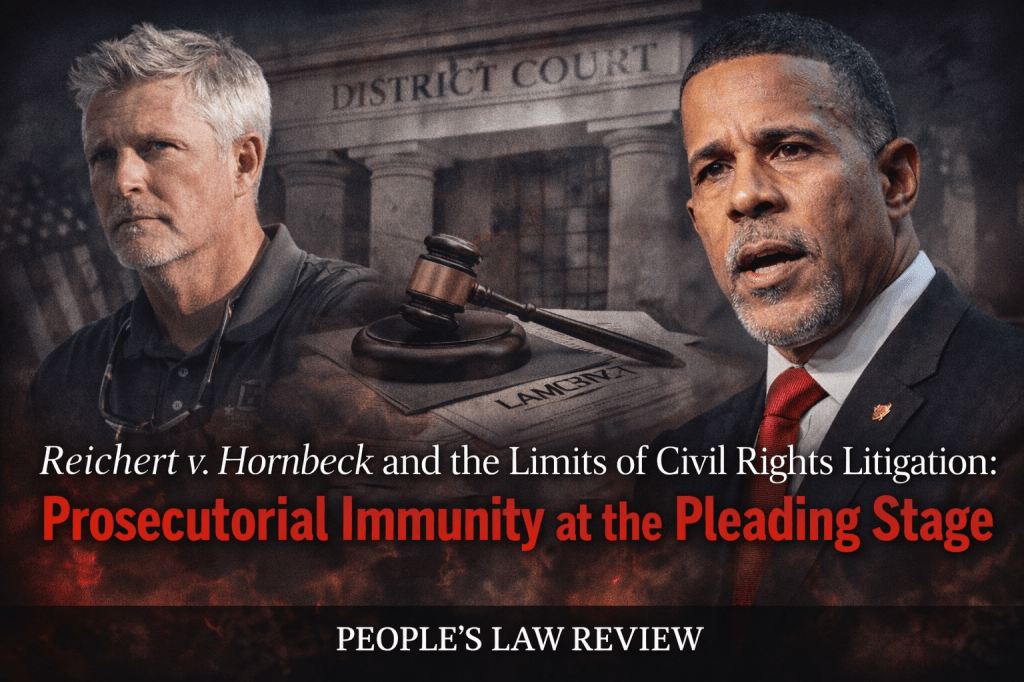
By Michael Phillips | People’s Law Review
A federal civil rights lawsuit arising out of a prolonged custody dispute in Maryland now turns not on disputed facts, but on doctrine.
In Reichert v. Hornbeck et al., the plaintiff alleges constitutional violations, equal protection claims, denial of access to courts, and disability discrimination under Title II of the Americans with Disabilities Act stemming from repeated criminal filings and protective order proceedings connected to a high-conflict custody matter.
The Maryland Office of the Attorney General, representing Assistant State’s Attorney Michelle Demma Fuller, has moved to dismiss the case under Federal Rule of Civil Procedure 12(b)(6), asserting absolute prosecutorial immunity and pleading insufficiency.
The motion places squarely before the federal court a structural question that has shaped civil rights litigation for nearly half a century:
When does prosecutorial immunity bar inquiry — even before discovery begins?
I. The Procedural Posture: A Rule 12(b)(6) Threshold Fight
Rule 12(b)(6) permits dismissal where a complaint fails to state a claim upon which relief can be granted.
At this stage:
- The court accepts well-pleaded factual allegations as true.
- Legal conclusions are disregarded.
- The complaint must state a “plausible” claim under Bell Atlantic Corp. v. Twombly and Ashcroft v. Iqbal.
Importantly, no evidence is considered. No discovery occurs. No credibility determinations are made.
If immunity attaches as a matter of law based on the allegations themselves, dismissal is appropriate at the pleading stage.
Thus, the case has become a doctrinal threshold contest — not a factual adjudication.
II. Absolute Prosecutorial Immunity: Origins and Scope
The doctrine of absolute prosecutorial immunity originates in Imbler v. Pachtman, 424 U.S. 409 (1976).
In Imbler, the Supreme Court held that prosecutors are absolutely immune from §1983 damages claims for actions “intimately associated with the judicial phase of the criminal process,” including:
- Initiating prosecution
- Presenting the State’s case
- Evaluating evidence for charging decisions
The Court’s reasoning was institutional:
- Prosecutors must exercise independent judgment.
- Exposure to civil liability would chill decision-making.
- The judicial system contains internal checks (appeals, professional discipline).
Over time, courts have distinguished between:
- Advocative functions (immune)
- Investigative or administrative functions (sometimes only qualified immunity)
The critical question in any such case is functional, not positional.
III. The Plaintiff’s Allegations in Context
The complaint in Reichert alleges:
- Repeated criminal charges later nolle prossed.
- Selective enforcement tied to custody conflict.
- Equal protection violations.
- ADA Title II discrimination.
- Denial of access to courts.
- Requests for declaratory and injunctive relief.
The plaintiff does not merely challenge a single arrest. He alleges a multi-year pattern of filings and prosecutorial actions that, taken together, violated constitutional protections.
The State argues that the conduct at issue — charging decisions — falls squarely within the core of prosecutorial immunity.
If the court agrees that the alleged conduct is advocative in nature, the immunity analysis may end the inquiry.
IV. The Structural Tension
Cases like Reichert expose a deeper structural tension within civil rights law.
On one hand:
- Prosecutorial independence is foundational.
- Domestic violence cases require rapid decision-making.
- Protective order systems are designed for accessibility.
On the other:
- Repeated charging cycles that end in dismissal can create perceptions of selective enforcement.
- Immunity doctrine prevents damages actions even where allegations describe troubling patterns.
- Plaintiffs often cannot reach discovery to examine internal policies or communications.
The law tolerates this asymmetry intentionally.
Absolute immunity prioritizes institutional function over individualized redress.
V. ADA Claims and the Heightened Pleading Burden
The complaint also includes claims under Title II of the ADA.
To survive dismissal, a plaintiff must plausibly allege:
- A qualifying disability.
- Exclusion from participation in or denial of benefits of a public entity’s services.
- Discrimination by reason of disability.
- Deliberate indifference for damages claims.
Courts routinely dismiss ADA claims at the pleading stage where allegations are conclusory or lack factual specificity regarding discriminatory intent.
The intersection of ADA claims and prosecutorial functions presents additional complexity, as courts must determine whether the alleged discrimination arises from protected prosecutorial acts.
VI. The Discovery Barrier
One of the most consequential aspects of absolute immunity is procedural.
Because immunity is not merely a defense to liability but a protection from suit itself, courts resolve immunity questions early — often before discovery.
This means:
- Internal communications remain unexamined.
- Charging guidelines are not scrutinized.
- Plaintiffs must plead with particularity without access to internal information.
This dynamic creates what scholars have described as an “accountability gap” — not because misconduct is presumed, but because institutional shielding prevents factual development.
VII. National Context
The problem is not unique to Maryland.
Across jurisdictions:
- Domestic assault cases frequently end in dismissal or nolle prosequi.
- Protective order systems prioritize speed over exhaustive fact-finding at the ex parte stage.
- Civil rights claims against prosecutors rarely survive the immunity barrier.
The Supreme Court has repeatedly reaffirmed the breadth of prosecutorial immunity, most recently clarifying functional distinctions but maintaining core protections.
Thus, Reichert is not doctrinally novel.
It is structurally illustrative.
VIII. What the Court Must Decide
The federal court must determine:
- Whether the alleged conduct falls within the scope of advocative prosecutorial function.
- Whether the complaint pleads sufficient non-conclusory facts to state plausible constitutional and ADA claims.
- Whether any claims for injunctive or declaratory relief survive even if damages claims do not.
The outcome will not establish guilt or innocence.
It will determine whether the plaintiff is entitled to discovery.
That procedural distinction is legally decisive.
IX. Beyond the Case
Regardless of the outcome, Reichert highlights recurring questions in civil rights litigation:
- Should absolute immunity remain as broad as Imbler envisioned?
- Does Rule 12(b)(6) screening adequately balance institutional protection and individual redress?
- Are repeat domestic filings an inevitable byproduct of protective systems, or evidence of insufficient safeguards?
These questions are policy-driven, not partisan.
They cut to the architecture of American civil rights enforcement.
Conclusion
Reichert v. Hornbeck is not simply a custody dispute reframed as a civil rights action.
It is a case study in the collision between:
- Prosecutorial immunity
- Pleading standards
- Disability law
- And the structural design of domestic legal systems
The federal court’s ruling will decide whether the complaint advances or ends.
But the deeper inquiry — the balance between independence and accountability — remains unsettled.
In American law, some doors close before evidence is heard.
The doctrine determines which ones.
You can read more about the case at FreeGrantReichert.com.
 The People's Law Review