
By Michael Phillips | People’s Law Review
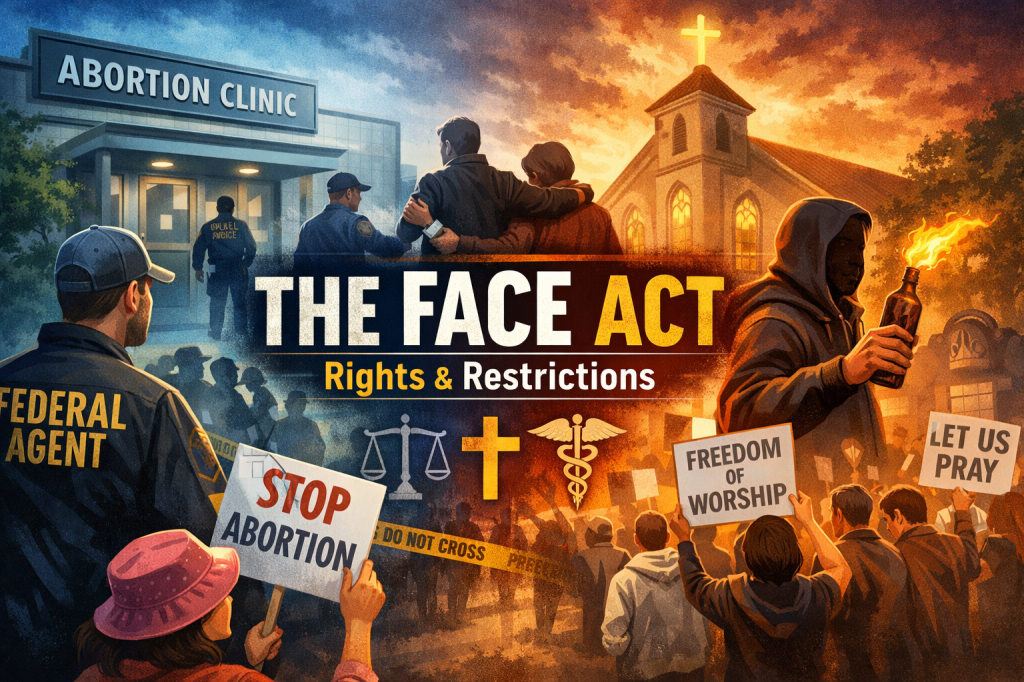
The Freedom of Access to Clinic Entrances Act—commonly known as the FACE Act—is one of the most misunderstood federal civil rights laws in contemporary legal debate. Enacted in 1994, the statute operates at the intersection of public safety, constitutional freedoms, and access to lawful activity, addressing conduct that crosses the line from protest into coercion.
Although often discussed solely in the context of abortion clinics, the FACE Act is a broader statute. It also explicitly protects houses of worship, reflecting Congress’s intent to safeguard access to constitutionally protected activities without regulating speech or belief.
This explainer examines what the FACE Act does, what it does not do, how it applies to religious facilities, and why it remains legally significant today.
What the FACE Act Is
The FACE Act makes it unlawful to use force, threats of force, or physical obstruction to intentionally:
- Injure, intimidate, or interfere with any person seeking or providing reproductive health services
- Damage or destroy the property of a facility providing such services
- Interfere with any person exercising religious freedom at a place of worship
- Damage or destroy religious property with the intent to disrupt worship
The law applies nationwide and authorizes both criminal enforcement and civil remedies, including private lawsuits and injunctions.
What the FACE Act Does Not Prohibit
A central feature of the statute—and the basis for its repeated survival in court—is that it does not regulate speech or viewpoints.
The FACE Act does not prohibit:
- Peaceful protest on public sidewalks
- Holding signs, chanting, or leafleting
- Verbal persuasion, prayer, or counseling
- Advocacy expressing moral, religious, or political opposition
The statute targets conduct, not expression. Courts have consistently held that the law leaves ample room for First Amendment activity while addressing behavior that interferes with access through intimidation or obstruction.
What Constitutes a Violation
Prohibited conduct under the FACE Act includes:
- Physically blocking entrances or exits
- Locking, chaining, or barricading doors
- Forming human blockades
- Threatening patients, staff, clergy, or congregants
- Vandalizing or destroying protected facilities
- Using intimidation designed to prevent access
Intent is required. Lawful presence or incidental inconvenience alone is insufficient to establish a violation.
Enforcement and Penalties
Violations may result in:
- Criminal penalties, including fines and imprisonment (up to 10 years if bodily injury occurs)
- Civil damages, including compensatory and punitive awards
- Injunctive relief, ordering individuals to cease unlawful conduct
The law is primarily enforced by the U.S. Department of Justice, though private plaintiffs—including clinics, churches, and individuals—may also bring civil actions.
Houses of Worship: A Core but Overlooked Provision
While abortion clinics dominate public attention, the FACE Act explicitly protects places of religious worship, including churches, synagogues, mosques, temples, and other religious facilities.
What the Law Protects at Religious Sites
The Act prohibits force, threats, or obstruction intended to:
- Prevent entry to or exit from religious services
- Intimidate worshippers, clergy, or staff
- Disrupt services through coercive conduct
- Damage or destroy religious property to interfere with worship
Congress placed religious worship on equal legal footing with medical access—not to endorse any belief, but to protect free exercise rights from physical interference.
What Remains Protected Near Houses of Worship
As with clinics, the FACE Act does not prohibit:
- Peaceful picketing
- Protest on public sidewalks
- Distribution of literature
- Expression of disagreement with religious doctrines
The line is crossed only when conduct becomes coercive or obstructive.
Why Congress Included Religious Facilities
In the late 1980s and early 1990s, lawmakers documented a pattern of:
- Church bombings and arson
- Organized blockades of religious services
- Threats against clergy and congregants
- Politically motivated interference with worship
Congress concluded that access intimidation tactics were being used across ideological lines and drafted the FACE Act to address these shared vulnerabilities without favoring any belief system.
Constitutional Significance
Federal courts have consistently upheld the FACE Act, finding that it:
- Is content-neutral
- Regulates conduct rather than speech
- Serves a significant government interest in public safety
- Preserves ample alternative channels for expression
The inclusion of houses of worship strengthens the statute’s constitutional footing by demonstrating neutrality and reinforcing Free Exercise protections.
The FACE Act After Dobbs
The Supreme Court’s abortion rulings did not alter the FACE Act. The statute does not create a right to abortion or override state law. Instead, it ensures that lawful activity—whatever the state framework—may be accessed without violence or coercion.
As protests increasingly spill into religious spaces over issues ranging from abortion to geopolitics, the worship provisions of the FACE Act are becoming more relevant, not less.
The Bottom Line
The FACE Act is not an abortion law and not a speech restriction. It is a civil rights and public safety statute designed to draw a clear constitutional line:
Peaceful protest is protected.
Physical obstruction, threats, and intimidation are not.
That principle applies equally to clinics and churches, regardless of ideology or belief. Understanding both sides of the statute is essential to understanding the law itself.
People’s Law Review publishes neutral, plain-language legal analysis focused on how laws function in practice, separate from political advocacy or rhetoric.
 The People's Law Review