
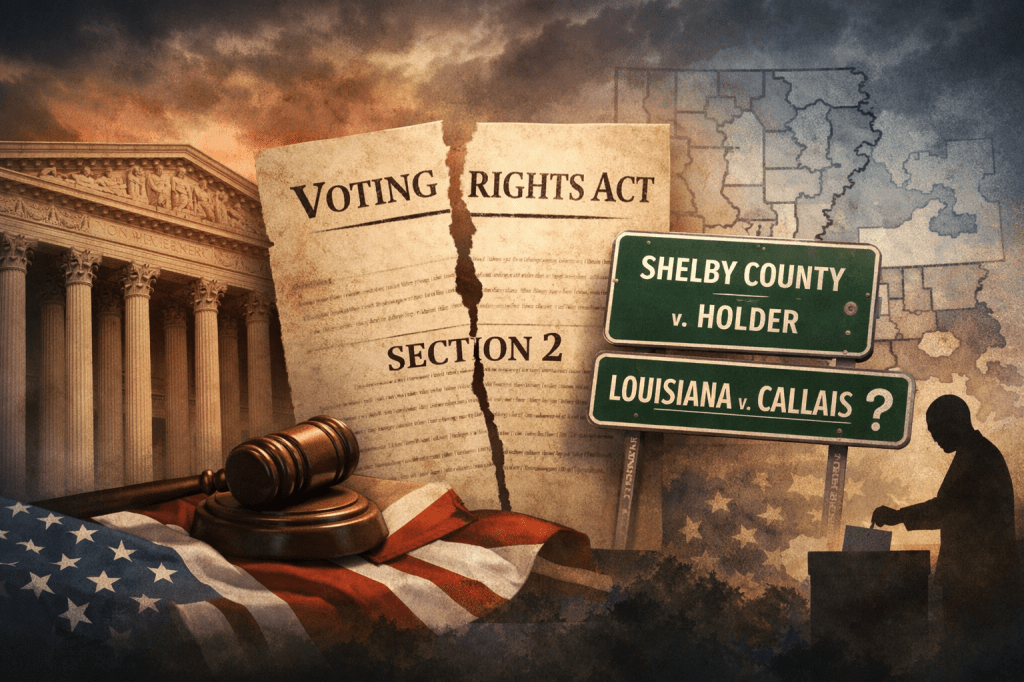
By Michael Phillips | People’s Law Review
For nearly six decades, the Voting Rights Act of 1965 (VRA) stood as one of the most effective civil rights laws in American history. It did not merely prohibit racial discrimination in voting in the abstract; it created enforcement mechanisms that acknowledged how discrimination actually operated—through local practices, structural barriers, and shifting tactics designed to evade formal bans.
At the federal level, however, the Supreme Court has steadily narrowed the scope and force of the VRA. The most significant turning point came in Shelby County v. Holder (2013). Now, a new case—Louisiana v. Callais—raises the possibility that the Court may further weaken, or effectively neutralize, Section 2 of the Act itself.
Together, these cases illustrate a broader judicial shift away from proactive civil rights enforcement and toward a formalistic vision of equality that leaves enforcement largely to Congress and the states—even where Congress has already acted.
Shelby County v. Holder (2013): Disabling Section 5 Without Repealing It
Before 2013, Section 5 of the Voting Rights Act required certain states and local jurisdictions with documented histories of voting discrimination to obtain federal “preclearance” before changing their election laws. This mechanism was designed to prevent discriminatory practices before they could take effect.
In Shelby County v. Holder, the Supreme Court struck down the coverage formula in Section 4(b), which determined which jurisdictions were subject to preclearance. Without that formula, Section 5 became unenforceable in practice.
The Court’s majority reasoned that the formula relied on “decades-old data” and that conditions had changed sufficiently to render the system unconstitutional. Notably, the Court did not find that Congress lacked the power to impose preclearance—it held that Congress must update the formula.
Congress has not done so.
The practical effect was immediate: states previously subject to preclearance enacted voter ID laws, redistricting plans, and changes to voting procedures without prior federal review. Litigation shifted from preventive oversight to reactive lawsuits—often after elections had already occurred.
Section 2: The Remaining Enforcement Backbone
After Shelby County, Section 2 of the VRA became the primary federal tool for challenging discriminatory voting practices. Unlike Section 5, Section 2 applies nationwide and allows private plaintiffs and the federal government to challenge voting laws or district maps that result in racial vote dilution or discrimination.
Section 2 does not require proof of discriminatory intent; it focuses on discriminatory effects, assessed under a framework developed in Thornburg v. Gingles (1986). Courts examine factors such as racially polarized voting, historical discrimination, and whether minority voters have an equal opportunity to elect candidates of their choice.
For the past decade, Section 2 has been the last meaningful guardrail against racially discriminatory redistricting in many states.
Louisiana v. Callais: A Direct Threat to Section 2
Louisiana v. Callais arises from challenges to Louisiana’s congressional map following the 2020 census. Despite having a substantial Black population, Louisiana enacted a map with only one majority-Black congressional district. Lower courts found that this likely violated Section 2 of the VRA by diluting Black voting strength.
Rather than contesting the factual findings alone, Louisiana’s arguments raise broader constitutional questions that could fundamentally alter how Section 2 operates—or whether it can operate at all.
At issue is whether Section 2 impermissibly requires states to engage in race-conscious decision-making, potentially conflicting with the Court’s recent equal protection jurisprudence, which has grown increasingly skeptical of race-based remedies.
If the Court accepts the argument that Section 2 itself pressures states into unconstitutional racial classifications, the result could be devastating: a ruling that sharply limits, or effectively nullifies, Section 2’s application to redistricting.
Such a decision would not formally repeal the Voting Rights Act—but it would remove its last effective enforcement mechanism.
A Broader Judicial Pattern
Shelby County and Louisiana v. Callais are not isolated cases. They reflect a broader judicial philosophy that treats race-conscious remedies with suspicion, even when they are designed to remedy documented discrimination.
The Court has increasingly emphasized principles of state sovereignty, formal equality, and colorblindness—often at the expense of Congress’s explicit enforcement powers under the Fifteenth Amendment.
Critics argue this approach misunderstands the nature of voting discrimination, which rarely appears as explicit exclusion and instead operates through structural design choices such as district boundaries, polling access, and election timing.
Supporters counter that federal oversight should be limited and that states should not be indefinitely subject to extraordinary federal constraints.
What is clear is that the balance has shifted decisively toward judicial restraint of civil rights enforcement—and away from congressional judgment.
Why This Matters
The Voting Rights Act was designed as a living statute—capable of responding to evolving forms of discrimination. By disabling Section 5 and potentially narrowing Section 2, the Supreme Court has left enforcement largely dependent on lengthy, expensive litigation with uncertain outcomes.
If Louisiana v. Callais results in a significant limitation on Section 2, the VRA will remain on the books but lack the tools necessary to fulfill its purpose.
That would represent not a single doctrinal shift, but the culmination of a long judicial retreat from one of the most consequential civil rights achievements in American law.
For voters, states, and courts alike, the question is no longer whether the Voting Rights Act is important—but whether it can still function as intended in the modern constitutional landscape.
Case-Law Citations & Footnotes (PLR Format)
You can append these as numbered footnotes to the main article.
Key Supreme Court Decisions
- Shelby County v. Holder, 570 U.S. 529 (2013).
The Court held that Section 4(b)’s coverage formula for preclearance under the Voting Rights Act was unconstitutional because it relied on outdated data, rendering Section 5 unenforceable absent congressional action. - Thornburg v. Gingles, 478 U.S. 30 (1986).
Established the three-part framework for Section 2 vote-dilution claims, focusing on racially polarized voting and minority voters’ ability to elect candidates of choice. - Brnovich v. Democratic National Committee, 594 U.S. ___, 141 S. Ct. 2321 (2021).
Narrowed Section 2 by articulating “guideposts” that make it more difficult to prove discriminatory effects in voting-procedure challenges, emphasizing state interests and historical baselines. - Allen v. Milligan, 599 U.S. ___, 143 S. Ct. 1487 (2023).
Reaffirmed the Gingles framework and held that Alabama’s congressional map likely violated Section 2, temporarily halting efforts to dismantle vote-dilution doctrine. - Louisiana v. Callais, cert. granted, ___ U.S. ___ (2025).
Raises constitutional questions about whether Section 2 impermissibly requires race-conscious redistricting, potentially threatening the statute’s continued viability.
Constitutional Authority
- U.S. Const. amend. XV, § 2.
Grants Congress the power to enforce the prohibition on racial discrimination in voting through “appropriate legislation.” - South Carolina v. Katzenbach, 383 U.S. 301 (1966).
Upheld the Voting Rights Act as a valid exercise of Congress’s Fifteenth Amendment enforcement power, emphasizing deference to congressional judgment in combating discrimination.
Companion Explainer
Section 2 of the Voting Rights Act — In Plain English
Section 2 of the Voting Rights Act is a nationwide rule that says states and local governments cannot use voting laws or district maps that result in racial discrimination—even if no one openly admits discriminatory intent.
In practice, Section 2 asks a simple question:
Do minority voters have a real, equal opportunity to participate in elections and elect candidates of their choice?
Courts look at how elections actually work on the ground, including:
- Whether voting is racially polarized
- Whether minority communities are large and cohesive enough to form a district
- Whether historical discrimination still affects political participation
Importantly, Section 2 does not require proof of racist motives. It recognizes that modern discrimination often operates through structural design—such as how districts are drawn—rather than explicit exclusion.
After the Supreme Court disabled Section 5’s preclearance system in 2013, Section 2 became the primary way voters could challenge discriminatory maps or voting rules. If Section 2 is weakened or invalidated, there would be no meaningful federal mechanism left to address racial vote dilution before or after elections.
Judicial Philosophy Sidebar
The Roberts Court vs. the Warren Court: Two Visions of Voting Rights
The Warren Court (1953–1969)
The Warren Court viewed voting rights as foundational to democratic legitimacy. It broadly interpreted Congress’s enforcement powers under the Reconstruction Amendments and upheld strong federal oversight of state election practices.
Key characteristics:
- Deference to congressional fact-finding
- Acceptance of race-conscious remedies to address discrimination
- Emphasis on outcomes, not just formal rules
Representative cases include Brown v. Board of Education, Reynolds v. Sims, and South Carolina v. Katzenbach.
The Roberts Court (2005–present)
The Roberts Court has taken a more skeptical view of race-based remedies and federal oversight. It emphasizes state sovereignty, equal protection formalism, and the idea that extraordinary remedies require extraordinary justification.
Key characteristics:
- Suspicion of race-conscious legal frameworks
- Focus on whether remedies treat states or individuals differently based on race
- Willingness to override congressional judgment
Cases like Shelby County v. Holder, Brnovich v. DNC, and potentially Louisiana v. Callais reflect this shift.
The Core Divide
The Warren Court asked whether laws effectively protected democratic participation.
The Roberts Court asks whether the tools used to protect participation themselves violate constitutional limits.
The result is not an outright rejection of voting rights—but a narrowing of how, and whether, they can be enforced.
COUNTER-ARGUMENT BOX
Why the Court Says the Voting Rights Act Must Be Limited
Supporters of the Supreme Court’s recent Voting Rights Act decisions argue that the Court is not hostile to voting rights, but instead enforcing constitutional boundaries.
1. Federalism and Equal State Sovereignty
The Court has emphasized that states are co-equal sovereigns and should not be subject to indefinite or unequal federal control without current justification. In Shelby County v. Holder, the Court argued that extraordinary federal oversight based on historical data no longer reflected present conditions.
2. Constitutional Limits on Race-Based Decision-Making
Recent decisions reflect concern that race-conscious remedies—even when intended to prevent discrimination—may conflict with the Equal Protection Clause. The Court has suggested that requiring states to consider race in redistricting risks entrenching racial classifications rather than moving toward a colorblind legal system.
3. Congress Must Update the Law
The Court has repeatedly stated that Congress retains the authority to enforce the Fifteenth Amendment, but must do so using contemporary evidence and narrowly tailored solutions. From this perspective, judicial intervention is framed as a corrective measure, not a rejection of congressional power.
4. Preventing Judicial Overreach
The Court’s majority has expressed concern that broad enforcement standards invite courts to act as de facto redistricting bodies, substituting judicial preferences for state policy judgments.
The Court’s Position in Brief
The Court maintains that protecting voting rights remains a constitutional priority—but that such protections must align with modern conditions, avoid racial classifications, and respect the limits of federal judicial power.
READER FAQ
Section 2 of the Voting Rights Act — Common Questions Answered
Does Section 2 require racial quotas or proportional representation?
No. Section 2 expressly states that it does not establish a right to proportional representation. Courts evaluate whether minority voters have an equal opportunity to participate in the political process, not whether electoral outcomes mirror population percentages.
Citation:
52 U.S.C. § 10301(b); Thornburg v. Gingles, 478 U.S. 30, 84 (1986).
Does Section 2 force states to draw districts based solely on race?
No. Section 2 allows race to be considered only to the extent necessary to prevent vote dilution. Courts require that any majority-minority district be reasonably compact and consistent with traditional redistricting principles, such as contiguity and respect for political subdivisions.
Citation:
Thornburg v. Gingles, 478 U.S. at 50–51; Allen v. Milligan, 599 U.S. ___, 143 S. Ct. 1487, 1503–04 (2023).
Is discriminatory intent required to prove a Section 2 violation?
No. Congress amended Section 2 in 1982 to establish an effects-based standard, explicitly rejecting a requirement that plaintiffs prove discriminatory intent. This was done to address structural and subtle forms of discrimination that are difficult to prove through intent alone.
Citation:
Voting Rights Act Amendments of 1982, Pub. L. No. 97-205; Chisom v. Roemer, 501 U.S. 380, 394 (1991).
Does Section 2 apply only to Southern states?
No. Section 2 applies nationwide. Unlike the former preclearance regime under Section 5, which covered specific jurisdictions, Section 2 allows challenges to voting practices in any state or locality.
Citation:
52 U.S.C. § 10301(a); Brnovich v. Democratic Nat’l Comm., 594 U.S. ___, 141 S. Ct. 2321, 2330 (2021).
Why do some Justices view Section 2 as constitutionally problematic?
Some members of the Court argue that Section 2 pressures states to engage in race-conscious decision-making, potentially conflicting with modern Equal Protection doctrine, which disfavors laws that classify citizens by race—even for remedial purposes.
Citation:
Brnovich v. DNC, 141 S. Ct. at 2348–49 (Alito, J.); Shelby County v. Holder, 570 U.S. 529, 543–44 (2013).
What happens if Section 2 is weakened or invalidated?
If Section 2 were significantly narrowed or invalidated, plaintiffs would likely be required to prove intentional racial discrimination to challenge voting laws or district maps—a far higher evidentiary burden. This would substantially limit federal oversight of racial vote dilution.
Citation:
Reno v. Bossier Parish Sch. Bd., 520 U.S. 471, 481 (1997); Shelby County v. Holder, 570 U.S. at 557.
Editorial Note for People’s Law Review
This FAQ reflects current doctrine as of the Supreme Court’s 2024–2025 Term. The outcome of Louisiana v. Callais may materially alter the legal landscape governing Section 2 enforcement..

