
What Lexos Media IP LLC v. Overstock.com Inc. Signals for Due Process and Court Integrity
By Michael Phillips | People’s Law Review
A recent sanctions order issued by the U.S. District Court for the District of Kansas has brought renewed attention to a growing and under-regulated problem in American litigation: the use of generative artificial intelligence in legal filings without adequate verification, and the due process risks that follow.
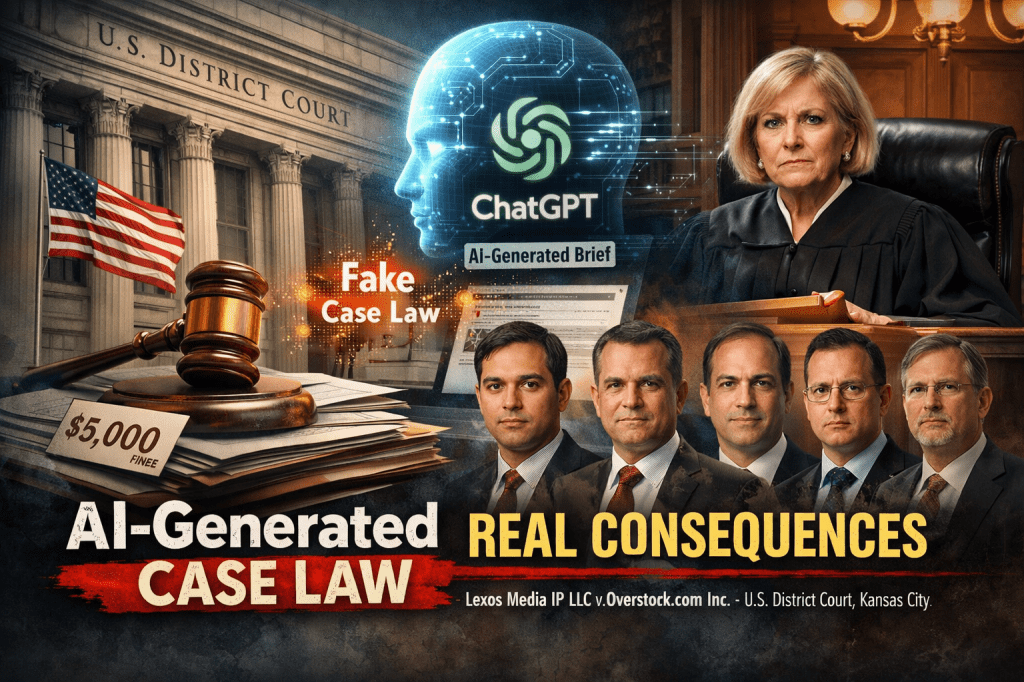
In Lexos Media IP LLC v. Overstock.com Inc., a federal patent infringement case, the court sanctioned multiple attorneys after discovering that a submitted brief contained citations to judicial opinions and quotations that did not exist. The fabricated authorities were generated by an AI tool and were filed as if they were legitimate precedent.
The court imposed monetary sanctions totaling $12,000 and ordered disciplinary reporting, making the ruling one of the clearest federal statements to date that reliance on AI does not diminish an attorney’s ethical and professional obligations.
Case Background
The underlying matter involved a patent dispute brought by Lexos Media IP LLC against Overstock.com Inc. During motion practice, counsel for the plaintiff submitted a brief that cited purported federal cases in support of its arguments. When the court attempted to review those authorities, it found that several of the cited cases were entirely fictitious.
The issue came to light not through opposing counsel, but through the court’s own review—underscoring the severity of the lapse.
The Sanctions Order
Senior U.S. District Judge Julie Robinson held that while one attorney acknowledged using AI to draft portions of the brief, responsibility extended to every lawyer who signed and filed the document.
The court sanctioned:
- Sandeep Seth, who used generative AI in drafting, fining him $5,000 and requiring him to report the ruling to Texas disciplinary authorities.
- Kenneth Kula and Christopher Joe, each fined $3,000 for submitting the brief without verifying the cited authority.
- Michael Doell and David Cooper, with Cooper sanctioned for failing to conduct independent review as local counsel.
Judge Robinson emphasized that Rule 11 obligations and basic duties of candor to the tribunal apply regardless of the tools used to draft a filing. AI assistance, the court noted, does not excuse failure to confirm the accuracy of legal authority.
Legal and Ethical Implications
This ruling reinforces several core principles of American legal practice:
- Non-delegable responsibility
Attorneys may delegate drafting tasks, but they cannot delegate responsibility. Signing a filing certifies that its contents have been reasonably investigated and are grounded in fact and law. - Technology neutrality in ethics
Courts are not hostile to legal technology. However, ethical duties are tool-agnostic. Whether a brief is written by a junior associate, a paralegal, or an algorithm, the lawyer of record remains accountable. - Judicial efficiency and institutional trust
Fabricated authority burdens courts, undermines confidence in filings, and threatens the reliability of adversarial proceedings.
Why This Matters for Family and Civil Courts
Although Lexos Media arose in a commercial patent dispute, its implications extend well beyond intellectual property litigation.
Family courts and high-volume civil dockets already struggle with asymmetry: one party often represented by counsel, the other self-represented; one side fluent in procedural norms, the other learning them under pressure. In these settings, courts rely heavily on the assumption that licensed attorneys are providing verified legal authority.
When that assumption fails, the consequences are not merely academic. In family court, outcomes shaped by unverified or erroneous legal arguments can affect custody, visitation, protective orders, and parental rights—often with limited avenues for correction.
At the same time, self-represented litigants routinely face sanctions, dismissals, or adverse inferences for comparatively minor procedural defects. The contrast underscores the importance of consistent accountability standards across the system.
A Broader Regulatory Question
The decision in Lexos Media adds to a growing body of case law signaling that courts expect proactive safeguards when AI tools are used in legal practice. What remains unresolved is whether courts or bar authorities will move toward:
- Mandatory disclosure of AI use in filings
- Certification requirements for citation verification
- Formal rules governing generative AI in court submissions
Absent such guidance, enforcement will continue to occur on a case-by-case basis, often only after harm or inefficiency has already occurred.
Conclusion
The sanctions in Lexos Media IP LLC v. Overstock.com Inc. do not represent judicial hostility toward innovation. They represent a reaffirmation of first principles: accuracy, candor, and accountability are foundational to due process.
As courts, attorneys, and litigants navigate the integration of AI into legal practice, this case serves as a clear reminder that technology may assist advocacy—but it cannot replace professional judgment, nor excuse its absence.
For a justice system already under strain, maintaining those boundaries is not optional. It is essential.
 The People's Law Review