
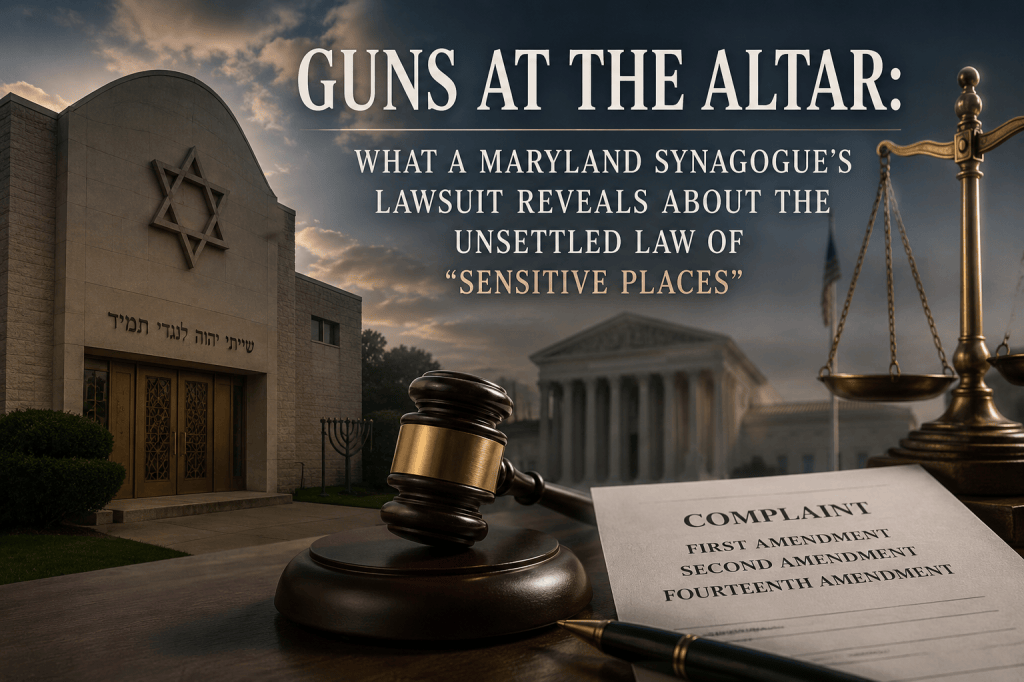
A federal lawsuit filed this week by a Silver Spring synagogue looks, at first glance, like a straightforward Second Amendment case. It isn’t. It’s the latest entry in a doctrinal fight that New York’s courts have already fought — and split on — and it turns on a Supreme Court private-property ruling that may not do the work the plaintiffs need it to do.
By Michael Phillips | The People’s Law Review
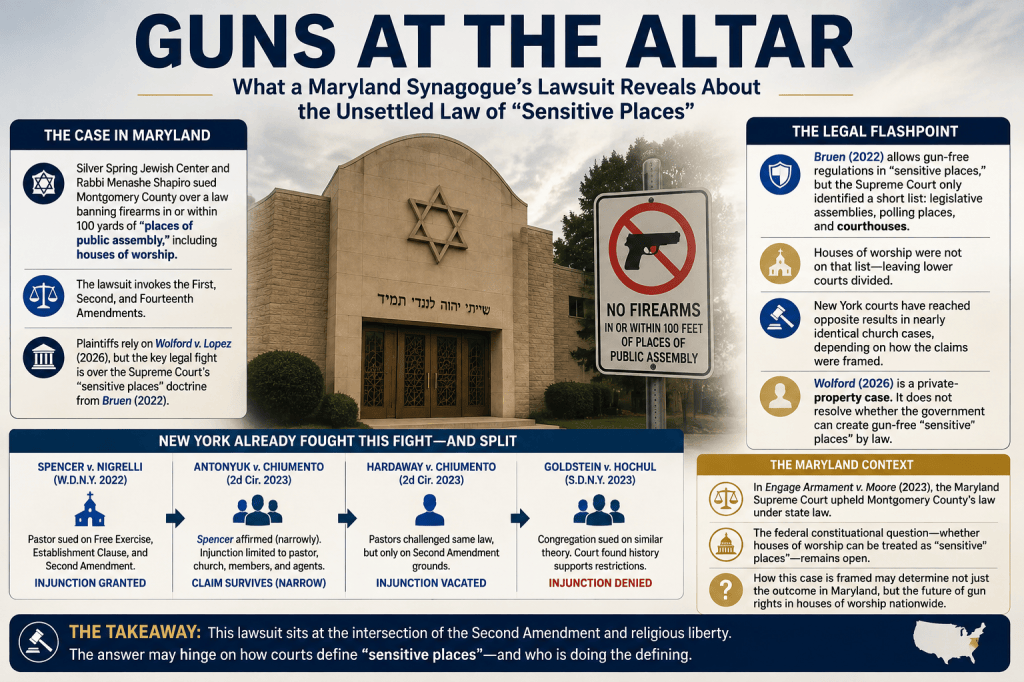
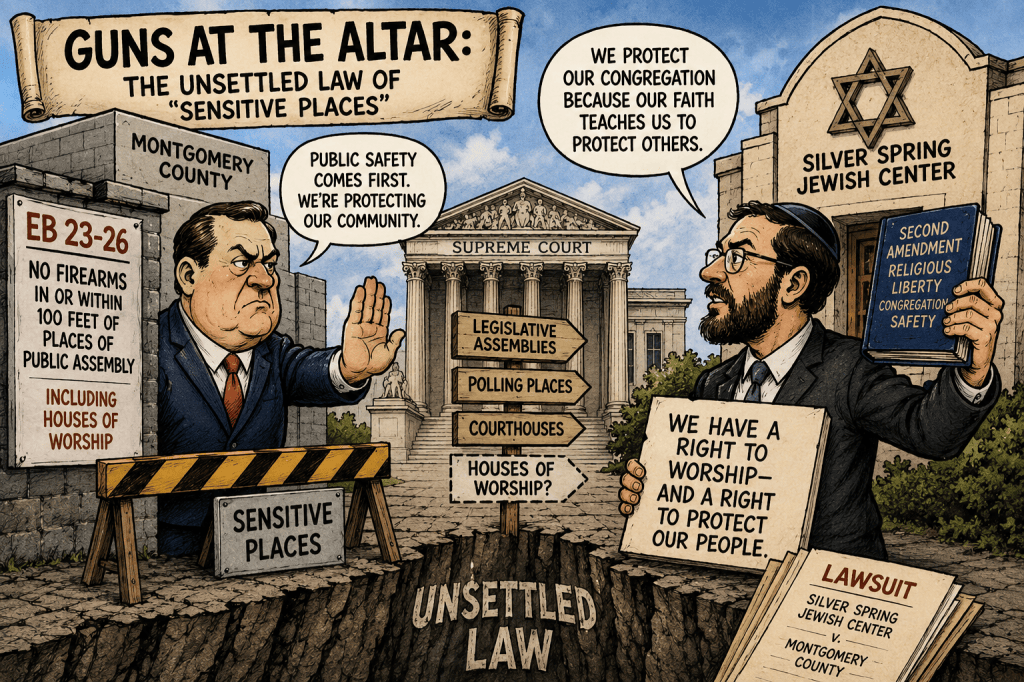
The Silver Spring Jewish Center and Rabbi Menashe Shapiro, represented by the New Civil Liberties Alliance, sued Montgomery County this week over Expedited Bill 23-26, which bars carrying firearms in or within 100 yards of “places of public assembly” — a list that includes houses of worship. The complaint invokes the First, Second, and Fourteenth Amendments, and leans heavily on Wolford v. Lopez, the Supreme Court’s June 25, 2026 decision reversing a Ninth Circuit ruling that had upheld Hawaii’s default rule barring concealed carry on private property absent the owner’s express consent.
The lawsuit is being covered as a story about a synagogue defending itself against antisemitic violence, and on the facts, it is that. But underneath the news story is a genuinely unsettled question of constitutional doctrine: what, exactly, makes a place “sensitive” enough that the government can disarm people inside it — and does that analysis change when the place is also where people go to exercise their religion? Courts have been fighting over that question since Bruen, and the fight has produced a real split that the Silver Spring case walks straight into.
This isn’t just another Second Amendment lawsuit. It’s a test of where religious liberty and the Supreme Court’s ‘sensitive places’ doctrine collide.
Where “Sensitive Places” Comes From
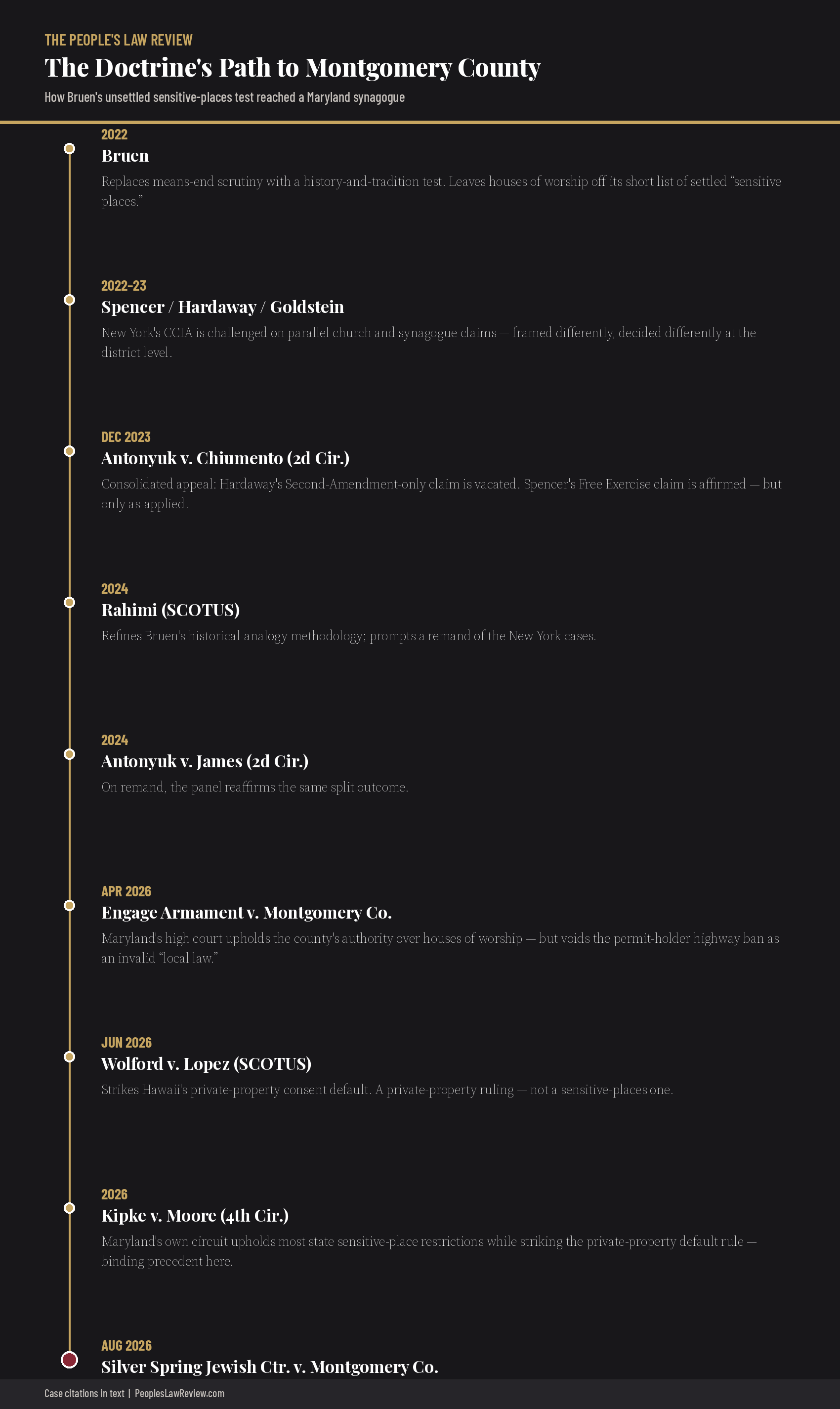
The doctrine traces to New York State Rifle & Pistol Association v. Bruen, 597 U.S. 1 (2022), which replaced means-end scrutiny with a history-and-tradition test: a modern gun regulation is constitutional only if it is consistent with the nation’s historical tradition of firearms regulation. Bruen carved out an exception for “sensitive places,” but the carve-out was narrower than most observers expected. The Court found firm historical grounding only for a short list — legislative assemblies, polling places, and courthouses — and explicitly rejected New York’s attempt to define “sensitive places” as anywhere crowded and generally policed. As the Court put it, there was no historical basis to treat all of Manhattan as a sensitive place merely because it was dense and patrolled by the NYPD.
Houses of worship were not on Bruen‘s short list. New York had proposed including them, alongside courthouses, airports, subways, and sports arenas, in its list of “sensitive” settings — but the Court didn’t rule on that proposal, leaving lower courts to work out on their own whether the historical tradition extends that far.
Bruen recognized ‘sensitive places’—but it never said houses of worship were one of them.
That’s exactly what happened next, in litigation that maps almost precisely onto the Maryland case now unfolding.
New York Already Fought This Fight — and Split
New York’s Concealed Carry Improvement Act (CCIA), passed immediately after Bruen, restricted carry in a long list of locations, including houses of worship. Multiple lawsuits followed, and the results diverged sharply depending on how the claim was framed.
The same court reached different outcomes because the claims were framed differently—not because the facts were.
In Spencer v. Nigrelli, 648 F. Supp. 3d 451 (W.D.N.Y. 2022), a Buffalo pastor and his congregation challenged the place-of-worship provision not primarily as a Second Amendment claim, but as a Free Exercise and Establishment Clause claim: the law, they argued, interfered with the pastor’s religious duty to protect his congregation by carrying a firearm and inviting armed congregants to do the same. The district court agreed and enjoined the provision on all three grounds — Free Exercise, Establishment Clause, and Second Amendment.
The Second Circuit’s resolution, in the consolidated appeal Antonyuk v. Chiumento, 89 F.4th 271 (2d Cir. 2023), makes the framing question unusually easy to isolate, because the same 261-page opinion decided two nearly identical church claims differently based on exactly that distinction. Hardaway v. Chiumento was brought by two pastors, in Niagara Falls and Buffalo, challenging the same place-of-worship provision — but only on Second Amendment grounds. They lost: the panel’s own summary vacates their injunction outright. Spencer, decided in the same opinion, added Free Exercise and Establishment Clause claims to the Second Amendment claim, built on Pastor Michael Spencer’s testimony about his religious duty to protect his congregation. That claim survived — the panel credited the argument that “a faith organization has a cognizable interest in eliminating barriers to its religious practice, including when the barriers primarily impact its adherents’ conduct,” Antonyuk, 89 F.4th at 157 — but even the Spencer win was narrow: the court’s summary confines the surviving injunction to “Pastor Spencer, the Tabernacle Family Church, its members, or their agents and licensees,” not a facial invalidation of the provision for everyone. On remand after Rahimi, the Second Circuit reaffirmed that same result in Antonyuk v. James, 120 F.4th 941 (2d Cir. 2024).
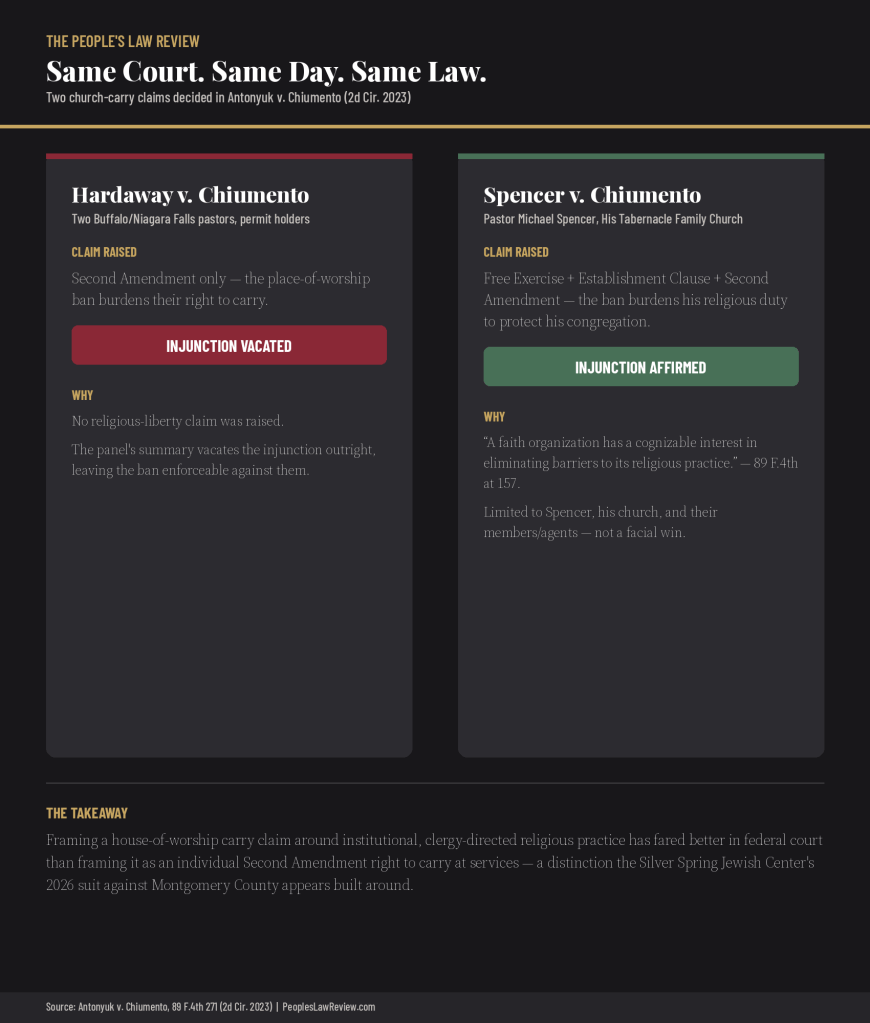
But a nearly identical claim, framed differently, lost. In Goldstein v. Hochul, 680 F. Supp. 3d 370 (S.D.N.Y. 2023), plaintiffs Meir Ornstein and Steven Goldstein, individually and on behalf of Congregation Bnei Matisyahu, sued on essentially the same theory — that the place-of-worship ban stripped congregants of the ability to defend themselves during services. Judge Vernon Broderick of the Southern District of New York denied a preliminary injunction on June 28, 2023, applying Bruen‘s historical-tradition test directly to the Second Amendment claim and finding the state’s restriction likely consistent with a historical tradition of regulating gatherings in crowded settings. One detail from Goldstein is worth underlining given what’s happening in Maryland: New York had already amended the CCIA, effective May 2023, to add an exception for “those persons responsible for security” at a place of worship — the same paid/volunteer distinction Montgomery County’s ordinance now draws.
Read together, Spencer/Antonyuk and Goldstein suggest something courts haven’t said outright but have functionally done: a claim framed around a congregation’s collective, clergy-led decision to organize religious self-defense — argued as Free Exercise — has fared better than a claim framed around an individual permit holder’s Second Amendment right to carry at services. The Silver Spring Jewish Center’s complaint is clearly aware of this; it invokes all three amendments together, and its factual narrative — an organized, clergy-blessed volunteer security team formed for a specific religious community after a specific triggering event — reads much closer to Spencer than to Goldstein.
What Wolford v. Lopez Actually Held — and Why It May Not Reach This Case
Wolford answered a private-property question—not a sensitive-places question.
The synagogue’s complaint leans on Wolford v. Lopez for the proposition that a private property owner’s decision to authorize carry on its own premises should override a government restriction. But Wolford was not a sensitive-places case. It arose from Hawaii’s law establishing a default rule that private property was closed to concealed carry unless the owner affirmatively posted consent — the mirror image of an opt-out regime. The Ninth Circuit case, 116 F.4th 959 (9th Cir. 2024), and the Supreme Court’s subsequent 6-3 decision reversing it — the principal opinion, joined in full by only four Justices as to one section, written by Justice Alito, Wolford v. Lopez, 609 U.S. ___, No. 24-1046 (June 25, 2026) — addressed whether a state can flip the historical default rule governing carry on private property generally. It did not involve, and does not squarely answer, whether a government can designate a category of location — a house of worship, a school, a courthouse — as categorically off-limits regardless of what the property owner wants.
That distinction matters doctrinally. A “sensitive place” restriction and a “private property default rule” are two different regulatory tools that happen to produce a similar practical result — no guns without permission — but rest on different constitutional footing. Wolford says the government cannot presume property owners want guns excluded from their own property; it says nothing about whether the government can override what a property owner wants once it has independently designated that property type as sensitive. The Silver Spring Jewish Center is, in effect, asking a federal court to treat Wolford‘s private-property-default holding as if it also constrained the state’s sensitive-places power — an extension the Supreme Court did not make and that no circuit has yet endorsed. That doesn’t mean the argument fails; sensitive-places doctrine is genuinely unsettled enough that a district court could be persuaded. But it means the case’s strongest path likely runs through the Free Exercise theory that worked in Spencer and Antonyuk, not through stretching Wolford past its facts.
The State-Law Wrinkle Maryland Adds — and a Fourth Circuit Case That Actually Governs
There’s a layer to the Maryland case that didn’t exist in the New York litigation, and it’s more specific than most coverage has captured. Bill 23-26 followed the Maryland Supreme Court’s April 28, 2026 decision in Engage Armament LLC v. Montgomery County, No. 9, Sept. Term 2025 (Md. Apr. 28, 2026) — but that opinion did not strike down the county’s authority to restrict carry near houses of worship. It upheld it. The Court held that places of worship, along with parks, schools, libraries, courthouses, legislative assemblies, and several other categories, are valid “places of public assembly” that a charter county may regulate under Criminal Law § 4-209(b)(1)(iii). It struck down only the county’s newer additions to that list — hospitals, childcare facilities, broadly-defined government buildings, and undefined “gatherings” — as exceeding the scope of what state law authorizes.
Montgomery County already won the state-law fight over regulating houses of worship. The federal constitutional fight is only beginning.
The provision that actually doomed the prior ordinance was a distinct one, resting on a different constitutional doctrine entirely. By removing the exception for state-issued wear-and-carry permit holders, the county had effectively banned carry on public highways anywhere they pass within 100 yards of a place of public assembly — sweeping in drivers from Prince George’s, Frederick, Howard, and Carroll Counties, and from Virginia and D.C., merely passing through on I-495, I-270, US-29, or MD-97. The Court held that reach made the provision not a valid “local law” under Article XI-A of Maryland’s Home Rule Amendment — a distinctly state-constitutional defect, independent of preemption, that a charter county has no power to cure by asserting a stronger state interest. Bill 23-26 restored an exception structure (paid security, among other categories) in response to that specific holding, not to a ruling that houses of worship couldn’t be regulated at all.
That background doesn’t immunize the ordinance from the synagogue’s federal constitutional challenge — a law’s motive and procedural history don’t change its effect on the people it burdens — but it does mean Montgomery County goes into this litigation having already won the underlying state-law fight over whether it can restrict carry at houses of worship at all. The remanded case isn’t closed, either: Montgomery County Circuit Court holds a status conference on August 12, 2026, where the county is expected to argue that its amended ordinance — including a narrow highway-travel exemption for permit holders and a fix to the ghost-gun serialization gap the Supreme Court identified — satisfies the mandate. Expect the county’s defense in the federal case to lean on Goldstein-style historical-tradition arguments, paired with the point that its own top court already validated the “place of public assembly” designation for houses of worship specifically.
There’s also a binding precedent hanging over this litigation that the Silver Spring case will have to contend with directly: Kipke v. Moore, 165 F.4th 194 (4th Cir. 2026), decided by the Fourth Circuit — Maryland’s own circuit, unlike the persuasive-only Second Circuit precedent discussed above. Kipke upheld Maryland’s separate state-level sensitive-places statute, Criminal Law § 4-111, as applied to government buildings, state parks, museums, healthcare facilities, and several other categories, while striking down the state’s private-property-consent default rule as unconstitutional. Kipke didn’t address houses of worship specifically — § 4-111 doesn’t include them, since counties retain that authority under § 4-209(b)(1)(iii) instead — but it signals how the Fourth Circuit approaches Bruen‘s history-and-tradition test for sensitive-places claims generally, and any Free Exercise argument in the Silver Spring case will have to be squared with a circuit that has already shown a willingness to uphold most locational restrictions on the merits.
How a congregation frames its claim may matter as much as the constitutional right it invokes.
Why This Matters Past Maryland
The Silver Spring lawsuit may ultimately decide whether religious self-defense receives greater constitutional protection than individual self-defense inside a house of worship.
The Silver Spring case is unlikely to be resolved quickly, and it’s very unlikely to be the last word — the underlying doctrinal question, whether Free Exercise claims can succeed against sensitive-places restrictions where standalone Second Amendment claims fail, is exactly the kind of circuit split Bruen invited and hasn’t yet produced a clean answer to. The DOJ’s public warning letter signals the federal government may litigate this directly rather than wait for a private plaintiff to do it, which could accelerate a circuit-level resolution.
What’s clear from the New York experience is that how a house-of-worship carry claim is framed may matter as much as the underlying facts. A congregation that presents its security posture as an institutional, clergy-directed exercise of religious practice has a real precedent behind it. A congregant asserting an individual right to carry at services, standing alone, does not — at least not yet. The Silver Spring Jewish Center’s lawyers appear to understand that distinction. Whether a federal court in Maryland will find it as persuasive as the Second Circuit did is the real question this case is going to answer.
Case citations: New York State Rifle & Pistol Ass’n v. Bruen, 597 U.S. 1 (2022); Hardaway v. Nigrelli, 639 F. Supp. 3d 422 (W.D.N.Y. 2022); Spencer v. Nigrelli, 648 F. Supp. 3d 451 (W.D.N.Y. 2022); Antonyuk v. Chiumento, 89 F.4th 271 (2d Cir. 2023); Antonyuk v. James, 120 F.4th 941 (2d Cir. 2024); Goldstein v. Hochul, 680 F. Supp. 3d 370 (S.D.N.Y. 2023) (No. 1:22-cv-08300); Wolford v. Lopez, 116 F.4th 959 (9th Cir. 2024), rev’d, 609 U.S. ___, No. 24-1046 (U.S. June 25, 2026); Kipke v. Moore, 165 F.4th 194 (4th Cir. 2026); Engage Armament LLC v. Montgomery County, No. 9, Sept. Term 2025 (Md. Apr. 28, 2026).

