
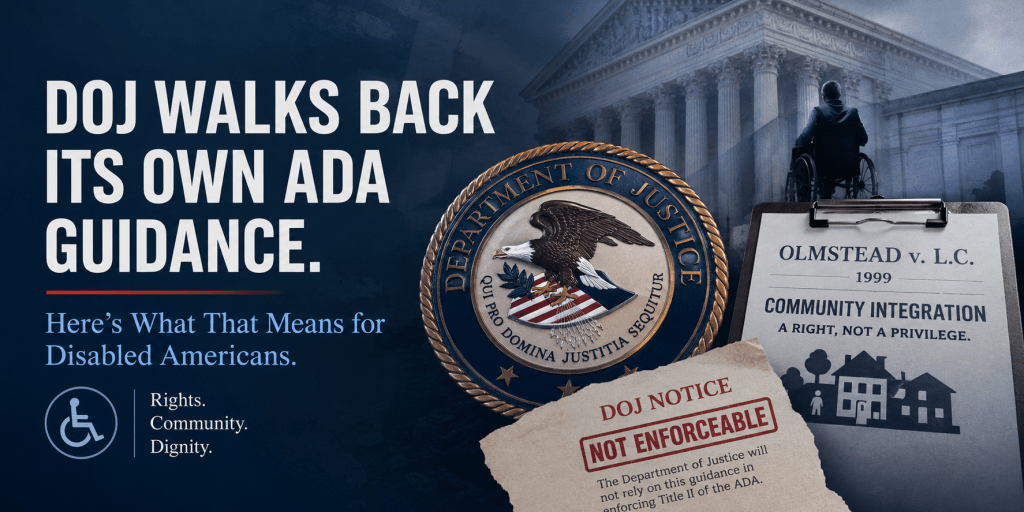
How a one-page “clarification” notice could unravel a promise, dating back to a 1999 Supreme Court ruling, that people with disabilities have the right to live in their own communities — not institutions.
By Michael Phillips | The People’s Law Review
On July 20, the U.S. Department of Justice published a notice in the Federal Register — dated July 13 and quietly moved through the pipeline in the week before — that could reshape how, or whether, one of the most consequential disability rights rulings in American history gets enforced.
The notice, signed by Assistant Attorney General for Civil Rights Harmeet Dhillon, declares that DOJ’s long-standing guidance interpreting Olmstead v. L.C. — the 1999 Supreme Court decision requiring states to serve people with disabilities in community settings whenever appropriate, rather than warehousing them in institutions — is “not enforceable.” Going forward, the department says it won’t rely on that guidance when deciding how to enforce Title II of the Americans with Disabilities Act.
If you’ve never heard of the Olmstead guidance, you’re not alone. But if you or someone you love has ever fought a state agency to get home-based care instead of a nursing facility, or pushed a school district for community-based services instead of a segregated placement, this document has probably shaped your case whether you knew it or not.
DOJ’s long-standing guidance interpreting Olmstead v. L.C. is ‘not enforceable.’ Going forward, the department says it won’t rely on that guidance when deciding how to enforce Title II of the Americans with Disabilities Act.
What Olmstead Actually Guaranteed
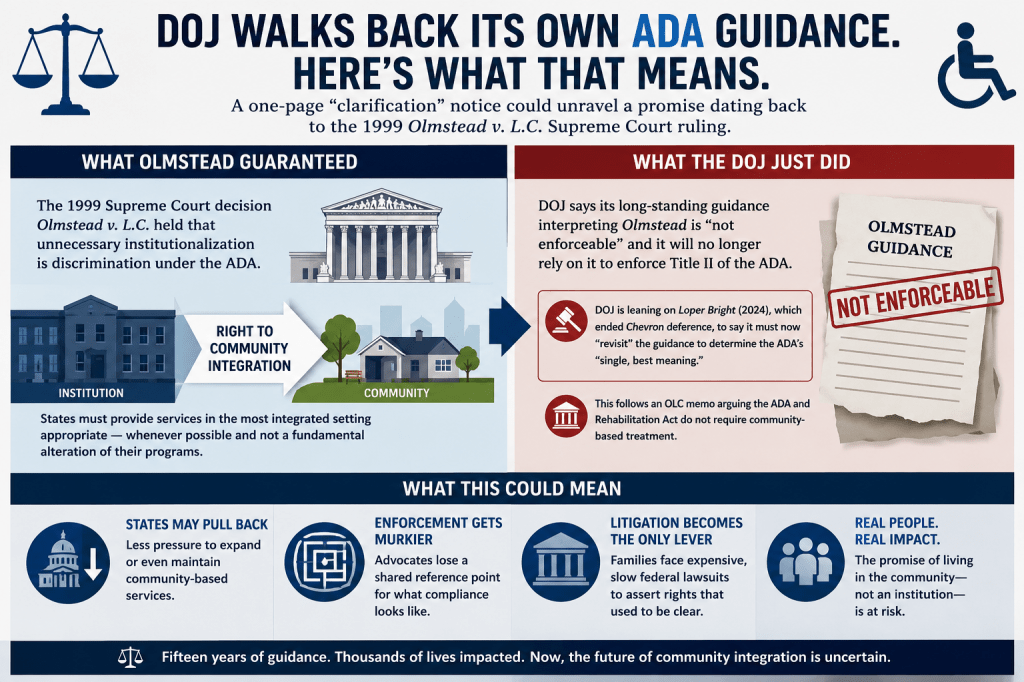
In Olmstead v. L.C., the Supreme Court held that unnecessary institutionalization of people with disabilities is a form of discrimination under the ADA. States are required to provide services in the “most integrated setting appropriate” — meaning community-based care — so long as it’s not a fundamental alteration of the state’s programs and the person doesn’t oppose it.
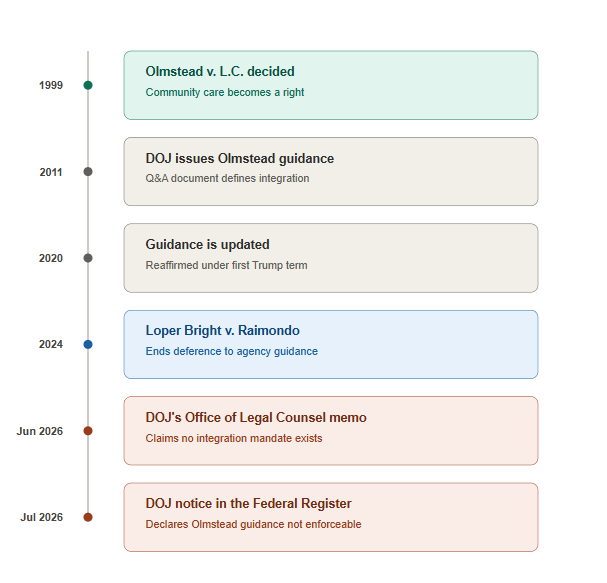
That ruling was a landmark. But rulings don’t enforce themselves. For 15 years, a 2011 DOJ Q&A document (updated again in 2020, notably under the first Trump administration) has served as the field manual: what counts as an “integrated setting,” who qualifies for community services, how states are supposed to comply. Courts across the country have leaned on it. States have built policy around it. Advocates have used it to negotiate settlements and win cases.
That ruling was a landmark. But rulings don’t enforce themselves.
That’s the document DOJ just disavowed.
Two moves, one direction. Neither has the force of law on its own. Both are aimed at the same target.
The Legal Sleight of Hand
Here’s the part worth paying close attention to, because it’s a pattern likely to repeat across other civil rights guidance in the months ahead.
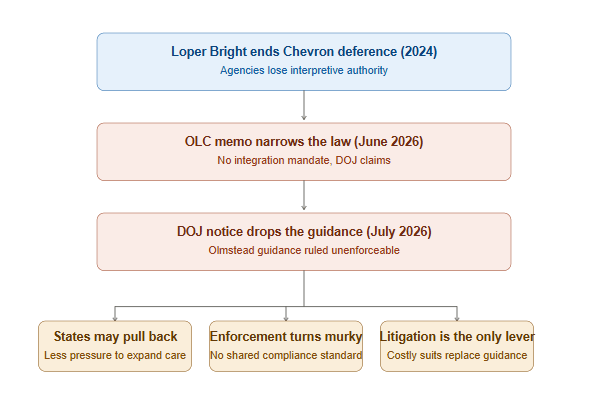
DOJ isn’t claiming the guidance was wrong on the law, exactly. It’s leaning on Loper Bright Enterprises v. Raimondo — the 2024 Supreme Court decision that ended Chevron deference and instructed courts to stop giving weight to how federal agencies interpret their own statutes. (Readers of this publication may recall our earlier coverage of how Loper Bright reshaped administrative power more broadly.) DOJ says it now needs to “revisit” the Olmstead guidance to determine whether it reflects the “single, best meaning” of the ADA — Loper Bright’s new standard.
A ruling aimed at reining in unelected agency overreach is now being used to strip away a tool that helped enforce a Supreme Court civil rights decision.
In plain terms: a ruling aimed at reining in unelected agency overreach is now being used to strip away a tool that helped enforce a Supreme Court civil rights decision. The guidance document itself always said it wasn’t legally binding — that’s not new. What’s new is DOJ actively telling the country not to rely on it anymore, one month after its Office of Legal Counsel issued a separate memo arguing that neither the ADA nor the Rehabilitation Act actually requires community-based treatment at all.
Two moves, one direction. Neither has the force of law on its own. Both are aimed at the same target.
Why “Not Legally Binding” Doesn’t Mean “Doesn’t Matter”
It’s tempting to read this as bureaucratic housekeeping — DOJ clarifying that a Q&A page was never technically a regulation. But guidance documents matter enormously in practice, especially for people without lawyers on retainer.
Disability rights attorneys and advocates say the real-world effect will be felt long before any court weighs in on whether DOJ’s new position is legally sound:
‘Not legally binding’ doesn’t mean ‘doesn’t matter.’
- States may pull back. If DOJ signals it won’t lean on the Olmstead framework, state Medicaid agencies and disability service systems have less pressure to expand — or even maintain — community-based options.
- Enforcement gets murkier. Advocates who’ve used the guidance to negotiate settlements or file complaints lose a shared reference point for what compliance looks like.
- Litigation becomes the only lever. Without administrative guidance to point to, families are pushed toward expensive, slow federal lawsuits to establish rights that used to be spelled out on a government webpage.
Without administrative guidance to point to, families are pushed toward expensive, slow federal lawsuits to establish rights that used to be spelled out on a government webpage.
Alison Barkoff, the George Washington University professor who oversaw the guidance’s development while serving as DOJ’s special counsel for Olmstead enforcement, put it directly: the guidance reflects decades of consistent judicial interpretation, and DOJ’s retreat is further evidence of the department stepping back from its historic commitment to enforcing integration rights.
Regan Rush, a former chief of DOJ’s Civil Rights Division special litigation section, offered a warning to states tempted to follow DOJ’s lead: courts have upheld the Olmstead framework for decades, and states that abandon their integration efforts now may still have to answer for it in court later — DOJ’s change of heart doesn’t rewrite what the case law says.
The Pattern to Watch
This is not an isolated event. It follows a now-familiar sequence: an OLC memo narrows the administration’s official reading of a civil rights law, followed by a formal notice disclaiming the guidance that operationalized the old reading — all wrapped in the technically-accurate language of a post-Loper Bright legal correction.
For readers tracking court reform and administrative power, the through-line matters: Loper Bright was framed as a win for accountability and against unchecked bureaucracy. Here, it’s being used as the legal cover for an agency to strip protections it once helped build — with no new regulation, no notice-and-comment process, and no vote from Congress.
Loper Bright was framed as a win for accountability and against unchecked bureaucracy. Here, it’s being used as the legal cover for an agency to strip protections it once helped build.
What to watch next: whether states begin visibly rolling back community-based service commitments, whether disability rights groups sue to challenge the OLC memo’s underlying legal theory, and whether courts — which have applied the Olmstead framework consistently since the 1999 ruling — treat DOJ’s about-face as persuasive or irrelevant to how they read the statute themselves.
Sources: This article draws on the Department of Justice’s official notice, Clarification on Department of Justice Guidance Titled “Statement of the Department of Justice on Enforcement of the Integration Mandate of Title II of the Americans with Disabilities Act and Olmstead v. L.C.”, published in the Federal Register on July 20, 2026 (dated July 13, 2026, and signed by Assistant Attorney General Harmeet K. Dhillon); reporting from Michelle Diament at Disability Scoop, Justice Department Deems Major ADA Guidance “Not Enforceable” (July 20, 2026), which includes on-record statements from Alison Barkoff (George Washington University, former DOJ special counsel for Olmstead enforcement) and Regan Rush (Democracy Forward, former chief of DOJ’s Civil Rights Division special litigation section); and the underlying case law, Olmstead v. L.C., 527 U.S. 581 (1999), and Loper Bright Enterprises v. Raimondo, 603 U.S. 369 (2024).
 The People's Law Review