
By Michael Phillips | People’s Law Review
Congress moved fast after September 11, 2001. The Authorization for Use of Military Force passed within a week. The USA PATRIOT Act followed six weeks later, expanding surveillance and detention authority after an extraordinarily compressed legislative process with limited debate over the final text, and a built-in expectation that courts would sort out the hard constitutional questions later. Twenty-five years on, they largely have — in fits and starts, through split decisions, and often years after the government conduct being challenged had already ended. The result is not a single clean doctrine but a patchwork: real limits on executive power established in landmark rulings, sitting alongside surveillance authorities that have outlived every legal challenge brought against them and are, as of this writing, in the middle of yet another fight over whether Congress will let them lapse for good.
Detention: Hamdi and the citizen’s day in court
The first major test came from an American citizen. Yaser Hamdi, captured in Afghanistan and held as an “enemy combatant” without charge, argued the government could not detain him indefinitely with no chance to contest the label. The government argued the opposite — that wartime detention decisions were the President’s alone to make.
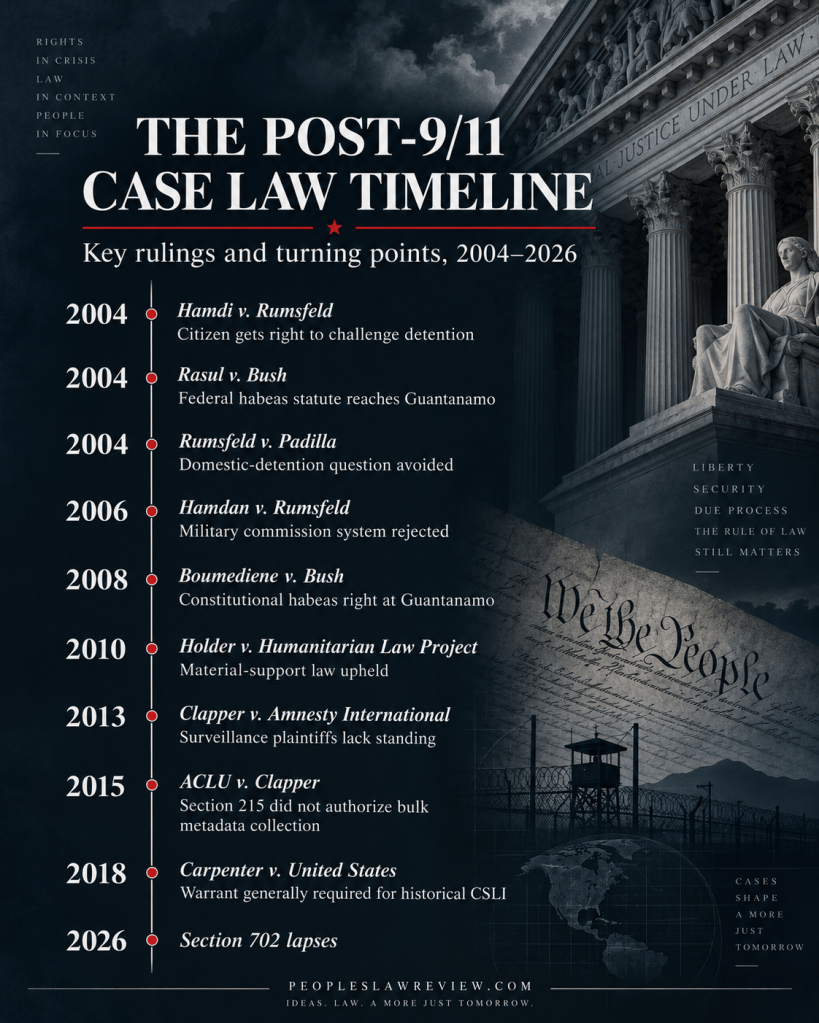
In Hamdi v. Rumsfeld (2004), the Supreme Court split the difference in a way that shaped everything that followed. Justice Sandra Day O’Connor’s plurality opinion agreed that detaining people captured fighting U.S. forces in Afghanistan, for the duration of that conflict, was a legitimate and long-accepted incident of war — but drew a line the administration had denied existed, insisting that a citizen held on that basis still had to get a meaningful opportunity to contest the government’s case before a neutral decision-maker. The often-quoted line from the opinion made the stakes explicit: a state of war is not a blank check for the President where the rights of citizens are concerned. Hamdi didn’t end detention; it required that detention come with a hearing.
The Court had a chance to go further the same day and declined to. Rumsfeld v. Padilla, decided alongside Hamdi, involved a U.S. citizen arrested on American soil — not a foreign battlefield — and held for over three years as an enemy combatant without charge, based on suspected al Qaeda ties. Padilla’s lawyers filed habeas papers in New York, where he’d first been held as a material witness; by the time the case reached the Supreme Court, he’d been moved to a Navy brig in South Carolina. A 5–4 majority dismissed the case on a jurisdictional technicality, ruling that the petition should have been filed in South Carolina against his immediate custodian rather than in New York against the Secretary of Defense, and never reached the underlying question of whether a citizen seized on domestic soil could be held as an enemy combatant at all. The government transferred Padilla into the ordinary criminal system and secured a conviction shortly before the Court could take the merits question up a second time, leaving the central issue Hamdi left open — citizen detention that starts at home rather than on a foreign battlefield — unresolved to this day.
Guantanamo: Rasul, Hamdan, and the long road to Boumediene
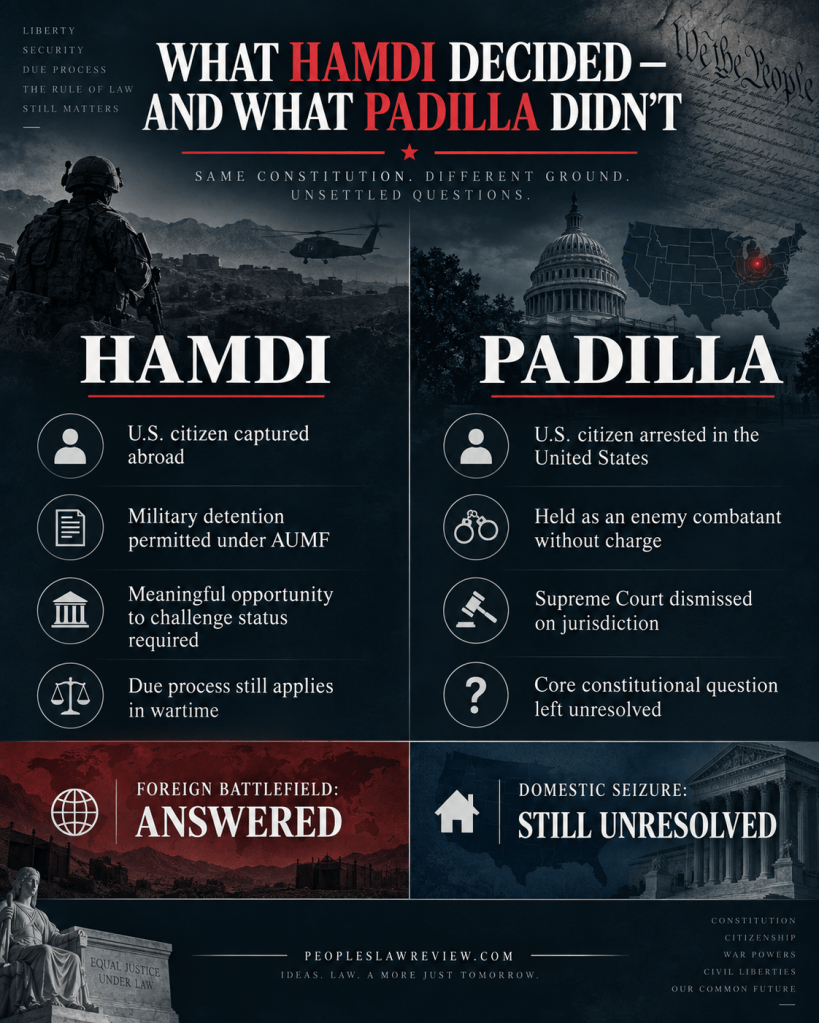
The citizenship question in Hamdi left open a bigger one: what about foreign nationals held outside the United States entirely? Guantanamo Bay had been chosen partly because the administration believed it sat outside the reach of federal courts. Rasul v. Bush (2004) rejected that premise on statutory grounds, holding that the general habeas statute extended to the base. Congress and the administration spent the next several years trying to legislate around that ruling — first through the Detainee Treatment Act of 2005, which sought to strip federal-court habeas jurisdiction over Guantanamo cases, and then, after Hamdan v. Rumsfeld (2006) held that the DTA’s jurisdiction-stripping provision did not apply to cases already pending and that the military commissions set up to try detainees violated the Geneva Conventions and exceeded the President’s authority, through the Military Commissions Act of 2006, which tried again to close the courthouse door.
That set up Boumediene v. Bush (2008), the case that finally settled the question the government had been trying to avoid since Rasul. In a 5–4 decision, the Court held that foreign nationals detained at Guantanamo have a constitutional — not merely statutory — right to habeas corpus, and that Congress cannot strip that right without formally suspending it under the Suspension Clause, something it had not done. Justice Anthony Kennedy’s majority opinion rejected the idea that the political branches could simply legislate their way out of judicial review by choosing where to hold someone: the Constitution’s guarantees do not turn on and off depending on where the government decides to put a prisoner. Boumediene remains the high-water mark of judicial pushback against the post-9/11 detention architecture — and, notably, a ruling about foreign nationals with no visa or citizenship claim to the U.S. at all.
But Boumediene‘s practical force didn’t survive contact with the D.C. Circuit, the one appeals court with jurisdiction over every Guantanamo habeas case. The Supreme Court had established the right to a hearing but left the details of how those hearings should work to the district courts, which went on to grant habeas relief to detainees in a majority of early cases — one count of the first 34 post-Boumediene decisions found detainees prevailing 56% of the time. But the D.C. Circuit’s own record tells a narrower story than a simple win-loss tally suggests: in every merits case it decided in which a district court had granted a detainee’s petition, the Circuit either reversed the grant outright or remanded it for further proceedings under a more government-favorable standard. It never once affirmed a district court’s grant of habeas relief to a Guantanamo detainee. Some district-court wins were never appealed at all — the government instead negotiated the detainee’s transfer on its own timeline rather than risk a losing appeal — but no detainee’s release has ever been the confirmed result of a habeas grant that survived full appellate review. By 2011, detainees’ own lawyers were advising some clients to abandon pending appeals as lost causes once the Supreme Court repeatedly declined to review the D.C. Circuit’s narrowing decisions, and one former federal judge who had ruled on several of these cases put the dynamic bluntly: the D.C. Circuit had been “hostile if not defiant” toward Boumediene, while the Supreme Court had effectively “washed its hands” of enforcing its own ruling. The formal right Boumediene announced was real; the practical remedy it promised proved far narrower than the ruling itself.
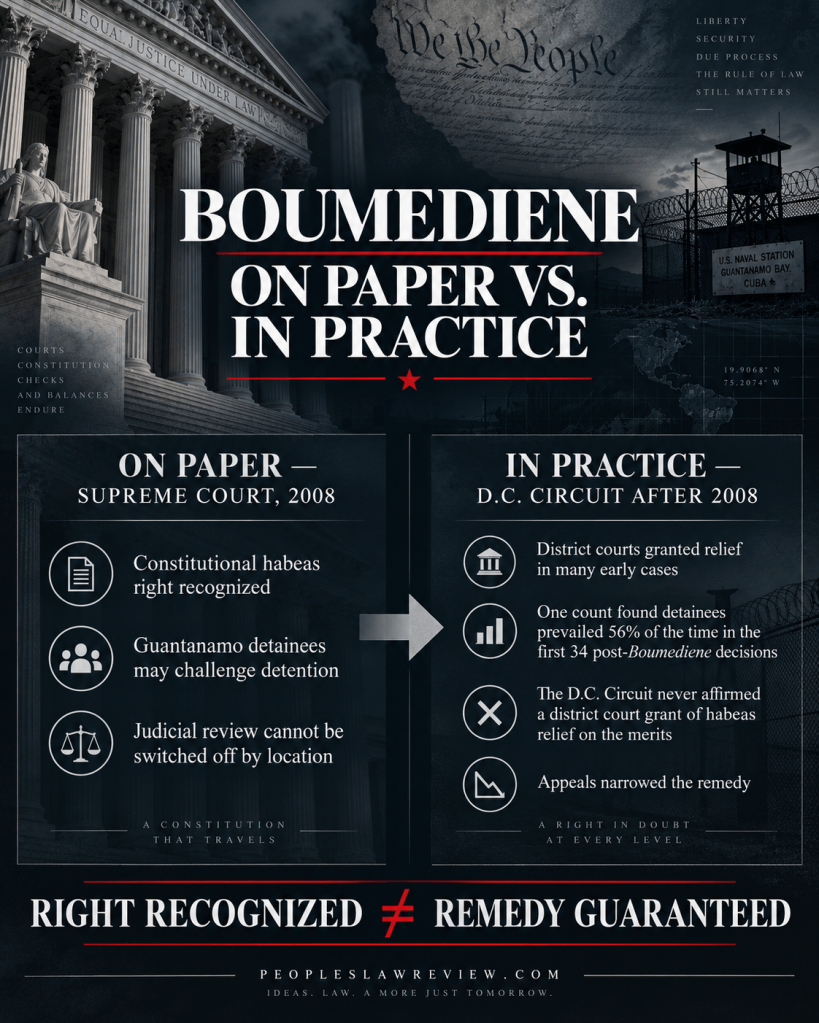
“The formal right Boumediene announced was real; the practical remedy it promised proved far narrower than the ruling itself.”
The PATRIOT Act’s other target: speech, not just detention
Not every PATRIOT Act challenge involved detention or surveillance dragnets. National Security Letters — administrative subpoenas, unreviewed by any judge, demanding records from banks, internet providers, and libraries — had existed since 1986, but Section 505 of the PATRIOT Act dramatically expanded when and how the FBI could issue them, dropping the prior requirement that the target be a suspected foreign agent in favor of a much looser “relevance” standard. NSLs came paired with a nondisclosure requirement that could run indefinitely, barring recipients from revealing they’d received one at all.
That gag provision became the subject of one of the more quietly significant PATRIOT Act rulings. In 2004, a federal judge in Manhattan struck down the NSL statute as unconstitutional in Doe v. Ashcroft, brought by the ACLU on behalf of an anonymous internet service provider; the judge wrote that a right, once extinguished, may be gone for good, and rejected the government’s position that senior officials could silence people simply by invoking national security. The case, later consolidated and renamed Doe v. Mukasey, reached the Second Circuit in 2008, which agreed the gag provision violated the First Amendment as written — it placed the burden on recipients to challenge their own silencing and required courts to defer almost entirely to the FBI’s say-so — while stopping short of striking down NSLs altogether. The court instead rewrote the process going forward, shifting the burden to the government to justify each gag order and guaranteeing recipients meaningful judicial review. A companion Connecticut case, brought by librarians barred from disclosing they’d received an NSL for patron records, became one of the earliest public faces of the PATRIOT Act fight once their gag order was finally lifted. Even after the ruling, individual plaintiffs sometimes stayed silenced for years while litigating the specifics of their own cases — the original Doe plaintiff remained under gag order for more than five years after first challenging it.
The material-support statute, enacted in 1996 and later expanded by the PATRIOT Act to reach “expert advice or assistance,” fared better for the government. In Holder v. Humanitarian Law Project (2010), a 6–3 Supreme Court upheld the law making it a crime to provide even non-violent “material support” — including legal training and advice on using international law to pursue peaceful ends — to a group designated a foreign terrorist organization, rejecting a First Amendment challenge from humanitarian groups that wanted to help Kurdish and Tamil organizations pursue their aims through lawful means. Chief Justice John Roberts’s majority opinion reasoned that even support intended purely for peaceful purposes could free up a terrorist organization’s other resources for violence and lend it legitimacy — a rationale that drew a sharp dissent from Justice Breyer, who argued the government had shown no evidence that the specific advocacy at issue posed any such risk. Where the NSL cases represent one of the few outright PATRIOT Act defeats for the government, Humanitarian Law Project stands as one of its clearest wins, and the two rulings together show a judiciary willing to police the government’s procedures for silencing people more closely than it was willing to police the government’s power to criminalize speech in coordination with a designated group.
Surveillance: two decades of standing problems and one real breakthrough
If detention law produced a real, if narrow, judicial check, surveillance law tells a messier story — one defined less by clear constitutional rulings than by procedural dead ends.
The first warrantless-surveillance program to reach a federal court was the NSA’s post-9/11 program of monitoring calls and emails without judicial authorization, publicly confirmed in 2005. A federal judge in Detroit ruled in 2006 that the program was unconstitutional, rejecting outright the administration’s claim that the President could set aside First and Fourth Amendment limits during wartime and insisting that no inherent presidential power exists outside what the Constitution itself grants. That ruling didn’t survive; it was overturned on appeal for lack of standing, a pattern that would repeat for the next decade.
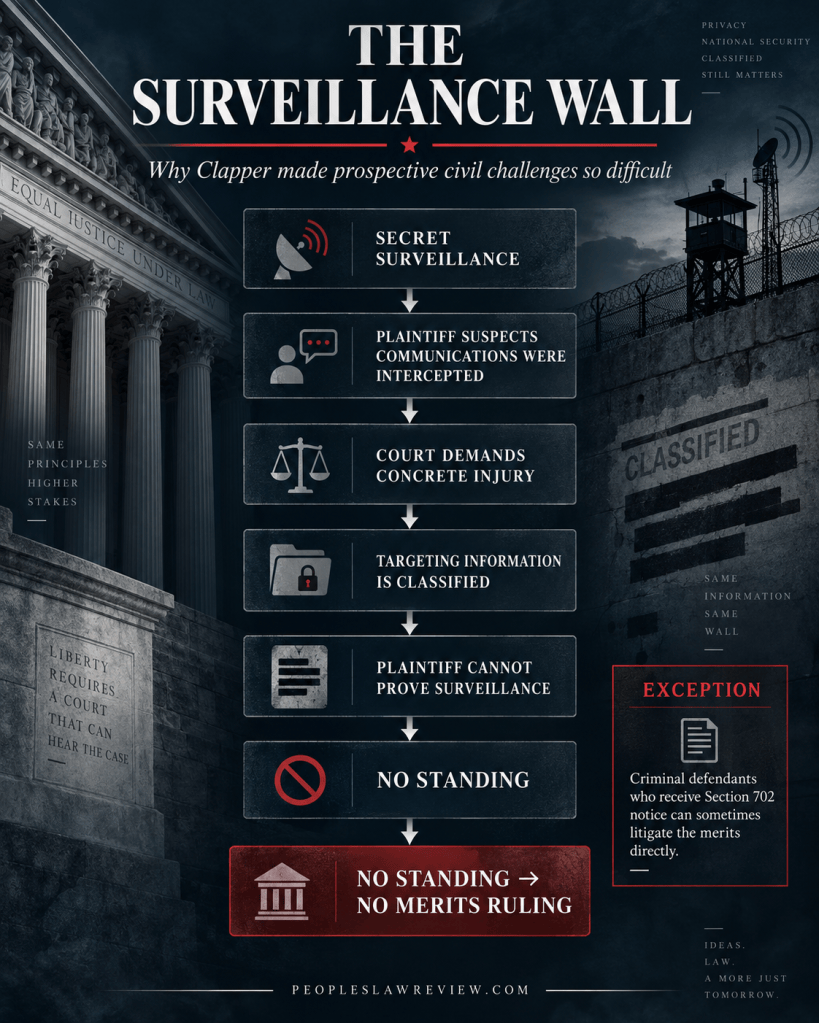
The doctrinal source of that pattern was Clapper v. Amnesty International USA (2013), a case worth naming because it shaped nearly every civil surveillance challenge that followed it. Attorneys, journalists, and human-rights groups who routinely communicated with people abroad likely to be surveillance targets sued to challenge the FISA Amendments Act’s Section 702 program, arguing the mere risk of interception chilled their work and forced them into costly workarounds like traveling to have conversations in person. A 5–4 Supreme Court, in an opinion by Justice Samuel Alito, held that the plaintiffs lacked standing because they couldn’t show their communications had actually been or were certainly about to be intercepted — a “highly attenuated chain of possibilities,” in the Court’s words, rather than a concrete, imminent injury. Justice Breyer’s dissent argued that common sense made the surveillance about as certain as these things get. The practical effect of the majority’s reasoning was to make Section 702 nearly unreviewable in civil suits brought by people trying to challenge the program prospectively: because targeting decisions are classified, almost no plaintiff can prove with the certainty Clapper demanded that they personally were watched, and without that proof, a court won’t hear the underlying constitutional question. The one path around that wall runs through criminal prosecutions, where a defendant who receives notice that Section 702 evidence was used against them can litigate the issue on the merits — as happened in the Ninth Circuit’s 2016 ruling in United States v. Mohamud, which reached the Fourth Amendment question directly and upheld the particular Section 702 acquisition at issue.
“The practical effect of the majority’s reasoning was to make Section 702 nearly unreviewable in civil suits brought by people trying to challenge the program prospectively.”
Edward Snowden’s 2013 disclosures of the NSA’s bulk telephone metadata program reopened the fight anyway, and this time it split the circuits. In Klayman v. Obama, a D.C. federal judge called the bulk collection program “almost Orwellian” and found it likely unconstitutional, only to be reversed on appeal — again on standing grounds, echoing Clapper, not on the merits. The Second Circuit went further in ACLU v. Clapper (2015) — a different case despite the shared name, brought by the ACLU rather than Amnesty International — actually reaching the merits, though on statutory rather than constitutional grounds: the court held that Section 215 of the PATRIOT Act, as written, did not authorize the NSA’s bulk collection of Americans’ phone-call metadata. It was Congress, via the USA Freedom Act passed that same year, that formally ended the bulk phone-records program, not the courts.
“The Second Circuit held that Section 215 of the PATRIOT Act, as written, did not authorize the NSA’s bulk collection of Americans’ phone-call metadata.”
The one unambiguous surveillance win for privacy advocates came from an unexpected source: cellphone tracking, not the PATRIOT Act. In Carpenter v. United States (2018), the Supreme Court held that police need a warrant to obtain historical cell-site location records from a phone carrier, rejecting the government’s argument that people forfeit Fourth Amendment protection over records held by a third party simply by using a phone. Then-Judge Brett Kavanaugh, who as a D.C. Circuit judge had defended the NSA’s bulk metadata program, later told senators during his Supreme Court confirmation hearings that Carpenter was a “game changer” that upended the precedent he’d relied on — testimony that captured, more candidly than most, how far the surveillance-law ground had shifted in less than a decade.
The PATRIOT Act’s own unfinished sunset
The PATRIOT Act was built with sunset clauses from the start, and those clauses — more than any single ruling — have been the real mechanism forcing periodic reassessment of surveillance power. Section 215, the bulk-collection authority, formally lapsed in 2020 after reform efforts stalled and was never revived in its original form. Section 702 of the separate FISA Amendments Act, which allows warrantless collection of foreign communications that inevitably sweep in Americans’ data, has followed its own version of the same cycle: reauthorized roughly every five to six years since its 2008 enactment — in 2012, 2018, and 2024 — with short-term patches clustering in the final weeks before each sunset date as Congress works out last-minute disputes over reform provisions.
That cycle is playing out again this year. Congress reauthorized Section 702 in April 2024 through 2026, but this spring’s renewal fight collapsed under disputes over reform amendments; after a series of short-term patches, the House failed to extend the authority and Section 702 formally lapsed on June 12, 2026 — the first time it has been allowed to expire since its creation. In practice, the lapse changed less than the headlines suggested: surveillance may continue under the existing annual Foreign Intelligence Surveillance Court certification, approved in March 2026 and good through March 2027, meaning the government’s collection authority runs largely uninterrupted even without the underlying statute on the books. Several competing reauthorization-with-reform bills remain pending, and whether Congress restores Title VII of FISA before that certification runs out next year is still an open question.
What a quarter-century of rulings adds up to
Read together, the case law of the last twenty-five years doesn’t describe a judiciary that reined in the post-9/11 security state so much as one that drew boundaries around its most extreme applications while leaving its core architecture largely intact — and even those boundaries proved narrower in practice than they looked on paper. Hamdi and Boumediene established that wartime detention has to answer to some form of judicial process, a real check won against a government that argued the opposite all the way to the Supreme Court twice; but Padilla shows the Court declining to reach the hardest version of that same question when a citizen was seized on U.S. soil rather than a foreign battlefield, and Boumediene‘s own promise was substantially narrowed by the D.C. Circuit in the years after the ruling — district courts granted relief in a majority of early cases, but the appeals court never once let a grant stand on the merits. Surveillance law tells a more equivocal story still: Clapper v. Amnesty International made most civil constitutional challenges nearly unreviewable by demanding a proof of injury that classified programs are built to prevent anyone from producing, and courts spent a decade dismissing follow-on challenges on that same standing logic before Carpenter finally produced a clear substantive win — one that addressed cellphone records, not the FISA and PATRIOT Act authorities that have persisted through every civil legal challenge brought against them. Even the PATRIOT Act’s clearest judicial defeat, the National Security Letter gag-order rulings, left the underlying subpoena power intact and only reformed the process around it, while Holder v. Humanitarian Law Project shows the Court willing to uphold the government’s power to criminalize even peaceful coordination with a designated terrorist group.
“The courts wrote the outer limits, narrower and more contested in practice than the landmark opinions alone suggest.”
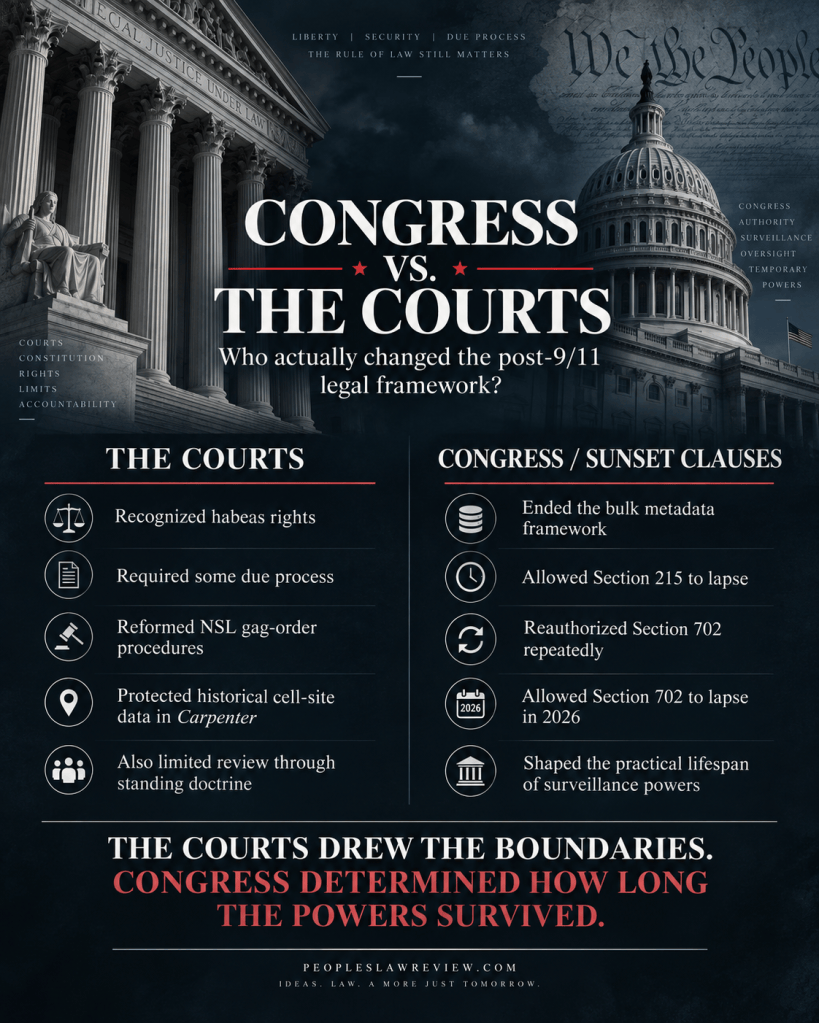
That may be the most durable legacy of this body of law: the biggest changes to surveillance authority — the 2015 end of bulk metadata collection, the 2020 lapse of Section 215, this year’s Section 702 impasse — have come from legislative sunset clauses and congressional gridlock, not judicial rulings. The courts wrote the outer limits, narrower and more contested in practice than the landmark opinions alone suggest. Congress, largely by inertia and expiration dates rather than deliberate choice, has ended up writing most of the rest.
“Congress, largely by inertia and expiration dates rather than deliberate choice, has ended up writing most of the rest.”
Sources: Supreme Court opinions in Hamdi v. Rumsfeld (2004), Rumsfeld v. Padilla (2004), Rasul v. Bush (2004), Hamdan v. Rumsfeld (2006), Boumediene v. Bush (2008), Doe v. Mukasey/Second Circuit opinion (2008), Holder v. Humanitarian Law Project (2010), Clapper v. Amnesty International USA (2013), and Carpenter v. United States (2018); United States v. Mohamud, 9th Circuit (2016); Library of Congress case files; Cornell Legal Information Institute; Justia Supreme Court Center; SCOTUSblog case archives and commentary, including “The Real D.C. Circuit Habeas Record”; NPR; American Civil Liberties Union and Electronic Frontier Foundation press releases and case archives; American Libraries Magazine; Reporters Committee for Freedom of the Press; Wikipedia entries on Klayman v. Obama, ACLU v. Clapper, Clapper v. Amnesty International USA, Doe v. Gonzales, Holder v. Humanitarian Law Project, and Boumediene v. Bush; PBS NewsHour; Common Dreams; Reason; Congressional Research Service reports on FISA Section 702 and the Reforming Intelligence and Securing America Act (R48592, LSB11444); EPIC.org; 5calls.org; Reuters and Ars Technica reporting on the 2026 Section 702 lapse; U.S. House of Representatives Office of the Historian; Studicata and PastPaperHero case briefs; American Society of International Law.

