
By Michael Phillips | People’s Law Review
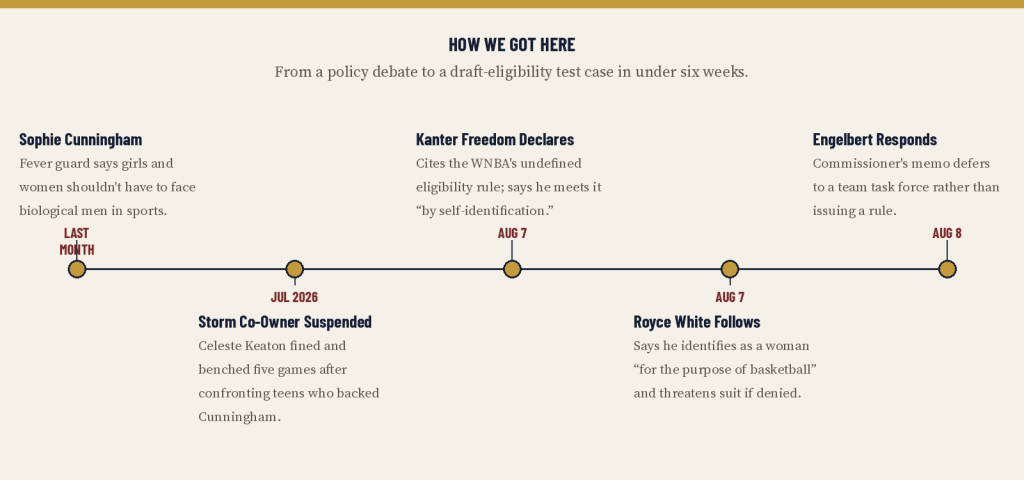
On August 7, 2026, former NBA first-round picks Enes Kanter Freedom and Royce White each announced they were declaring for the 2027 WNBA Draft. Freedom framed his declaration as a test of consistency, arguing the league’s public rhetoric on inclusion should apply to him as much as anyone. White went further, telling reporters he identifies as a woman “for the purpose of basketball” and that he would pursue legal action if denied a roster spot.
The stunt landed at a specific moment: Indiana Fever guard Sophie Cunningham had drawn national attention the previous month for saying girls and women shouldn’t have to compete against biological men, and a Seattle Storm co-owner had just been fined and suspended after a confrontation with teenagers supporting Cunningham’s position. WNBA Commissioner Cathy Engelbert responded to the Kanter/White declarations with a memo to teams saying the league would continue discussing the issue with a task force of team presidents and general managers.
What actually governs this isn’t a vibe or a “checkmate.” It’s the WNBA’s 2026 Collective Bargaining Agreement, and the federal statute sitting behind it.
The Text Everyone Is Arguing Around
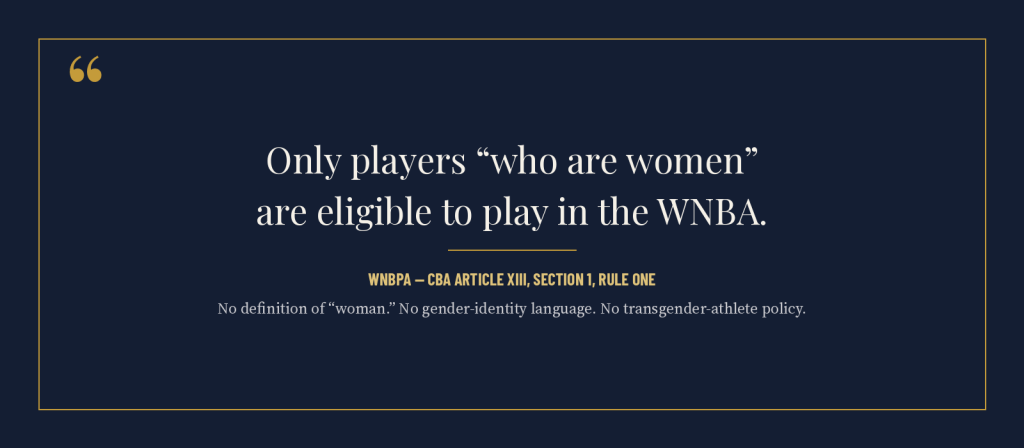
The WNBPA’s own CBA training materials, published on the union’s website, state the rule plainly under Article XIII, Section 1: “Only players ‘who are women’ are eligible to play in the WNBA.” That’s it. No definition of “women.” No reference to gender identity, hormone levels, or sex assigned at birth. No separate transgender-athlete policy appears anywhere in the union’s public materials. That silence is the entire reason this stunt works as a stunt — and it’s also the entire reason the legal analysis is more interesting than the social-media version.
(A note on sourcing: this comes from a WNBPA staff training module on Article XIII, not a leaked or published copy of the executed 2026 long-form agreement itself. It’s the union’s own paraphrase of the rule for its members, hosted publicly on wnbpa.com — a legitimate primary-adjacent source, but not a verbatim contract scan.)

1. Bostock v. Clayton County (2020)
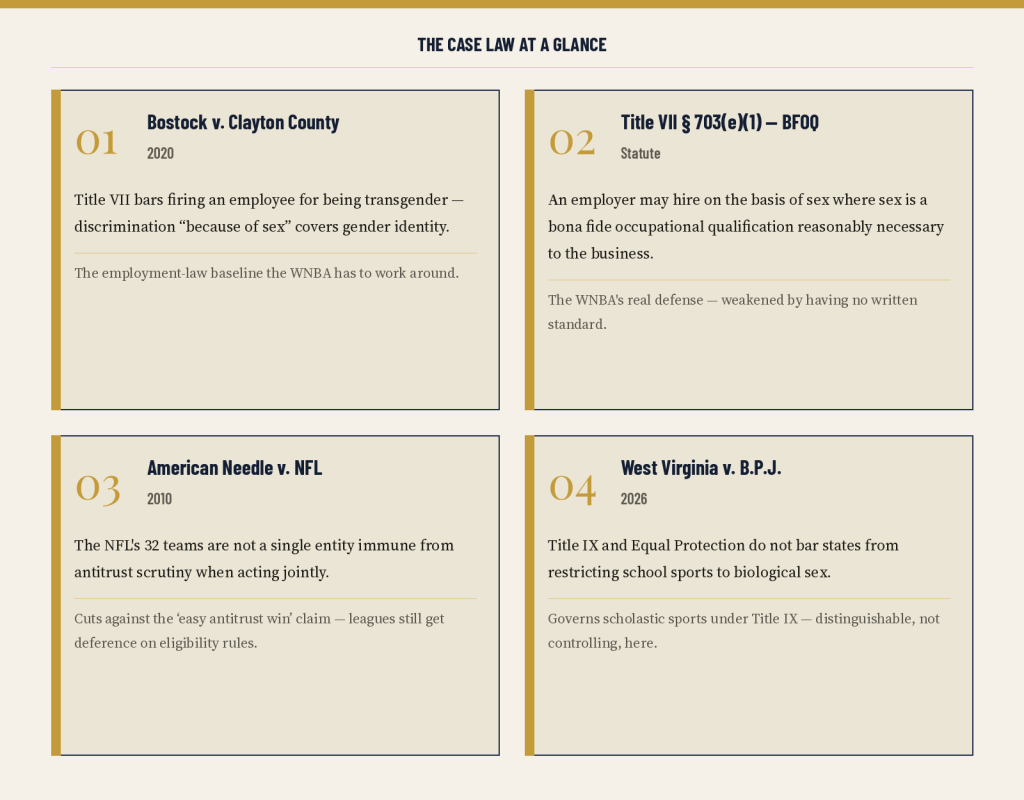
Holding: An employer who fires an individual merely for being gay or transgender violates Title VII of the Civil Rights Act of 1964, because discrimination “because of sex” necessarily accounts for an individual’s transgender status.
This is the case nobody in the Twitter debate is naming, and it’s the one that actually matters. WNBA players are employees under a collectively bargained contract, not student-athletes governed by Title IX. Title IX — the statute at issue in West Virginia v. B.P.J. and much of the litigation over scholastic transgender-athlete eligibility — is not the natural federal employment-discrimination framework for a WNBA roster decision. The WNBA is a professional league, and the relevant employment statute is Title VII, where Bostock lives.
Worth being precise about what Bostock itself is: an employment-discrimination decision, not a ruling on sex-separated athletic competition. It says an employer cannot fire someone merely for being gay or transgender. It says nothing about who is eligible to compete on a sex-segregated sports roster — that’s a materially different question, and it’s exactly the question the Supreme Court took up in B.P.J. four years later, in the school-sports context. The two cases aren’t in tension; they’re answering different questions under different statutes. But conflating them — treating Bostock as though it resolved athletic eligibility, or treating B.P.J. as though it controls a private employer — is the kind of move that turns a real legal question into a talking point in either direction.
Elements at issue:
- Whether declining to roster Freedom or White “because of” their claimed gender identity constitutes an adverse employment action taken because of sex
- Whether a professional sports league’s roster/draft decisions fall within Title VII’s employment-discrimination framework at all (courts have generally said yes for pro leagues, given the employer-employee relationship between team and player)
- Whether the WNBA’s undefined “women only” clause, left unenforced against a specific claimant, could itself become evidence of inconsistent application
2. The BFOQ Defense — Title VII § 703(e)
Statutory text: It is not unlawful for an employer to hire on the basis of sex “in those certain instances where religion, sex, or national origin is a bona fide occupational qualification reasonably necessary to the normal operation of that particular business.”
This is the WNBA’s actual shield, and it’s the piece missing from nearly every hot take on this story. A bona fide occupational qualification (BFOQ) defense lets an employer maintain a sex-specific requirement where sex is genuinely necessary to the job — not merely preferred, not merely traditional. Courts have applied BFOQ narrowly, but professional women’s sports leagues sit closer to the paradigm case than almost any other employer: the entire commercial and competitive premise of the league is sex-segregated athletic competition.
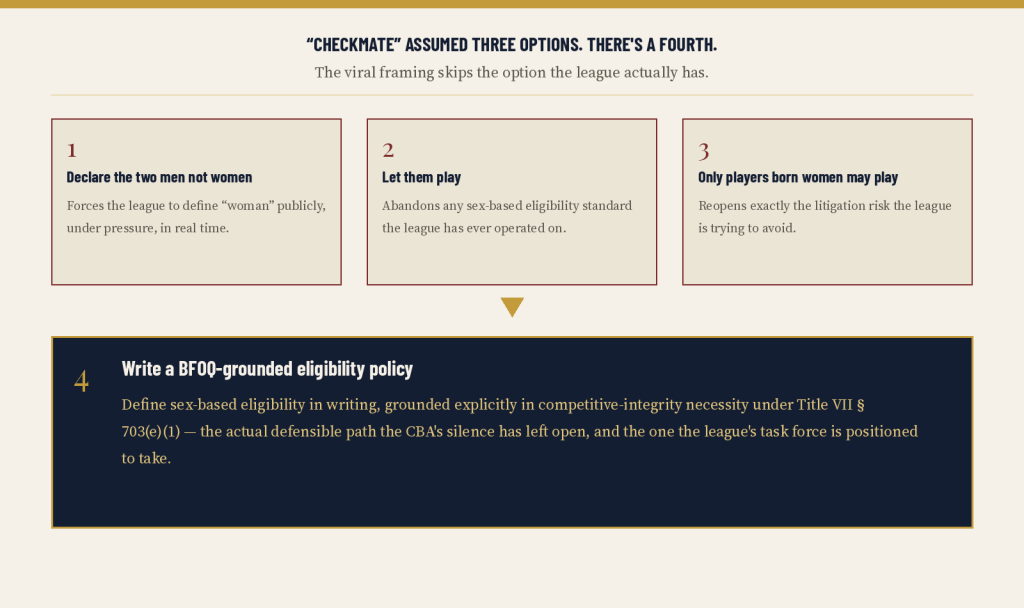
The open legal question isn’t whether the WNBA can assert a BFOQ defense — it’s how a “women only” roster requirement, entirely undefined in the CBA, gets applied to a specific claimant without the league first articulating criteria. A BFOQ defense built on ambiguity is weaker than one built on a written standard. That’s the actual “checkmate” in this story, and it points the other direction from where Clay Travis’s post put it: the league’s exposure comes from the absence of a written policy, not from Title VII forcing them to accept any claimant who self-declares.
3. American Needle, Inc. v. NFL (2010)
Holding: NFL teams, in licensing their intellectual property collectively, do not automatically constitute a “single entity” immune from Section 1 of the Sherman Act; each team remains a separate economic actor capable of conspiring with the others.
Travis’s viral thread argued that if the WNBA “refuses to draft the men,” the men could sue alleging antitrust violations. This overstates the antitrust exposure considerably. American Needle cuts against broad single-entity immunity for leagues, which sounds like it helps an antitrust claim — but the holding doesn’t do the work Travis needs it to. American Needle was about a licensing arrangement, not a roster decision, and the Court didn’t say every joint decision by league teams automatically violates the Sherman Act — only that it isn’t automatically immune from scrutiny. An antitrust claim still requires showing an unreasonable restraint on a relevant market. Declining to roster one player is not, by itself, that restraint. Freedom and White would need to show the WNBA’s eligibility rule harms competition in a defined market, not merely that it excludes them individually — a considerably harder case to make than “checkmate” suggests, even under American Needle‘s narrower single-entity holding.
Where This Actually Leaves the League
The WNBA’s genuine legal exposure isn’t a lawsuit it’s certain to lose — it’s the fact that an undefined eligibility clause is easier to litigate against than a defined one. A written policy, grounded explicitly in a BFOQ rationale tied to competitive integrity, is far more defensible than the current one-sentence clause. Engelbert’s memo — convening a task force rather than issuing a rule — reads less like stalling and more like an organization trying to write that policy before it gets tested in court by a claimant with actual standing and actual intent to play, rather than two retired men making a point.
Conclusion
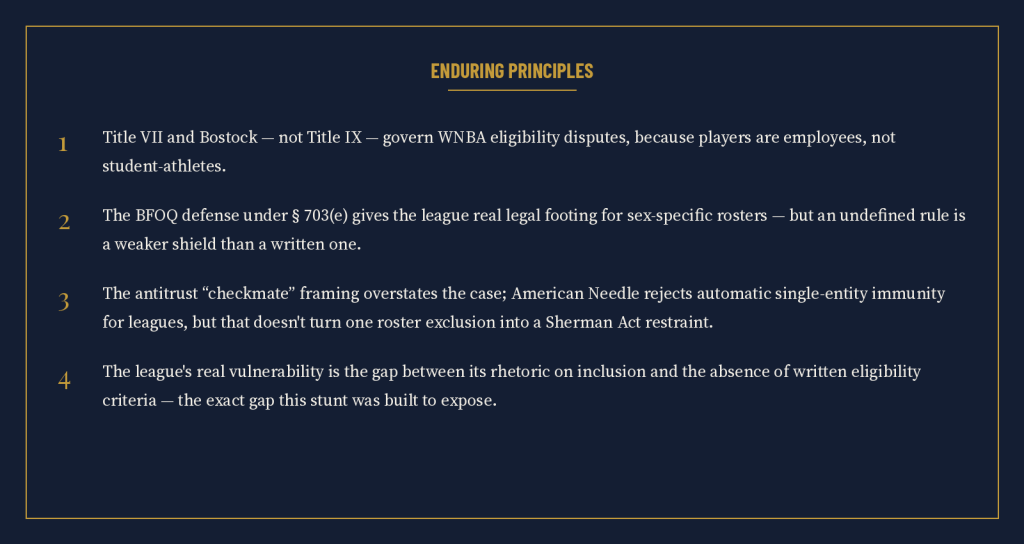
- Title VII and Bostock, rather than Title IX, provide the principal federal employment-discrimination framework for a WNBA roster dispute because professional players are employees rather than student-athletes.
- The BFOQ defense under § 703(e) gives the WNBA a real, if underdeveloped, legal basis to maintain sex-specific rosters — but an undefined rule is a weaker shield than a written one.
- The antitrust “checkmate” framing overstates the case; American Needle rejects automatic single-entity immunity for leagues, but that doesn’t turn one roster exclusion into a Sherman Act restraint.
- The league’s real vulnerability is the gap between its rhetoric on inclusion and the total absence of written eligibility criteria — a gap this stunt was specifically designed to expose.
Sources: IBTimes UK; Forbes; Basketnews.com; Fox News/OutKick; BroBible; Bettors Insider; Complex; The Mirror US; ESPN; Associated Press (via ABC News, KSAT, U.S. News); WNBPA Article XIII CBA training module (wnbpa.com); Factually.co.
 The People's Law Review