

By Michael Phillips | People’s Law Review
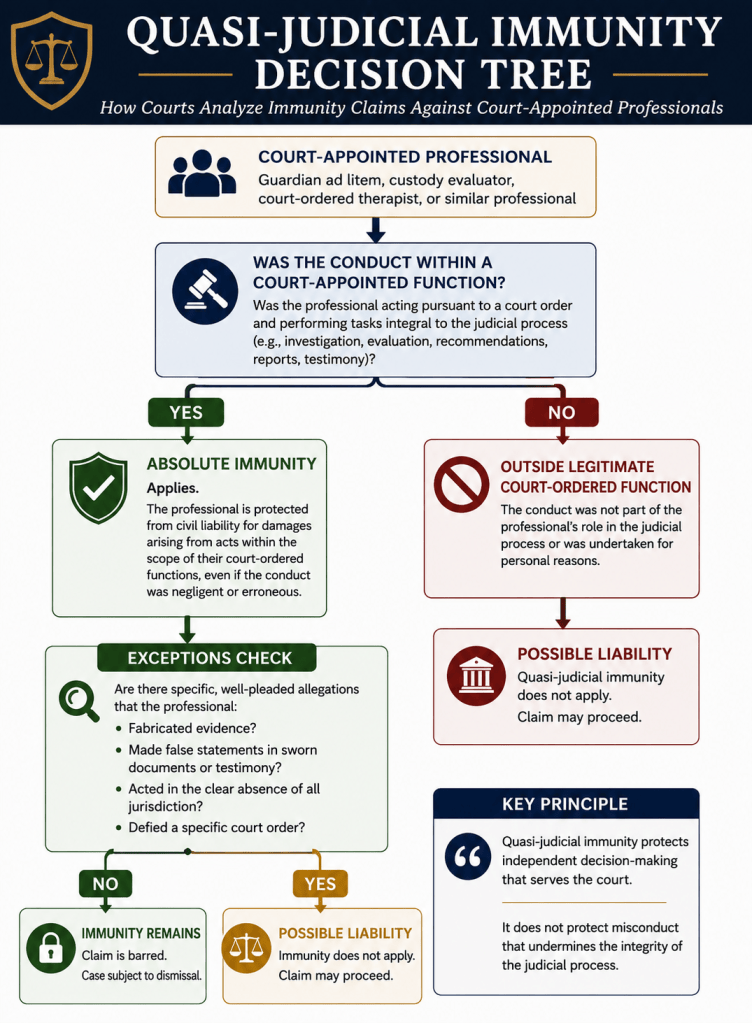
Guardians ad litem, custody evaluators, and court-ordered therapists occupy an unusual position in the American legal system. They are not judges, yet courts across the country have long treated them as functionally equivalent to judges for purposes of civil liability — a doctrine known as quasi-judicial immunity.
The doctrine rarely makes headlines, but it does most of the work in determining whether a parent or child who believes they were failed by the family court system has any civil remedy at all. This article examines the doctrine’s legal foundations, the leading case applying it, the narrow exceptions courts have carved into it, and the meaningful differences in how it operates across circuits — including in Maryland.
The Legal Foundation: Quasi-Judicial Immunity
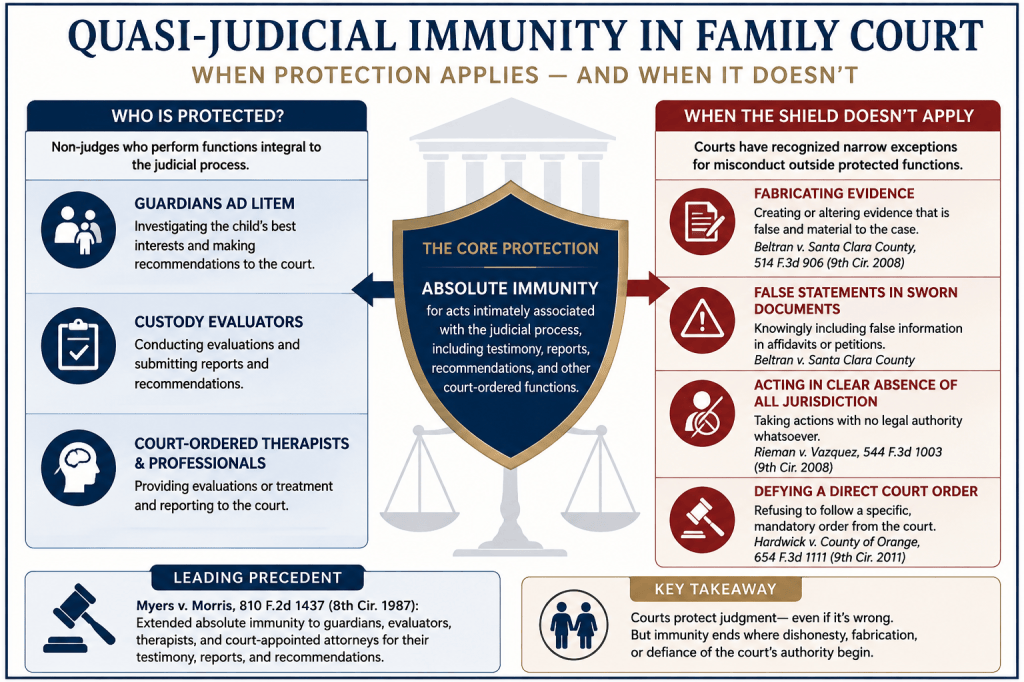
Quasi-judicial immunity extends absolute immunity — the strongest form of civil immunity recognized in American law — to non-judges who perform functions integral to the judicial process. Guardians ad litem investigating a child’s best interests, custody evaluators submitting recommendations, and court-ordered therapists testifying about a family’s progress all typically fall within its scope.
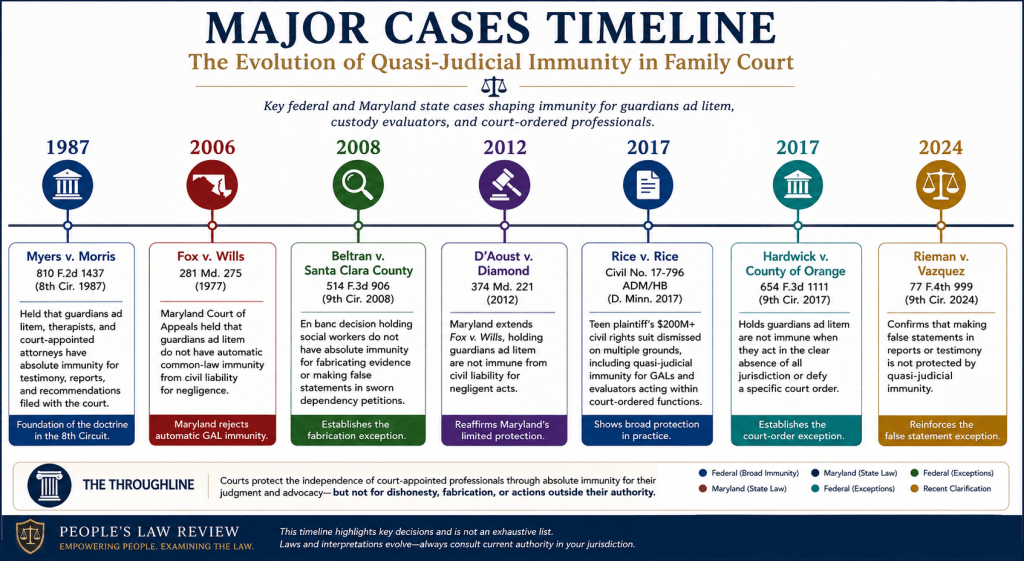
The leading Eighth Circuit case, Myers v. Morris, 810 F.2d 1437 (8th Cir. 1987), held that guardians, therapists, and court-appointed attorneys have absolute immunity for damage claims tied to their court testimony — and that the immunity extends beyond the witness stand to the written reports and recommendations such officials file with the court. Other circuits have adopted substantially similar frameworks, reasoning that guardians ad litem and evaluators cannot perform their function effectively if every disappointed party can sue them personally for the outcome.
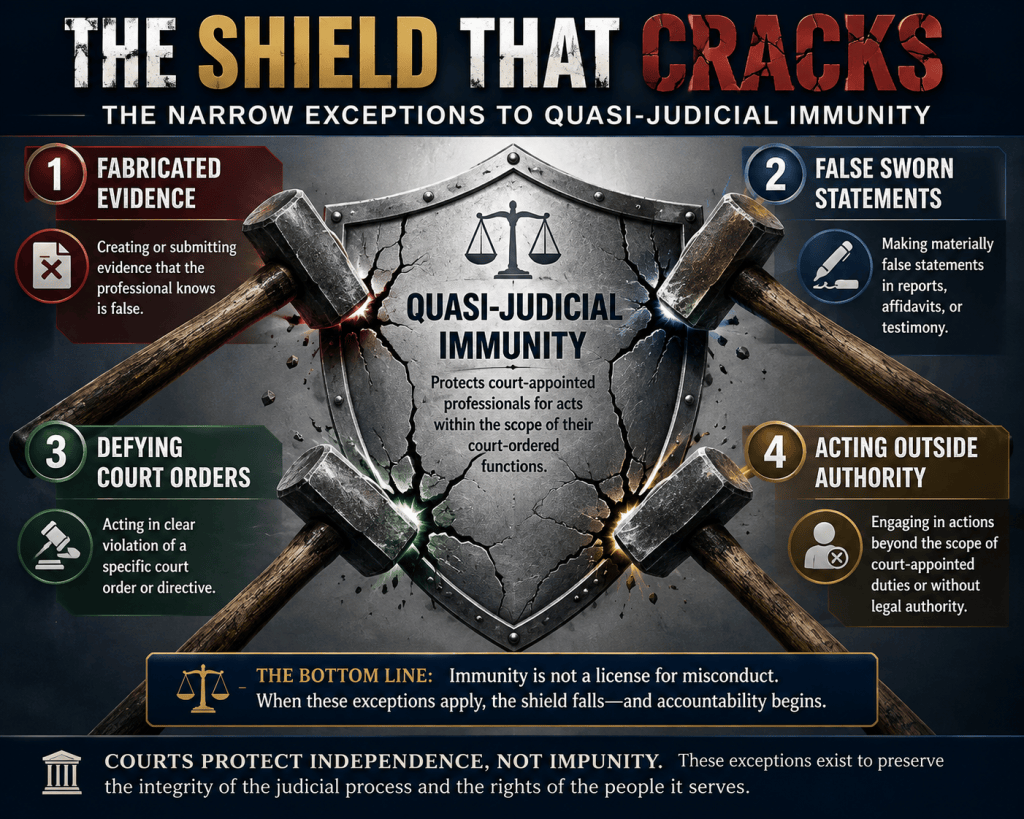
The doctrine is not unlimited. As the case law below shows, courts have consistently distinguished between protected judgment — even badly exercised judgment — and conduct that falls outside any legitimate court-ordered function, such as fabricating evidence or defying a direct order.
Case Study: Rice v. Rice (D. Minn. 2017)
The clearest illustration of how this doctrine operates in practice is Rice v. Rice, Civil No. 17-796 ADM/HB (D. Minn. Sept. 19, 2017).
Annelise Rice was seven years old when her parents’ divorce proceedings began in Hennepin County, Minnesota. A 2005 custody trial resulted in a March 2006 referee’s order awarding her father sole physical custody of Rice and two siblings. Years of continued conflict followed, including a suspended visitation order, a Child in Need of Protection or Services proceeding, and — when Rice was 12 — a flight to Canada with her mother that ended in her mother’s arrest and eventual conviction on child-deprivation charges. An appellate court later vacated that conviction, citing improperly excluded evidence of the father’s abuse; prosecutors did not retry the case.
In March 2017, at age 19, Rice filed a civil rights suit seeking more than $200 million in damages against nearly every professional connected to her case — guardians ad litem, social workers, custody evaluators, her father’s divorce attorney, her father, and two counties — alleging a conspiracy to deprive her of her constitutional right to a relationship with her mother and siblings.
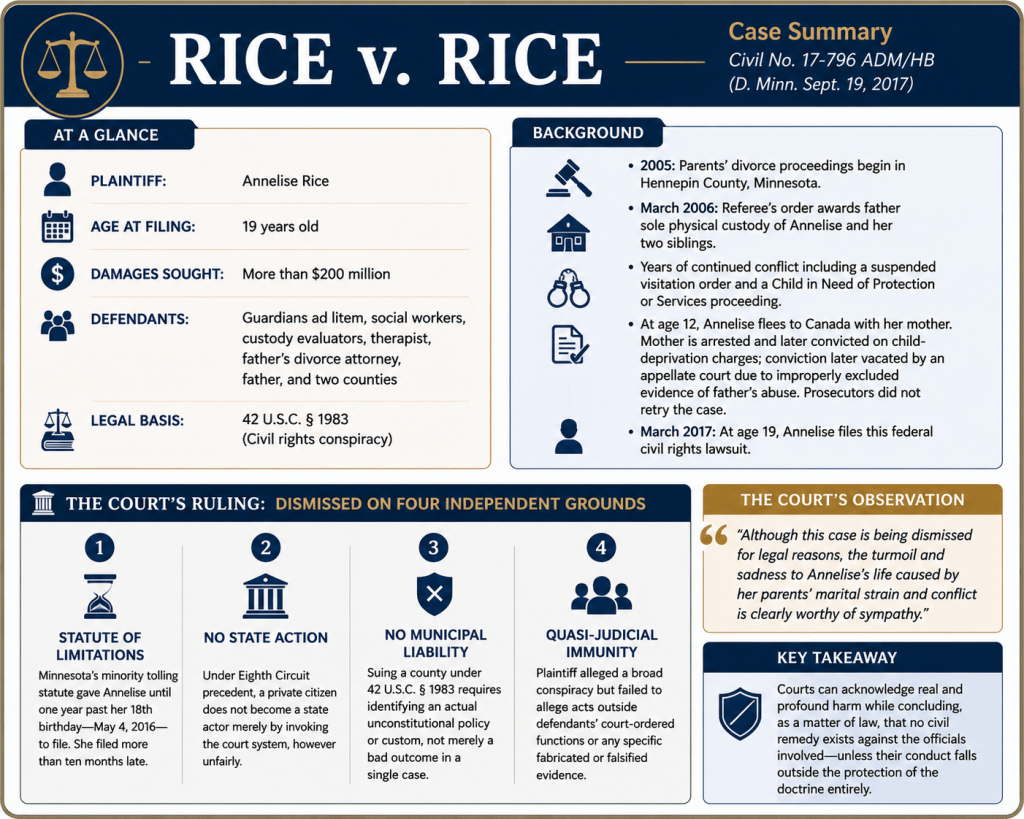
The court dismissed the case on four independent grounds:
- Statute of limitations. Minnesota’s minority tolling statute gave Rice until one year past her 18th birthday — May 4, 2016 — to file. She filed more than ten months late.
- No state action. Under Eighth Circuit precedent, a private citizen does not become a state actor merely by invoking the court system, however unfairly.
- No municipal liability. Suing a county under 42 U.S.C. § 1983 requires identifying an actual unconstitutional policy or custom, not merely a bad outcome in a single case.
- Quasi-judicial immunity. The court found that although Rice alleged a broad conspiracy, she never alleged it was carried out through acts outside the defendants’ court-ordered functions, and she pointed to no specific evidence that was actually fabricated or falsified.
The court’s closing observation is worth quoting directly, because it captures the doctrine’s practical effect better than any summary:
Although this case is being dismissed for legal reasons, the turmoil and sadness to Annelise’s life caused by her parents’ marital strain and conflict is clearly worthy of sympathy.
A court can fully credit that a plaintiff suffered real harm and still hold, as a matter of law, that no civil remedy exists against the officials involved — unless the conduct falls outside the doctrine’s protection entirely.
Where Courts Have Pierced the Shield
Quasi-judicial immunity is not absolute in the colloquial sense, even when it is “absolute immunity” in the formal legal sense. Courts — most consistently the Ninth Circuit — have identified specific categories of conduct that fall outside its protection.
The difference between protected judgment and actionable misconduct is often the difference between a recommendation and fabricated evidence.
Beltran v. Santa Clara County (2008): The Fabrication Exception
Sitting en banc, the Ninth Circuit in Beltran v. Santa Clara County, 514 F.3d 906 (9th Cir. 2008), overruled its own prior precedent to hold that social workers do not have absolute immunity for fabricating evidence during an investigation or for making false statements in a sworn dependency petition affidavit.
Reasoning
The court’s logic borrowed directly from prosecutorial immunity doctrine: a social worker’s decision to institute custody proceedings is a protected discretionary judgment, but fabricating evidence is not an exercise of judgment at all — it is misconduct, and a prosecutor who fabricates evidence during an investigation receives no immunity for that conduct either.
Hardwick v. County of Orange (2017): Defying a Court Order
In Hardwick v. County of Orange, 844 F.3d 1112 (9th Cir. 2017), social workers were ordered by a court to return two children to their mother’s custody. Rather than comply, they placed the children in foster care instead, where they remained for three months.
Reasoning
The Ninth Circuit held that defying a direct court order falls outside any legitimate quasi-prosecutorial function, and immunity therefore did not apply. This decision was cited directly in the Rice v. Rice opinion as the standard Annelise Rice’s allegations failed to meet.
Rieman v. Vazquez (2024): False Statements to the Court
Most recently, in Rieman v. Vazquez, 96 F.4th 1085 (9th Cir. 2024), social workers failed to provide legally required notice of a juvenile detention hearing, then gave the court false information about why notice had not been given.
Reasoning
The Ninth Circuit held that failing to provide mandated notice is not a discretionary act entitled to absolute immunity, and that giving false information to the court amounted to judicial deception that no reasonable social worker could believe was constitutionally permitted.
Absolute immunity protects poor judgment. It does not protect judicial deception.
The Legislative Response: California’s Statutory Carve-Out
Beyond case law, California’s legislature has directly narrowed immunity by statute. Cal. Gov’t Code § 820.21 provides that civil immunity for juvenile court social workers and child protection workers does not extend to perjury, fabrication of evidence, failure to disclose known exculpatory evidence, or obtaining testimony through duress or fraud, when committed with malice.
This is a meaningful contrast to the judge-made exceptions discussed above: it represents a legislative body determining that court-created immunity had grown too broad, and correcting it directly rather than waiting for further litigation. Few states have adopted comparable statutory carve-outs.
A Circuit Split: Where Immunity Holds
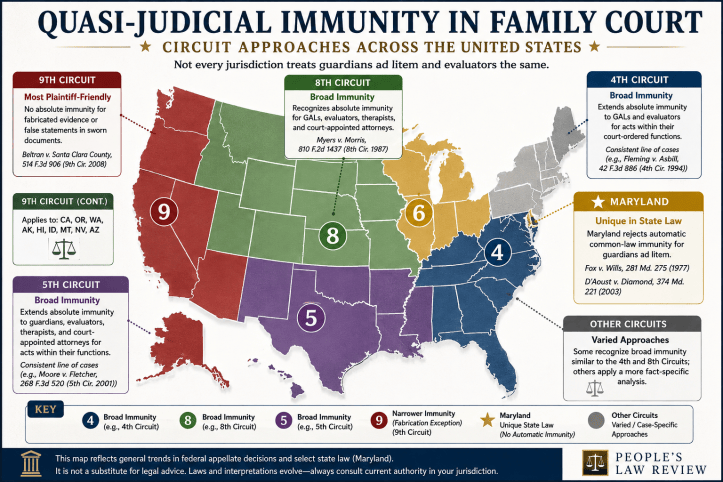
Not every circuit has followed the Ninth Circuit’s approach. The Eighth Circuit’s Myers standard, applied in Rice, remains considerably more protective of guardians ad litem and evaluators. The Fourth Circuit — which governs Maryland — has trended in a similar direction, though through a different doctrinal mechanism.
In an unpublished 2026 ruling, the Fourth Circuit affirmed qualified immunity for a South Carolina social worker even where the underlying facts were undisputed and troubling: a foster teenager with a known history of sexual misconduct was placed into a family’s home without disclosure of that history, and the teen went on to harm the family’s other children. The court did not dispute those facts. It held that the plaintiffs could not identify clearly established law recognizing a constitutional right belonging to them under those specific circumstances.
The doctrinal tool is different — qualified immunity rather than the absolute quasi-judicial immunity at issue in Rice — but the practical effect for the plaintiffs is the same: the underlying conduct can be fully conceded, and the case still ends without reaching a jury.
Maryland’s Unique Common-Law Position
Maryland rejected automatic common-law immunity for guardians ad litem—but federal constitutional claims remain a different story.
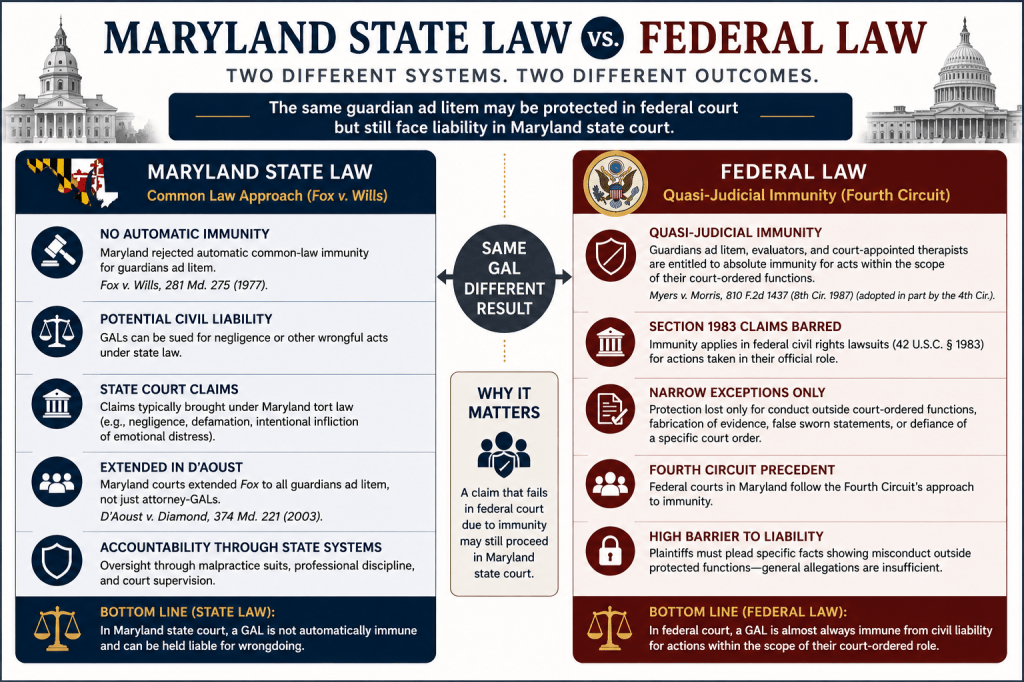
Maryland’s own state courts have gone further than most jurisdictions in one important but narrow respect. In Fox v. Wills, 390 Md. 620, 890 A.2d 726 (2006), Maryland’s highest court held that “guardians, guardians ad litem, and non-judicial personnel appointed by courts for particular purposes, have no immunity from suit under the common law.”
The court reasoned that Maryland’s guardian ad litem statute authorizes a GAL only to represent the child — nothing more — and concluded that a GAL’s functions “are no more ‘judicial’ than the functions of many other trial attorneys.” The court also pointed to the legislature’s own conduct as evidence of intent: where Maryland lawmakers have wanted to grant immunity to court-appointed advocates for children, they have done so expressly, in other statutes. Because they had not done so for guardians ad litem, the court declined to create that immunity itself.
A later Court of Appeals decision, D’Aoust v. Diamond, 424 Md. 549, 36 A.3d 941 (2012), cited Fox approvingly and extended the same reasoning to court-appointed trustees, confirming this is a sustained doctrinal position rather than an isolated ruling.
An Important Limitation
Fox was decided as a state common-law legal malpractice claim, not a federal civil rights action. A Maryland guardian ad litem sued under 42 U.S.C. § 1983 in federal court — the vehicle Annelise Rice used — would still face the Fourth Circuit’s separate, and considerably more protective, federal quasi-judicial immunity standard. Fox narrows the door in Maryland state court for malpractice-type claims. It does not close the gap that families most often encounter when pursuing federal constitutional claims arising from family court proceedings.
Illinois: A Functional Test
Illinois offers a different doctrinal approach entirely. In Nichols v. Fahrenkamp, 2019 IL 123990, the Illinois Supreme Court rejected the premise that the title “guardian ad litem” carries automatic immunity, holding instead that courts must examine the actual function being performed.
This functional test cracked immunity open in probate-adjacent contexts even as the court preserved it for ordinary custody and divorce proceedings — underscoring that “guardian ad litem” is not a single, uniformly defined legal status nationwide, but a title states and courts interpret differently.
What This Means for Families and Practitioners
None of the above should be read as an argument that quasi-judicial immunity serves no legitimate purpose. The doctrine exists because requiring every guardian ad litem and evaluator to litigate a civil suit brought by every disappointed party would make the roles difficult to fill and would give every losing party in a custody dispute a second forum in which to relitigate the outcome through a damages claim.
For plaintiffs, specificity is everything. General disagreement rarely survives a motion to dismiss.
Courts also maintain other mechanisms intended to address misconduct without exposing every court-appointed professional to personal civil liability: appeal of the underlying custody decision, complaints to state attorney disciplinary or licensing boards, and the presiding judge’s own authority to remove or sanction a guardian who is not performing the role appropriately. Whether these mechanisms function adequately in practice is a separate question — but they are the system’s structural answer to the accountability gap this doctrine creates.
For practitioners, the throughline across every successful exception discussed above is specificity. General disagreement with a GAL’s recommendation, however consequential, is not sufficient to overcome immunity. What has worked — in the narrow set of cases where it has worked — is a specific, provable allegation: a fabricated document, a sworn false statement, a refusal to comply with an explicit court order. Plaintiffs and their counsel evaluating a potential claim against a court-appointed official should assess, at the outset, whether the available evidence supports that level of specificity, because the case law surveyed here suggests that nothing less is likely to survive a motion to dismiss.
Conclusion
Quasi-judicial immunity is one of the most consequential—and least understood—doctrines in American family law.
The precedents examined in this article establish several consistent principles across jurisdictions:
- Absolute quasi-judicial immunity protects the reports, recommendations, and testimony of guardians ad litem, evaluators, and court-ordered therapists, even where that judgment turns out to be badly mistaken.
- The immunity does not extend to fabricated evidence, sworn false statements, or a refusal to comply with a direct court order — but a plaintiff must plead and prove that specific conduct, not merely an unfavorable outcome.
- Circuits differ meaningfully in how protective this doctrine is. The Ninth Circuit has developed the most detailed exceptions; the Eighth and Fourth Circuits remain considerably more protective of the officials involved.
- California has gone further than case law alone by codifying limits on social worker immunity directly into statute.
- Maryland’s own courts have adopted an unusually strong position against common-law immunity for guardians ad litem — but that position does not extend to the federal civil rights claims most families actually pursue.
Quasi-judicial immunity will continue to determine, in case after case, whether a family that believes it was failed by the court system has any civil remedy available to it. As the Rice opinion itself acknowledged, a court can find a plaintiff’s suffering fully credible and still conclude, as a matter of law, that the doctrine forecloses relief. Understanding exactly where that doctrine bends — and where it does not — is essential for any family, attorney, or advocate evaluating whether a civil claim against a family court official is viable.
Sources: This article draws on the court’s opinion in Rice v. Rice, Civil No. 17-796 ADM/HB (D. Minn. Sept. 19, 2017), for the facts and procedural history of Annelise Rice’s case, including the four independent grounds for dismissal and the court’s closing remarks on the limits of quasi-judicial immunity. The foundational immunity standard is drawn from Myers v. Morris, 810 F.2d 1437 (8th Cir. 1987). The narrower, plaintiff-favorable exceptions are drawn from three Ninth Circuit decisions: Beltran v. Santa Clara County, 514 F.3d 906 (9th Cir. 2008) (en banc); Hardwick v. County of Orange, 844 F.3d 1112 (9th Cir. 2017); and Rieman v. Vazquez, 96 F.4th 1085 (9th Cir. 2024). California’s statutory carve-out is drawn from Cal. Gov’t Code § 820.21. The Fourth Circuit’s more protective posture is drawn from an unpublished 2026 qualified-immunity ruling in a South Carolina foster-placement case. Maryland’s state-court position is drawn from Fox v. Wills, 390 Md. 620, 890 A.2d 726 (2006), and D’Aoust v. Diamond, 424 Md. 549, 36 A.3d 941 (2012), the latter of which cites and extends the former. Illinois’s functional test is drawn from Nichols v. Fahrenkamp, 2019 IL 123990. All case citations and holdings were independently verified against primary court opinions or court-confirmed secondary sources rather than advocacy summaries.
 The People's Law Review