By Michael Phillips | The People’s Law Review
A federal appeals court handed Arizona a win this week in a years-long fight over how the state manages its voter rolls — but the ruling comes with an unusual wrinkle. The 11 judges who decided the case agreed on the outcome, but a slim majority of the court’s own reasoning was rejected by nearly half the judges who signed onto the result anyway. The disagreement centers on a question that reaches well beyond Arizona: how hard should it be for public-interest groups to get into federal court in the first place?
The case is Arizona Alliance for Retired Americans v. Mayes, and it’s been working its way through the courts since 2022.
What the Law Does
At issue is Arizona Senate Bill 1260, signed into law in June 2022. The law made three changes to how the state handles voter registration:

- A “cancellation provision” requiring county recorders to cancel a voter’s registration once another county confirms the person has re-registered there.
- A “felony provision” making it a crime to knowingly provide a “mechanism for voting” to someone registered in another state — a phrase the law never defines.
- A “removal provision” governing the state’s permanent early-voting list, which was never challenged in this case and has been in effect since 2022.
Just weeks after the law took effect, three voter-advocacy groups — the Arizona Alliance for Retired Americans, Voto Latino, and Priorities USA — sued, arguing the cancellation and felony provisions were unconstitutional and violated federal voter-protection law. A federal judge agreed and blocked both provisions before the 2022 midterms. Arizona has been fighting to reinstate them ever since.
A Fight About Who Gets to Sue
The legal question that ended up dominating this case isn’t really about voting at all — it’s about standing: the constitutional requirement that anyone suing in federal court show they’ve actually been harmed by what they’re challenging.
For years, the Ninth Circuit made it relatively easy for advocacy organizations to clear that bar. If a law interfered with a group’s mission and forced it to spend money responding to that law, courts generally let the case proceed.
“The legal question that ended up dominating this case isn’t really about voting at all — it’s about standing.”
That changed in 2024, when the U.S. Supreme Court decided FDA v. Alliance for Hippocratic Medicine, a case involving anti-abortion medical groups challenging an FDA drug policy. The Court held that simply feeling frustrated by a law, or spending money to fight it, isn’t enough — an organization has to show the law directly interferes with its actual, ongoing work.
That ruling reshaped this Arizona case. A three-judge Ninth Circuit panel applied Hippocratic Medicine in September 2024 and ruled 2-1 that the advocacy groups lacked standing to challenge the cancellation provision. One judge dissented, and the full 11-judge court agreed in March 2025 to rehear the case — wiping out the panel’s decision and starting over.

The En Banc Ruling: A Split Decision on the Reasoning
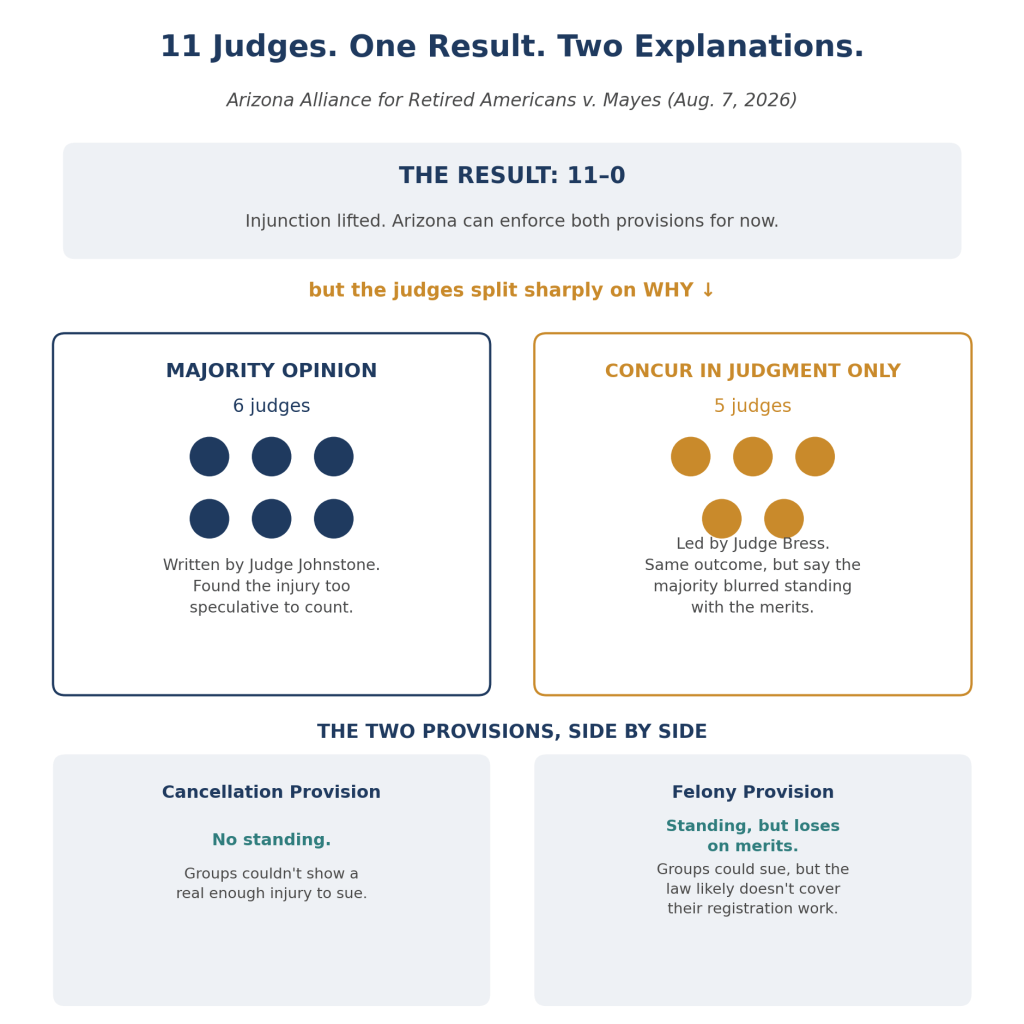
After hearing arguments in Seattle in June 2025, the full court issued its ruling on August 7, 2026. The bottom line: the district court’s injunction is lifted, and the case goes back for further proceedings. But the court didn’t treat the two provisions the same way.
Cancellation provision: The court found the advocacy groups still don’t have standing. Their fear — that a voter’s new registration might get mistakenly canceled instead of an outdated one — was, in the majority’s view, too speculative to count as a real injury, especially since Arizona’s own election procedures already instruct county recorders to cancel only the old registration.
Felony provision: Here, the groups do have standing — the court found their voter-registration work is close enough to the undefined phrase “mechanism for voting” to create a real risk of prosecution. But they lost anyway, because the court concluded that phrase almost certainly means physical voting materials like a ballot, not registration or outreach work.
“That’s a 6-5 split on legal reasoning wrapped inside an 11-0 result.”
Here’s where it gets interesting: even though all 11 judges agreed with that outcome, five of them — led by Judge Daniel Bress and joined by Judges Callahan, Bennett, R. Nelson, and VanDyke — refused to sign onto the majority’s reasoning. In a pointed separate opinion, they argued the majority opinion, while reaching the right result, actually blurred the line between standing and the merits of the case — quietly reintroducing the kind of loose analysis the Supreme Court had just rejected. Judge VanDyke went a step further, arguing in his own writing that the Ninth Circuit should make it easier for three-judge panels to depart from outdated circuit precedent whenever the Supreme Court has moved in a different direction — even without a full en banc rehearing.
That’s a 6-5 split on legal reasoning wrapped inside an 11-0 result — the kind of internal disagreement that often signals a doctrine isn’t as settled as a single opinion might suggest.

Why This Matters Beyond Arizona
The Ninth Circuit covers nine western states and is the largest federal appeals court in the country. By formally overruling a string of prior cases — including East Bay Sanctuary Covenant v. Biden, Sabra v. Maricopa County Community College District, and National Council of La Raza v. Cegavske, among others — the court has made it meaningfully harder for advocacy groups across the circuit to sue over election rules using the “diversion of resources” argument that used to work.
“Advocacy groups and states alike now have two competing roadmaps within the same opinion to argue from in future cases.”
But because five judges think the majority didn’t go far enough in applying the Supreme Court’s standard correctly, this likely isn’t the last word. Advocacy groups and states alike now have two competing roadmaps within the same opinion to argue from in future cases.
What’s Next
“The court found their voter-registration work close enough to the undefined phrase ‘mechanism for voting’ to create a real risk of prosecution.”
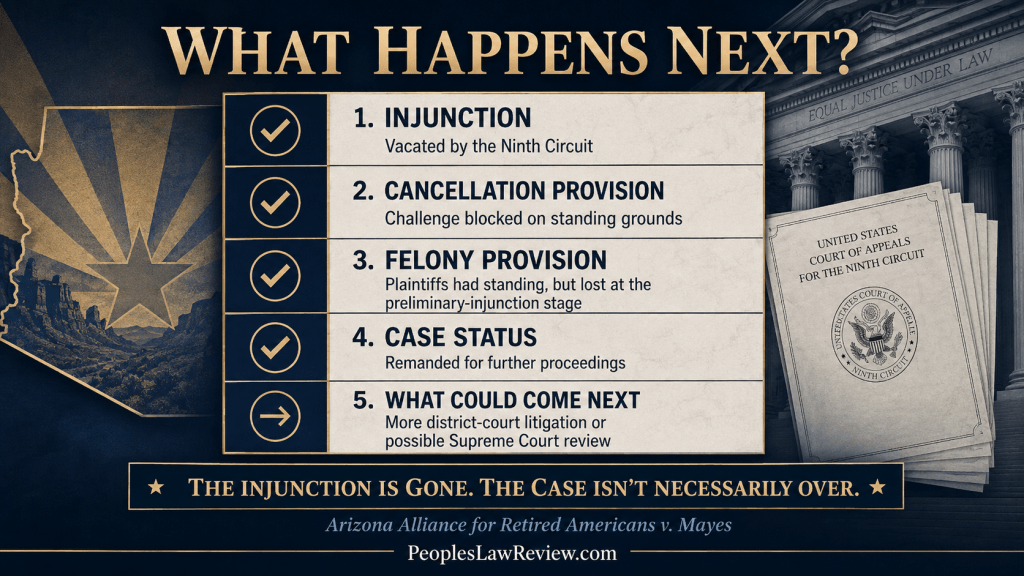
The case returns to the district court, where the underlying legal questions about the cancellation provision’s compliance with federal voter-protection law haven’t actually been resolved — they were dismissed on standing grounds, not decided on the merits. A further appeal, including a possible request for U.S. Supreme Court review, remains possible given how divided the Ninth Circuit itself is on the reasoning.
For now, the preliminary injunction blocking both provisions has been vacated. Whether either survives another round in court is a different question — one this opinion leaves very much open.
“Whether either survives another round in court is a different question.”