
By Michael Phillips | People’s Law Review
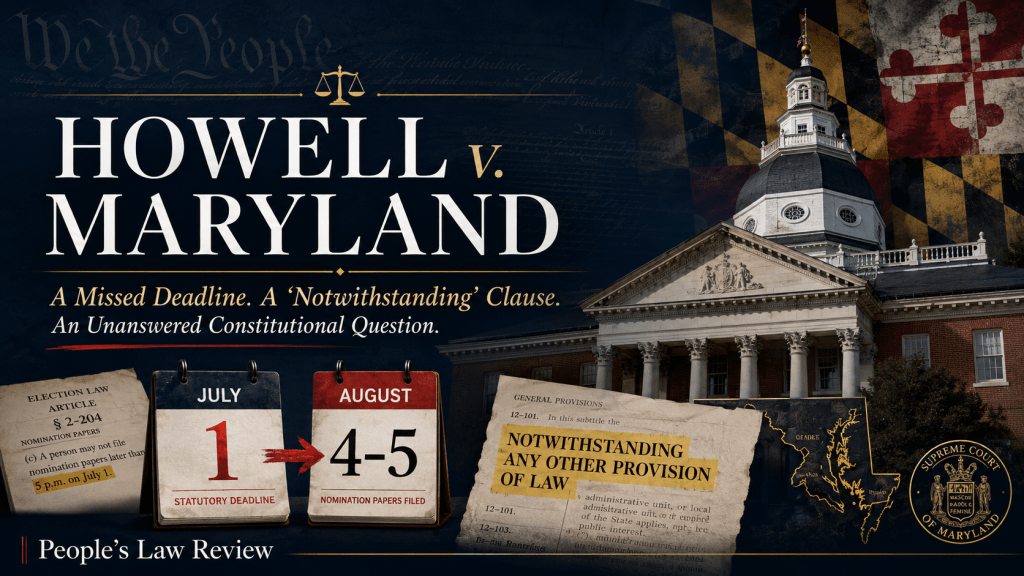
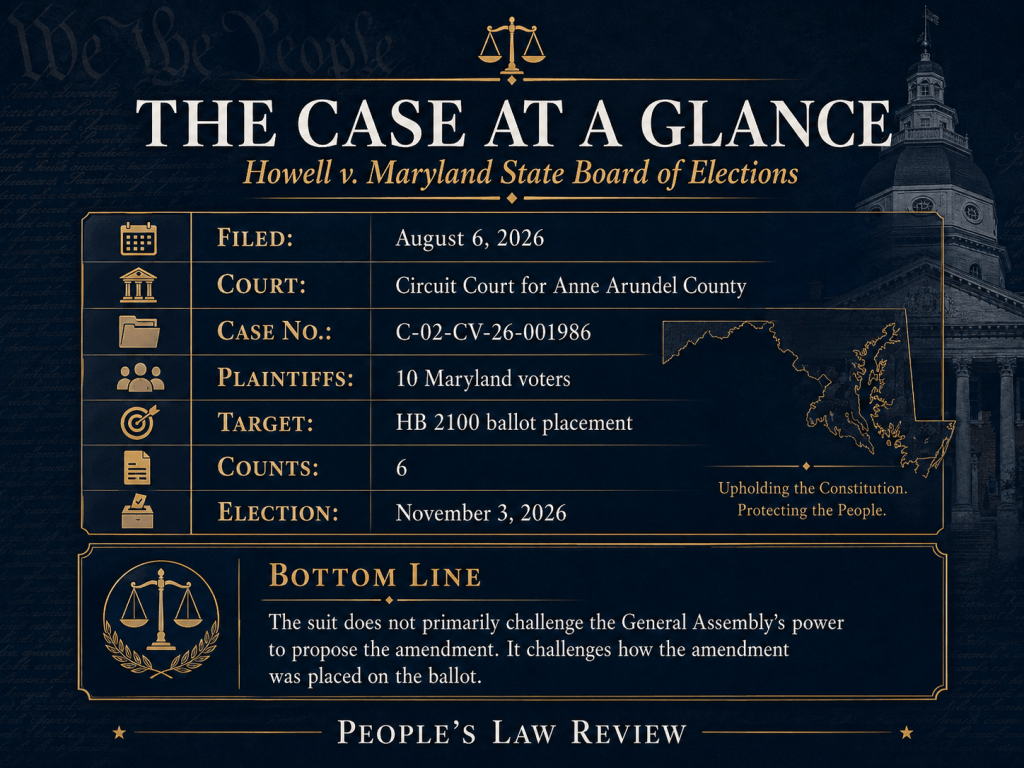
On August 6, 2026, ten Maryland voters filed a Complaint for Declaratory Judgment and Injunctive Relief and Petition for Judicial Review in the Circuit Court for Anne Arundel County, challenging the placement of a redistricting-related constitutional amendment on the November ballot. The case is Howell v. Maryland State Board of Elections, Case No. C-02-CV-26-001986.
The amendment at issue, House Bill 2100, would strip Maryland’s constitutional compactness and contiguity requirements from congressional districts, leaving them applicable only to state legislative districts. That policy question is not, on its face, what the complaint is about. The complaint concedes the General Assembly has the power to propose that amendment. What it disputes is whether the process used to place it on the ballot — compressed into a three-day special session, against a deadline that had already lapsed — complied with Maryland law.
Six counts are pled. Two rest on dates that are difficult to dispute. One rests on a structural question Maryland courts do not appear to have resolved before. This piece works through each, against the controlling and analogous precedent that will likely shape how a court reads them.
The Statutory Backdrop: SB 29
Before reaching HB 2100, it is necessary to understand the statute it allegedly violates.
In the 2026 regular session, the General Assembly passed Senate Bill 29, amending Title 7 of the Election Law Article. It passed the Senate 44-0 on February 5, 2026, passed the House 135-0 on April 13, 2026, and was signed by Governor Moore on May 12, 2026, effective June 1, 2026. Among its changes, SB 29 revised Md. Code Ann., Election Law § 7-103(c)(1) to read:
“On or before July 1 immediately preceding a general election, the Secretary of State shall prepare and certify to the State Board the information required under subsection (b) of this section, for all statewide ballot questions…”
The complaint emphasizes, correctly, that § 7-103 contains no exception for late certification. SB 29 also revised § 7-105(b), requiring notice of a statewide ballot question to reach the State Board by the “first Monday in August,” and added § 9-207(f), which forecloses the argument that a later ballot-layout certification under § 9-207 could substitute for the § 7-103 certification.
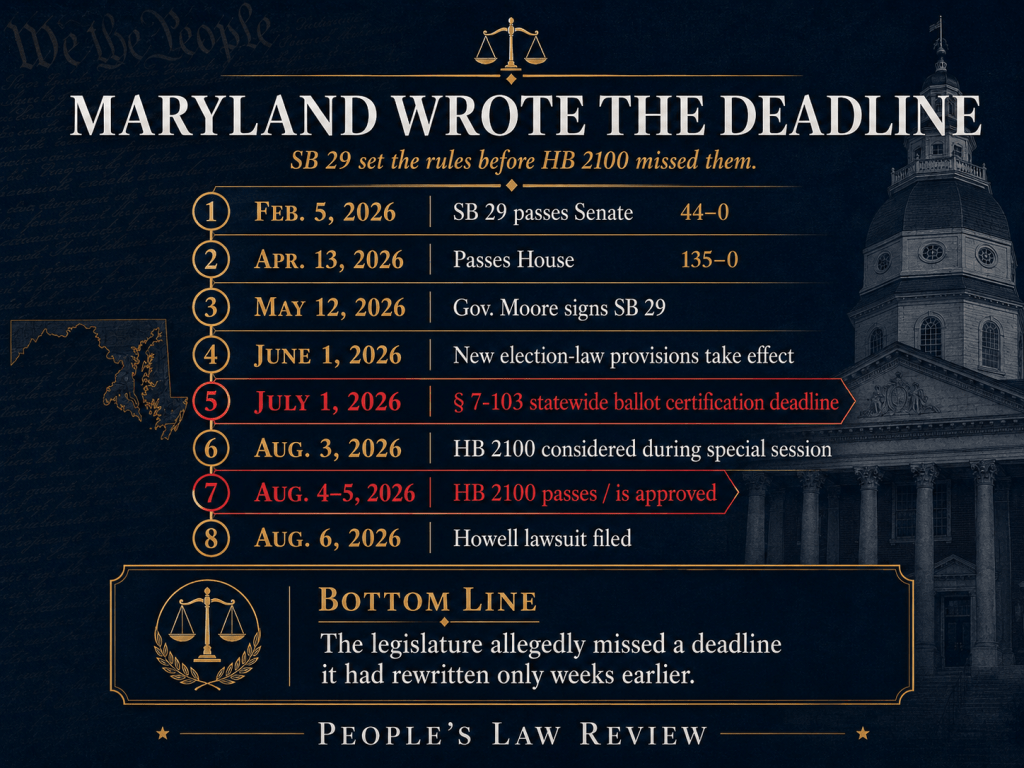
This matters for more than narrative color. It means the deadlines HB 2100 allegedly missed were not inherited from an older, less deliberate Assembly — they were written, passed unanimously, and signed by the same governor who would go on to sign HB 2100 less than three months later.

Count II and Count III: The Deadline Claims
Count II alleges HB 2100 violates § 7-103(c)(1) because the General Assembly did not pass, and Moore did not approve, the amendment until August 4-5 — more than a month after the July 1 certification deadline.
Count III alleges a separate violation of § 7-105(b): the “first Monday in August” notice deadline, which HB 2100 also missed by passing on August 4.
Of the six counts, these two are the most factually clean. The elements are not contested interpretive questions — they are dates on a calendar, measured against an unambiguous statutory deadline with, per the complaint, no textual exception. The complaint bolsters this with an admission from the floor: it quotes Democratic state Sen. Cheryl Kagan telling colleagues “July 1st is in the rearview mirror,” and that there was no remaining time to follow the statute’s notice-and-comment procedure. It also cites the Department of Legislative Services’ own fiscal note on HB 2100, which acknowledges the July 1 deadline had passed by the time the bill was considered.
The live legal question is not whether the deadlines were missed. It’s whether they were curable — specifically, whether the General Assembly could lawfully override its own June 2026 deadline statute through language in HB 2100 itself. That question is the subject of Count V.
The live legal question is not whether the deadlines were missed. It’s whether they were curable.
Count V: The Non Obstante Clause and Bicameralism-and-Presentment
This is the complaint’s most doctrinally significant claim, and the one least likely to have a settled answer waiting for it.
The clause itself
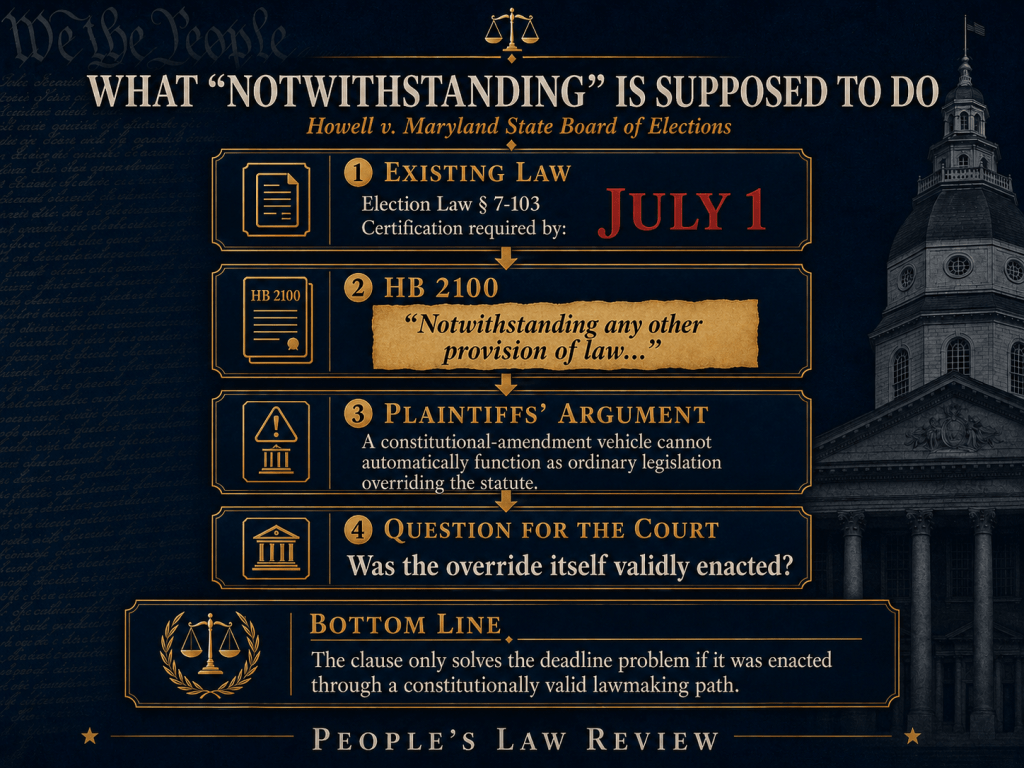
HB 2100 § 3(b)(2) provides: “Notwithstanding any other provision of law, at [the November 3, 2026] general election, the following question shall be submitted to the qualified voters of the State[.]” According to the complaint, this language — a non obstante clause, from the Latin for “notwithstanding” — was inserted by floor amendment on August 3, 2026, less than an hour before the Joint Committee hearing on the bill.
Non obstante clauses are a familiar tool in ordinary legislation: a later statute can generally override an earlier one of equal legal standing, including by express non obstante language, so long as the later statute is itself validly enacted. The complaint’s argument is not that such clauses are categorically improper. It’s that this one was never enacted through any valid channel.
Why the amendment process doesn’t validate it
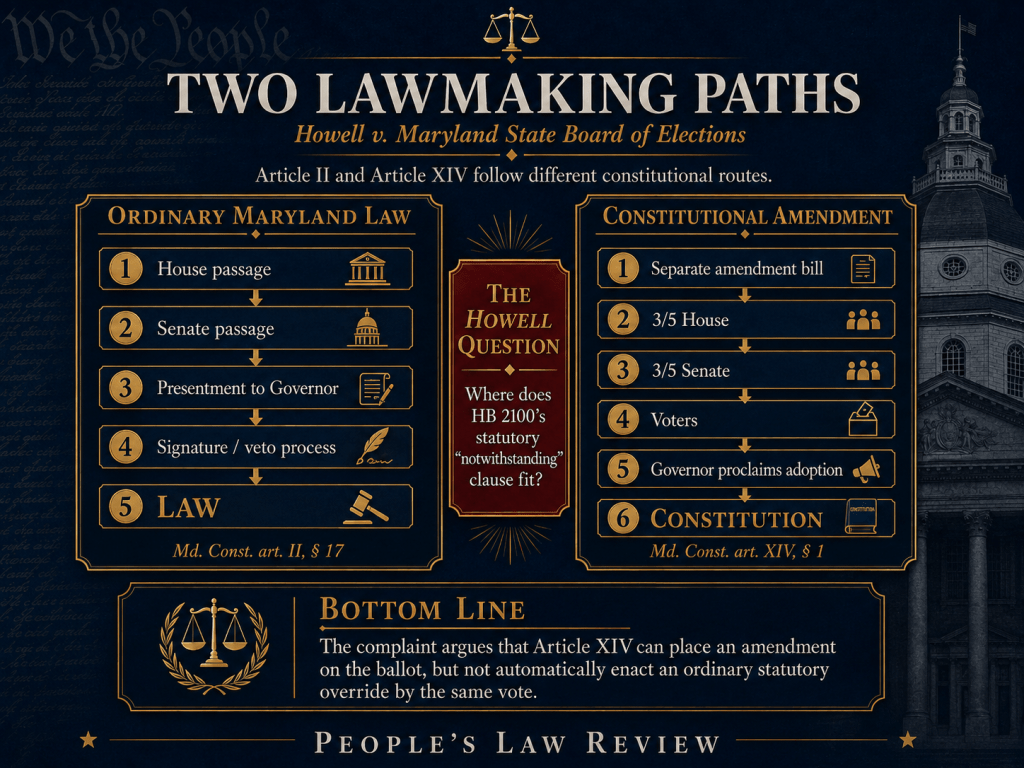
Maryland’s process for proposing a constitutional amendment is set out in Article XIV, Section 1 of the Maryland Constitution:
“The General Assembly may propose Amendments to this Constitution; provided that each Amendment shall be embraced in a separate bill… and passed by three-fifths of all the members elected to each of the two Houses…”
Article XIV’s only reference to the Governor’s role comes after the election: if a majority of votes favor the amendment, “the Governor shall, by his proclamation, declare the said amendment… to have been adopted.” Nothing in Article XIV requires — or even contemplates — gubernatorial signature during passage. The complaint’s inference follows directly from the text: Moore’s signature on HB 2100 may have been symbolically significant, but it was constitutionally superfluous to the amendment process, and cannot retroactively supply what that process never required.
That creates the structural bind the complaint identifies. Ordinary Maryland legislation becomes law through bicameralism and presentment — passage by both chambers and presentment to the Governor, under Md. Const. art. II, § 17. A constitutional amendment becomes a ballot question through a different path entirely: a three-fifths supermajority in both chambers, full stop, with no gubernatorial role until after voters have spoken. The complaint argues the non obstante clause was never validly enacted by either path: not as ordinary law, because the vote that passed it was cast under the Article XIV supermajority procedure rather than as an ordinary bicameralism-and-presentment vote on freestanding legislation; and not as part of the constitutional amendment itself, because the override language does not appear in the ballot question voters will actually see and vote on.
The complaint argues the non obstante clause was never validly enacted by either path.
The closest analogous doctrine

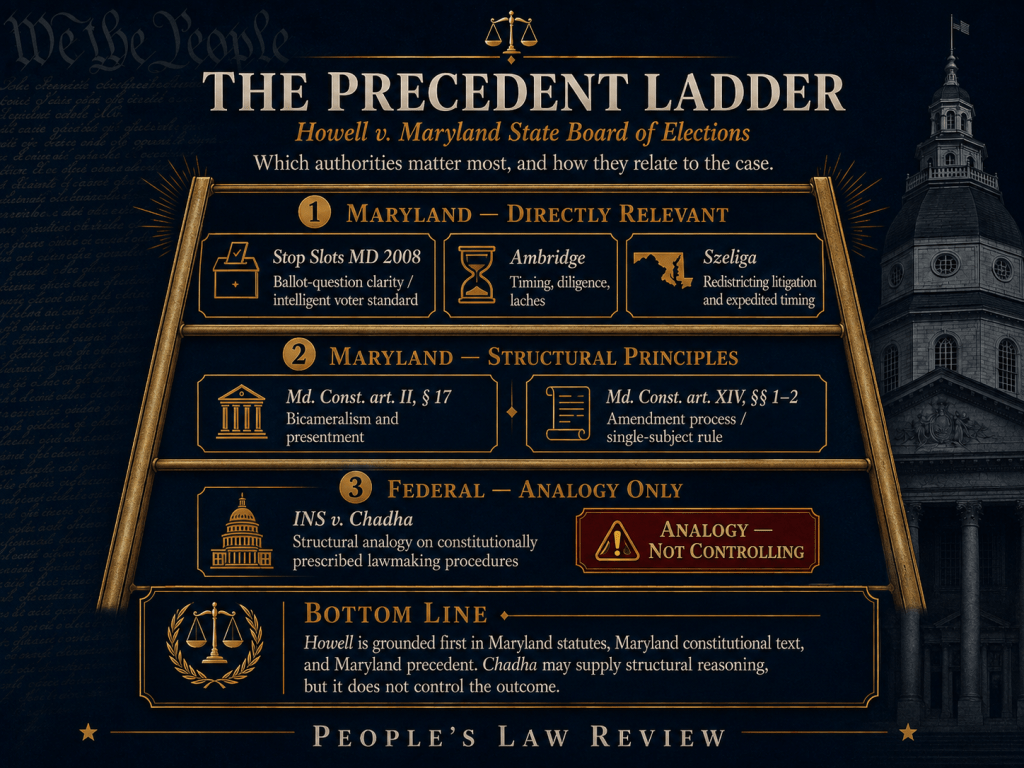
Maryland’s appellate courts do not appear to have decided a case squarely on this fact pattern — a non obstante clause embedded in a constitutional-amendment vehicle, purporting to override ordinary statutes, without being disclosed as part of the referendum question itself. The closest analogous reasoning is federal: INS v. Chadha, 462 U.S. 919 (1983), in which the U.S. Supreme Court held that a one-house legislative veto was unconstitutional because it altered legal rights and obligations without satisfying bicameralism and presentment, regardless of how administratively convenient the shortcut was. Chadha is not controlling here — it interprets Article I of the federal Constitution, not Maryland’s — but its underlying principle, that a procedural shortcut cannot substitute for the specific lawmaking process the constitution actually prescribes, is the same structural logic the complaint invokes against HB 2100’s override clause.
This is the count most likely to turn on how a judge reads it, rather than on an established rule. The deadline counts are close to arithmetic. This one is a genuine question of first impression.
The deadline counts are close to arithmetic. This one is a genuine question of first impression.
Count IV: The Misleading Ballot Question Claim
Count IV alleges a violation of § 7-103(b)(6), which requires every statewide ballot question to include “a brief statement explaining what the practical outcome of each voting choice would be.” The complaint alleges the HB 2100 ballot question omits any explanation of what the non obstante clause actually does, while Maryland’s other 2026 ballot questions do include the required statement.
Maryland’s Supreme Court has articulated the operative standard for this kind of claim in Stop Slots MD 2008 v. State Board of Elections, 424 Md. 163, 193 (2012):
A reviewing court must ask “whether or not [the question’s] publication… permitted, in a meaningful manner, an intelligent decision, by an average voter, when he exercised his choice, in voting either ‘FOR’ or ‘AGAINST’ the proposed amendment.”
This is a workable standard, but not a mechanical one — it asks a question of degree, not a bright line. Count IV is stronger than a bare formatting complaint because § 7-103(b)(6) is a specific, textual requirement, and the complaint alleges other 2026 ballot questions satisfied it while this one did not — a comparison that, if accurate, undercuts any argument that omission here was a wash across the board. But “meaningful” and “intelligent decision” leave room for a court to find substantial compliance even where a technical gap exists.
Count VI: The Single-Subject Rule
Article XIV, Section 2 of the Maryland Constitution requires that a proposed amendment “embrace only a single subject.” The complaint’s theory is straightforward: HB 2100’s stated subject is congressional districting criteria, while the non obstante clause concerns an unrelated matter — the suspension of ballot-certification procedure. Maryland’s single-subject requirement, like similar provisions in roughly 40 other states, exists chiefly to prevent logrolling and to ensure voters aren’t asked to approve unrelated provisions bundled into one up-or-down vote.
Single-subject challenges are notoriously difficult to win as a general matter — courts across jurisdictions have struggled for over a century to define “subject” with precision, and tend to defer to the legislature’s own characterization absent a clear mismatch. What distinguishes Count VI from a typical single-subject claim is that it isn’t really arguing two policy topics were bundled into one amendment. It’s arguing that a procedural override of unrelated statutes was smuggled into a substantive amendment about districting criteria — which, if the Count V theory is right that the clause isn’t part of the amendment question at all, makes Count VI something closer to a backstop than an independent claim.
Count I: The Declaration of Rights Claim
Count I invokes Article 7 of the Maryland Declaration of Rights (the right to free and frequent elections) and Article 24 (due process), arguing that the combination of statutory violations deprived voters of the process Maryland law promises them. The complaint leans on Ulman v. Baltimore, 72 Md. 587, 593 (1890), for the proposition that due process “extends to every case which may deprive a citizen of life, liberty, or property, whether the proceeding be judicial, administrative or executive in nature,” and on Stop Slots for the notice standard discussed above. This count functions less as an independent basis for relief than as a constitutional frame tying Counts II through VI together — a common structure in election-law complaints, where a due-process count often survives or falls with the more specific statutory claims beneath it.
Procedural Posture: Standing, Timing, and the Ambridge Precedent
Any assessment of this suit’s prospects has to account for how Maryland’s Supreme Court has treated procedural gatekeeping in recent ballot-question litigation — because that, as much as the merits, is where similar suits have foundered.
Whatever else can be said about the merits, the plaintiffs here did not make the mistake that sank the Ambridge plaintiffs.
Maryland State Board of Elections v. Ambridge, 489 Md. 404 (2025), is instructive and cited directly in the complaint. There, the Supreme Court reversed a circuit court that had allowed a Baltimore ballot challenge to proceed, in part on the ground of laches — the equitable doctrine that bars relief where a plaintiff “fails to timely assert his or her rights due to his or her own negligence or lack of diligence.” Ambridge, citing Ademiluyi v. Egbuonu, 466 Md. 80, 124 (2019). The Ambridge plaintiffs had known about the disputed ballot language for months before suing; the Court found that delay fatal to emergency relief close to an election.
§ 12-202(b)(1) of the Election Law Article, the same provision the Howell plaintiffs invoke for jurisdiction, requires suits of this kind to be filed within 10 days of the act or omission giving rise to the claim. The complaint was filed the night of August 6 — one day after Moore signed HB 2100. Whatever else can be said about the merits, the plaintiffs here did not make the mistake that sank the Ambridge plaintiffs. If the State’s litigation strategy includes a laches or diligence argument, this complaint does not hand them the same opening.
Historical Precedent on Timing: Szeliga v. Lamone

Separately from the merits, there is a practical question: can Maryland courts actually resolve a case like this before the November 3 election?
Szeliga v. Lamone, No. C-02-CV-21-001816 (Md. Cir. Ct., Anne Arundel Cnty., Mar. 25, 2022) — the same case establishing the compactness standard HB 2100 seeks to remove — was filed December 23, 2021, and decided March 25, 2022: 92 days, following a four-day trial, in the same courthouse. This complaint was filed August 6, 2026, 89 days before the general election. The plaintiffs have requested expedited review and assignment to a three-judge panel under Election Law § 12-203(a)(1)-(2), both mechanisms designed for exactly this kind of time-sensitive dispute. Nothing guarantees the same pace here. But the closest available precedent — from the same court, involving several of the same plaintiffs’ counsel and legal theories — suggests a decision before Election Day is well within the range of what Maryland courts have previously managed.
Conclusion
Whether HB 2100 ultimately reaches Maryland voters in November will likely turn less on the deadline it missed than on a structural question the Maryland Supreme Court has never had occasion to answer.
This complaint does not present a uniform set of claims. It presents a layered one, and the layers carry different weight:
- Counts II and III (the certification and notice deadlines) rest on largely undisputed dates measured against statutory language with no stated exception — the closest thing in this complaint to a bright-line violation.
- Count V (the non obstante clause) raises a genuine question of first impression under Maryland’s bicameralism-and-presentment and constitutional-amendment provisions, with no squarely on-point Maryland precedent and only analogous federal doctrine to draw from.
- Counts IV and VI (misleading ballot language and single-subject) are real but more discretionary claims, dependent on how a court weighs “meaningful” notice and what counts as one “subject.”
- Count I functions as a constitutional umbrella over the rest rather than an independent basis for relief.
- On procedure, the plaintiffs’ 10-day filing avoids the diligence problem that doomed the Ambridge plaintiffs, and Maryland’s own docket history in Szeliga suggests the timeline plaintiffs are asking for is not unrealistic.
Whether HB 2100 ultimately reaches Maryland voters in November will likely turn less on the deadline it missed than on a structural question the Maryland Supreme Court has never had occasion to answer: whether a supermajority vote to place a constitutional amendment before voters can also, without more, function as ordinary legislative repeal of a statute it never mentions on the ballot itself.
Sources: complaint filed Aug. 6, 2026, Anne Arundel County Circuit Court (Howell v. Maryland State Board of Elections, Case No. C-02-CV-26-001986); Md. Code Ann., Election Law §§ 7-103, 7-105, 9-207, 12-202, 12-203; Md. Const. art. II, § 17; art. XIV, §§ 1-2; Md. Declaration of Rights arts. 7, 24; Stop Slots MD 2008 v. State Board of Elections, 424 Md. 163 (2012); Maryland State Board of Elections v. Ambridge, 489 Md. 404 (2025); Ademiluyi v. Egbuonu, 466 Md. 80 (2019); Smigiel v. Franchot, 410 Md. 302 (2009); Ulman v. Baltimore, 72 Md. 587 (1890); Szeliga v. Lamone, No. C-02-CV-21-001816 (Md. Cir. Ct., Anne Arundel Cnty., Mar. 25, 2022); INS v. Chadha, 462 U.S. 919 (1983); The American Redistricting Project; Loyola Law School’s “All About Redistricting.”
 The People's Law Review